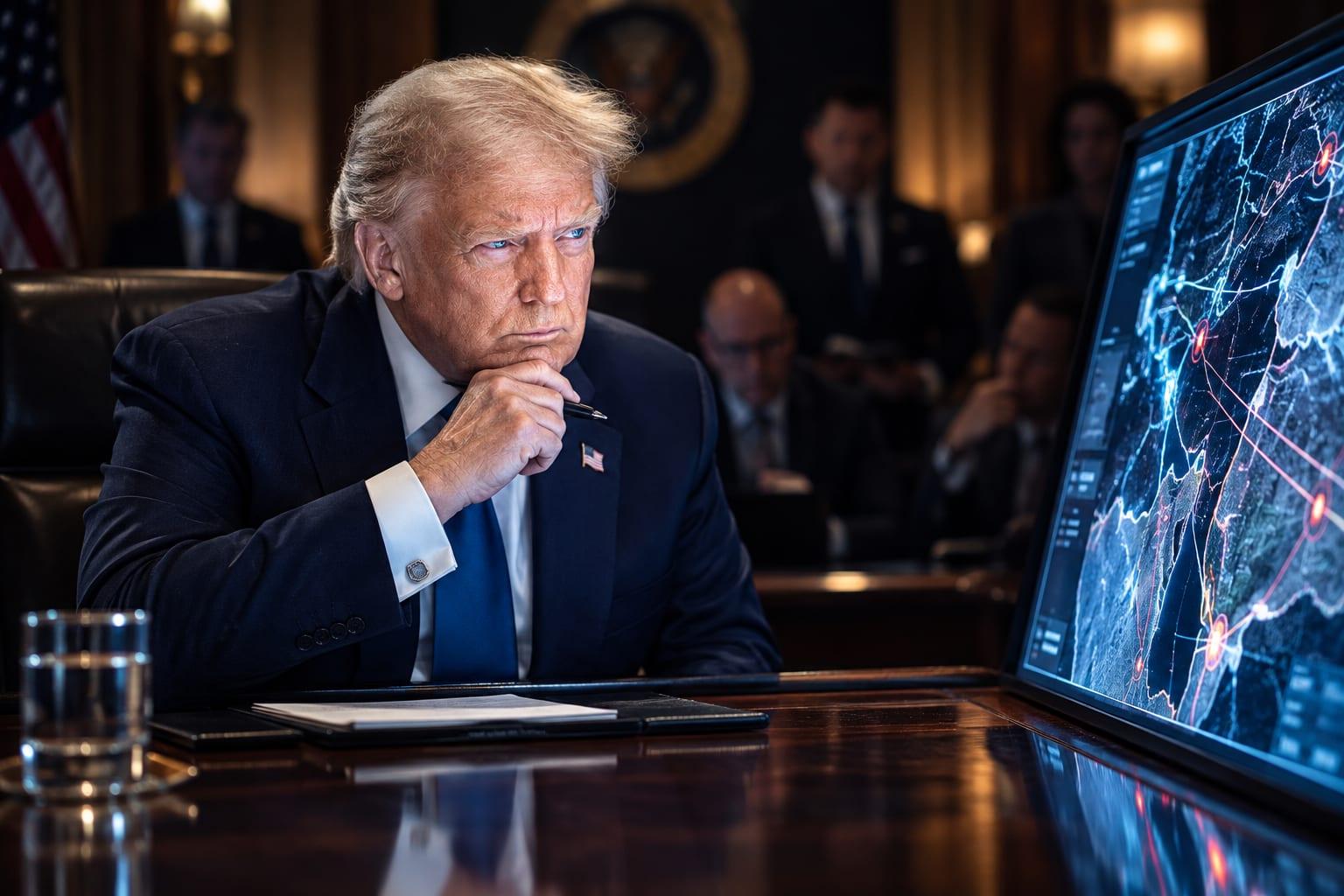
President Donald Trump has named Director of National Intelligence Jay Clayton as the administration's AI czar, tasking him with leading a newly formed White House task force on artificial intelligence that will deliver a report on the technology's risks and opportunities within 120 days, according to reporting from the Wall Street Journal.
The panel, which Trump has dubbed the "Super Intelligence Force," reflects the president's preference for the term "super intelligence" over standard industry language, the Journal reported. Clayton told the outlet in an exclusive interview that the stakes of the effort are straightforward.
"Not being first increases the identified, and unidentified, risks, particularly from our adversaries," Clayton said. "Being first will better enable us to address those risks on behalf of the American people."
According to the Journal's reporting, the task force's charter directs it to review AI-related risks and the current government reporting mechanisms for hacks, breaches, and other incidents, then recommend ways to strengthen federal response capabilities under existing authorities. The group will yield to industry as the primary vehicle for managing risk rather than pursuing a heavy regulatory hand — a posture consistent with the administration's broader deregulatory approach.
Clayton's appointment follows speculation that he would take the role. According to the Journal, the task force's work could be extended beyond the initial 120-day window if needed, or its functions could be transferred to a government agency.
WHO'S ON THE FORCE
The vice chairs of the task force will be Emil Michael, Scott Kupor, and Federal Trade Commission Chair Andrew Ferguson, per the Journal. Members will include Vice President JD Vance, Defense Secretary Pete Hegseth, White House deputy chief of staff Richard Walters, Treasury Secretary Scott Bessent, and White House Chief of Staff Susie Wiles, among others.
External participants will include venture capitalist David Sacks, co-chair of the president's Council of Advisors on Science and Technology, and Condoleezza Rice, who served as Secretary of State under President George W. Bush, the Journal reported.
This marks the second time Trump has named an adviser to oversee AI-related decisions. Sacks previously held an AI and crypto portfolio in the administration before the czar role was formalized around Clayton.
Clayton, who has led the Office of the Director of National Intelligence, told the Journal that he expects industry-style mechanisms to develop through dialogue. "I expect there will be mechanisms developed in dialogue, just like there are in other industries," he said.
THE CHINA QUESTION
The task force's formation comes as Washington moves to secure an edge in advanced AI against China. Clayton's framing — that falling behind increases risks from adversaries — aligns with the administration's position that American dominance in the technology is a national security imperative, not merely an economic one.
The 120-day timeline puts the report's delivery in late January 2027. Whether the force extends beyond that window or hands its functions off to a permanent agency structure is not yet determined, according to the Journal's reporting.
For everyday Americans, the practical questions — how AI will be governed, what guardrails exist for data and security, and whether Washington can foster innovation without strangling it — now rest with a task force stacked with national security officials and Silicon Valley veterans rather than career regulators.
Our Take
Here's the tell in this whole arrangement: Trump didn't hand the AI file to a bureaucracy, he handed it to an intelligence chief. That's not an accident. While Democrats spent years fretting about "misinformation" and dreaming up new censorship boards, Trump is treating super intelligence as what it actually is — a national security race against the CCP, where second place isn't an option.
And notice the roster. Vance, Hegseth, Bessent, Wiles, Ferguson — that's not a panel designed to slow-walk American innovation into a European-style regulatory coma. Mixing in David Sacks and a venture-capital brain trust signals the opposite: move fast, stay ahead, let builders build. The task force's charter reportedly leans on industry as the primary risk manager instead of a new federal leash. That's the America First approach — trust the market, secure the homeland, and don't let some unelected agency in D.C. decide which algorithms are allowed to exist.
The 120-day clock is smart, too. Twelve months in government time is three years in real time, and the Chinese Communist Party isn't waiting around for a committee to finish its literature review. Patriots should watch two things: whether this force actually produces teeth on countering CCP theft of American AI, and whether it resists the inevitable pressure from the usual suspects to turn "AI safety" into another censorship regime.
Clayton said it plainly — not being first increases the risks. So here's the question every American should be asking: do you want the United States setting the rules for super intelligence, or do you want Beijing writing them for you?
