
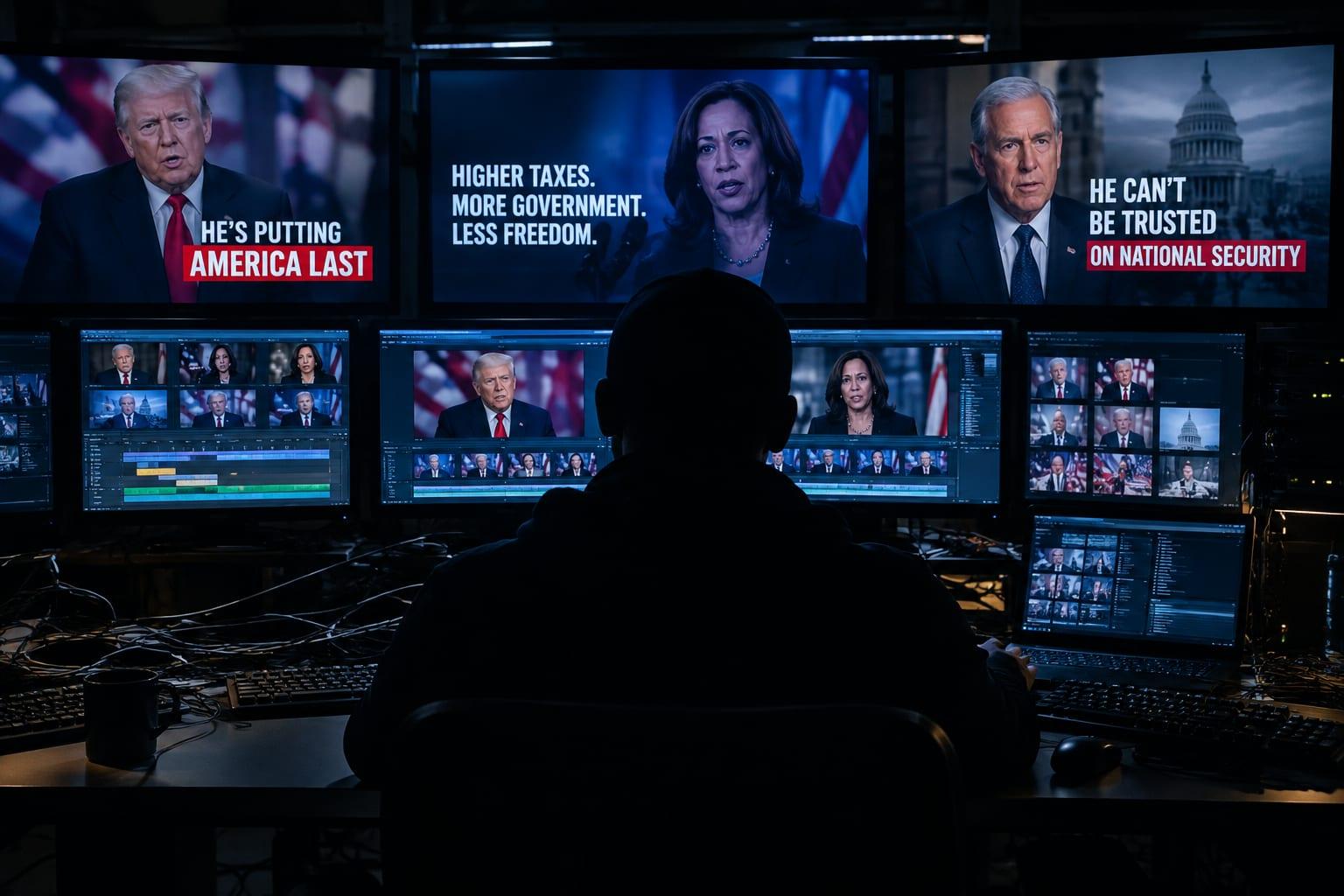
Artificial intelligence has flooded the 2026 midterm advertising wars, collapsing the cost of producing political attack ads from days of writing, voiceover work, video shoots and post-production down to minutes — and raising a question that strategists on both sides are still trying to answer: does any of it actually win elections?
Campaign operatives can now generate in hours what once required an entire creative team, a shift that veteran Republican consultant Jesse Hunt told Fox News Digital "certainly allows you to produce more content in varying styles and more cost effective." Democratic strategist Chris Moyer acknowledged the same dynamic from the other side of the aisle, telling Fox News Digital that "AI gives campaigns more tools for less cost. So there is a democratizing of the tools that campaigns used to have to spend valuable resources on ... You can get access to things with a smaller budget."
The numbers are still small but climbing fast. The ad-tracking firm AdImpact had identified 29 campaign ads in federal and gubernatorial contests that disclosed using AI-generated content as of roughly two weeks ago, according to Fox News Digital. The Wesleyan Media Project, which also counts ads that carry no AI disclosure, has catalogued at least 164 AI-influenced ads this cycle. Both figures come from the outlets' own tracking, not from any government registry — there is no federal requirement that campaigns reveal when AI is used in a political ad.
The Cost of a Message Has Fallen Through the Floor
Will Ritter, a longtime Republican ad maker and co-founder of the creative and strategy agency Poolhouse, told Fox News Digital that his shop "went from last cycle doing basically doing nothing with AI to most of our ads now have some AI component."
"The good news is that it's really cool technology. It allows a lot of people to make stuff. You can make almost anything," Ritter said. But he added a warning that cuts against the hype: "You still need to be able to know what you're doing with the tools."
Ritter said his agency has "professionals who know how to use and integrate them, and they also know the point of this is to have a good" — a sentiment that gets at the central tension of the AI boom in politics. Production speed is not the same thing as persuasion.
Viral Is Not Victory
The clearest evidence that AI reach doesn't translate into votes may be in Massachusetts. According to Streamlinefeed's coverage of the same story, Republican gubernatorial candidate Brian Shortsleeve leaned heavily on AI-generated content and racked up massive viral visibility — and still failed to convert the attention into an electoral win. Streamlinefeed reported that the correlation between AI-driven virality and ballot-box success "remains tenuous," pointing to several high-profile candidates who chased algorithmic attention and lost.
That matches what the operatives quoted by Fox News Digital are saying out loud. The technology is restructuring the economics of campaigning — turning political creative from a premium asset into something closer to disposable content — but it cannot manufacture a message that resonates. An attack ad churned out in four minutes that nobody remembers by dinner is worth less than a single spot that lands.
Disclosure Is a Mess — and That's the Point
The gap between AdImpact's 29 disclosed AI ads and Wesleyan's 164 AI-influenced ads tells its own story. Campaigns are not required under federal law to flag AI content, so the true footprint of the technology in the 2026 cycle is unknown. That matters for voters who increasingly cannot tell a real clip of a candidate from a synthesized one.
Deepfake content has already appeared in campaigns across the country this cycle, according to the reporting, though the outlets did not break down how much of it originated from official campaign accounts versus outside groups and anonymous posters. There is no comprehensive federal framework governing AI-generated political content as of late September 2026.
What is clear is that the barrier to entry has vanished. A well-funded Senate campaign and a guy with a laptop and a subscription now have access to the same production horsepower. Whether that produces a better-informed electorate or just a louder, cheaper, more confusing noise is the open question every strategist quoted in this story is quietly wrestling with.
Our Take
Here's the part the AI hype merchants don't want to hear: cheap ads are not the same as good ads, and going viral is not the same as winning. Brian Shortsleeve is the proof. He got the clicks. He didn't get the job.
That should be a warning to every consultant who thinks a subscription to an AI video tool replaces knowing what voters actually care about. The left is already using this tech to flood the zone with cheap smears, and the answer is not for conservatives to match them volume-for-volume with synthetic sludge. The answer is to use the tools to say something true, fast, and unforgettable — and to remember that no algorithm has ever knocked on a door or hauled a neighbor to the polls.
There's also an unmentioned issue in this whole boom. If campaigns aren't required to disclose AI content, and the two main tracking firms can't even agree on the count, then the deepfake threat in 2026 is running in the dark. Lawmakers had a chance to set basic rules — a simple disclosure requirement for synthetic political content — and they didn't. Expect the first real AI scandal of this cycle to arrive with no warning, and expect the legacy media to blame the Right for it regardless of who made it.
The tools are here to stay. The question is whether We the People get sharper at spotting the fake — or whether we let the machines decide what we believe.
