
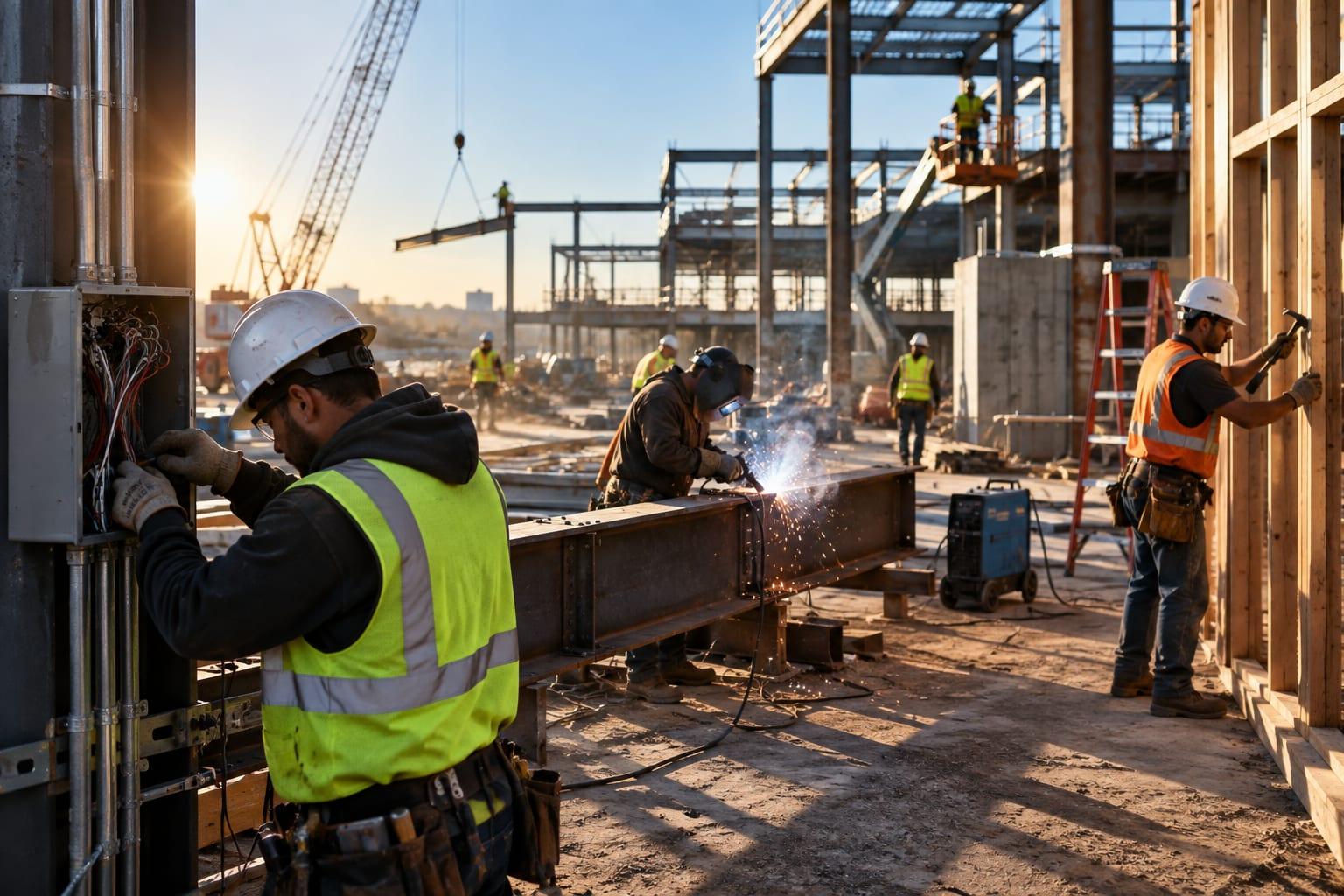
A construction site south of Dallas is doing what a thousand policy speeches could not: proving that the artificial intelligence boom runs on American tradesmen, not just computer science degrees.
Compass Datacenters CEO Chris Crosby pointed to his company's Red Oak, Texas campus as the clearest example of a hiring shift that has caught much of the country flat-footed. The sprawling facility needs electricians, welders, carpenters, pipefitters and heavy equipment operators — workers who largely skipped the four-year degree track and were told for two decades that they were on the wrong side of the economy.
"Data centers need electricians, welders and carpenters over degrees," Crosby said, describing the Red Oak project as a case study in what the industry actually requires.
That is not a marketing line. It is a description of the physical reality of the AI buildout. Every rack of servers pulling power for AI training models needs switchgear, transformers, conduit and cooling systems installed by hand. The hyperscale data center construction market has become one of the largest single sources of demand for skilled electrical labor in the country, and the men and women doing that work are not being replaced by software.
The numbers behind the trend are difficult to ignore. Compass and its competitors are racing to bring hundreds of megawatts of capacity online across Texas, Virginia, Ohio, Arizona and Georgia. Each campus is measured in millions of square feet and is built entirely by trades labor before a single server is racked. The work does not move offshore, and it cannot be automated into a cloud instance — someone still has to pull the wire.
Texas has become the center of gravity. The state's relaxed regulatory posture, abundant land and grid buildout have turned the Dallas-Fort Worth corridor into one of the densest concentrations of data center construction on earth. Red Oak sits in Ellis County, one of the fastest-growing counties in the nation, where the population boom and the industrial boom are colliding at the same time.
For workers, the consequences are concrete. Electrical apprenticeships in Texas have seen surging demand, and contractors report that experienced journeymen electricians can now command wages that rival or exceed what many four-year degree holders earn in their first decade out of school — without carrying student debt into the jobsite. The same dynamic applies to welders, pipefitters and HVAC technicians, trades that were starved of new entrants for years while every high school senior was pushed toward a bachelor's degree.
The broader labor picture explains why the shift caught forecasters flat-footed. For years, the prevailing assumption in policy circles was that American manufacturing and construction labor was a declining asset — a sector to be managed, retrained or written off. That assumption ran directly into an AI infrastructure buildout projected to require billions of dollars of physical construction, and into a domestic energy and industrial policy that has actively encouraged it.
Data center construction is not a niche. It has become a major driver of commercial electrical contracting, and the demand is showing up in apprenticeship enrollment, union and non-union alike. Contractors in multiple states have said the constraint on finishing projects on schedule is not capital and not land — it is finding enough qualified tradespeople to do the work.
The politics of this are awkward for the credential-first consensus. Both parties spent years telling young Americans that a degree was the only reliable path to the middle class. The result was a generation pushed into debt-financed higher education while critical trades aged out. Now the market is repricing that advice in real time, and it is doing so in states that have leaned into energy production and light-touch regulation rather than against it.
What is not yet known is how long the surge lasts. Data center construction is cyclical, and a slowdown in AI capital spending would hit the trades as fast as it would hit the companies ordering the servers. For now, though, the cranes over Red Oak are not idle, and the hiring is not slowing.
Our Take
Patriots, here is what the establishment media will never tell you straight: the biggest story in the American economy right now is not a tech company's stock price. It is a welder in Ellis County, Texas, earning a real wage with no student loan servicer taking a cut every month.
For two decades, the American education establishment sold a lie — that the only respectable path to a middle-class life ran through a university admissions office." Meanwhile, the trades got older, the apprenticeship pipelines dried up, and shop class got bulldozed to make room for more testing.
Now the AI revolution — the same revolution the Left lectured us would put blue-collar workers out of business — needs those exact workers more than it needs another mid-level manager with a communications degree. You cannot import a data center's electrical backbone from overseas. You cannot automate a pipefitter. You can only hire an American who knows the trade, and right now there are not enough of them, which is why the pay is going up.
This is what an economy built for working people actually looks like: real demand for real skills, wages set by scarcity instead of a government program. It is happening in Texas, in the middle of a data center boom that the politicians who lecture us about "the future of work" failed to see coming.
So here is the question every parent and every high school senior should be asking this week: if the fastest-growing jobs in America do not require a six-figure degree and a lifetime of debt, why are we still telling our kids that the trades are a consolation prize? The men and women wiring the AI economy already know the answer. The rest of the country is just catching up.