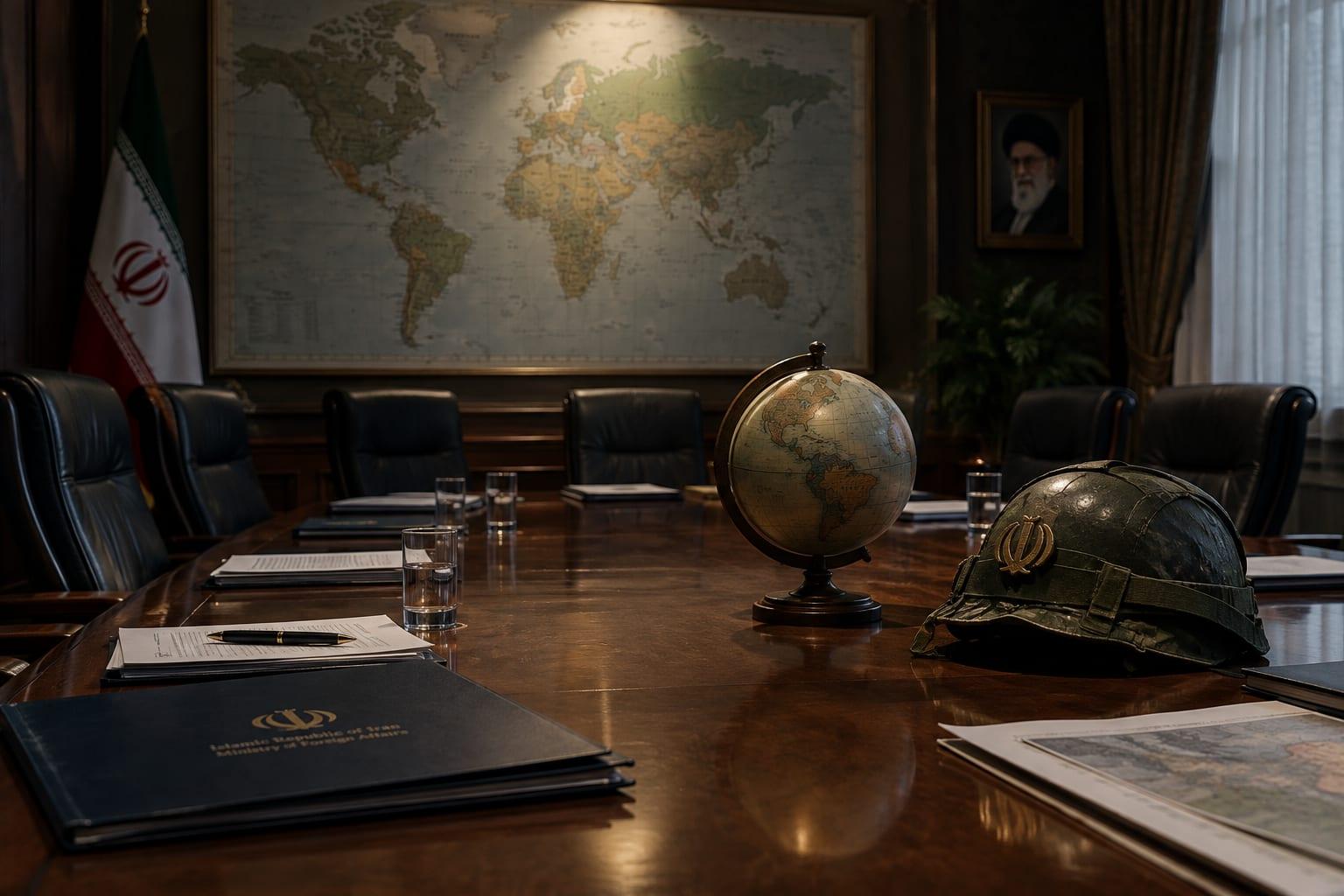
Iran's foreign ministry said it held a meeting with envoys in Tehran on regional issues, a brief statement that lands as the seven-month conflict between Iran and the United States continues to reshape diplomacy across the Middle East.
The ministry did not name the envoys, did not say which countries they represent, and did not describe what was discussed beyond the phrase "regional issues." No readout of the meeting was released, and no joint statement followed. The account @FirstSquawk carried the ministry's line, which is the only public description of the gathering available.
On its own, a foreign ministry sitting down with diplomats is routine. What gives the Tehran meeting weight is the posture Iran has taken in public while the fighting persists: a foreign minister who says his government is serious about a negotiated settlement and, in the same breath, fully prepared to fight.
Foreign Minister Abbas Araghchi has said Tehran remains serious about pursuing a diplomatic solution while maintaining full military readiness in the event of United States military action. That formulation — talks and war in the same sentence — has become the standard Iranian public position as the conflict enters its seventh month. It is a posture that lets Tehran signal openness to negotiation without appearing to back down, and it is the frame into which the envoys meeting fits.
Araghchi's position has been echoed in Iran's public messaging toward its adversaries. Tehran has warned its enemies of a "much stronger" response if military action resumes, language meant to raise the cost of any new round of strikes while keeping the door to talks visibly ajar. The warning and the offer of diplomacy are not competing messages. They are the same message: Iran wants the other side to weigh the price of escalation before it chooses.
That is the context in which the envoys meeting should be read. A foreign ministry gathering with diplomats in Tehran is one of the few channels through which Iran can communicate with capitals it does not formally deal with directly. The ministry's refusal to name the participants is itself a signal — a meeting kept deliberately vague can serve as a probing exercise, a way to test whether the other side is interested without committing to anything.
Iran's diplomacy has been active on several fronts during the conflict. Araghchi's public comments have been aimed at multiple audiences at once: domestic hardliners who need to hear that Tehran is not capitulating, regional governments weighing whether to align with Washington or hedge, and the United States itself. The foreign minister's line — diplomacy and readiness — is calibrated for all three.
The regional dimension is where the meeting's significance lies. The war between Iran and the United States has not stayed contained. It has pulled in shipping lanes, militias, and governments across the Gulf and the Levant, and it has forced regional capitals to recalculate their relationships with both Tehran and Washington. A foreign ministry meeting with envoys in Tehran is one of the mechanisms through which those recalculations get communicated.
What the envoys were told is not publicly known. The ministry's statement gives no indication of whether Iran presented a proposal, responded to one, or simply delivered its position. It is not known which countries were represented, whether the meeting was called by Iran or requested by the envoys, or whether any follow-up is planned. Those gaps matter, because in a conflict where public signaling is often the point, the absence of detail can be as deliberate as the meeting itself. It is also not known whether the meeting produced any concrete diplomatic movement, or whether it was exploratory in nature.
The account @FirstSquawk carried the ministry's statement, which is how the meeting became public. The account's post is a social media post, not reporting, and it attributes the claim to the Iranian foreign ministry rather than to independent confirmation. Next News Network could not independently verify that the meeting took place as described or that the participants were as characterized.
The broader trajectory of the conflict remains unresolved. Seven months in, neither side has achieved a decisive outcome, and the diplomatic track has produced no visible breakthrough. Iran's public posture — talks and readiness, in equal measure — reflects that stalemate. Tehran is keeping its options open because it does not know which one it will need.
For Washington, the envoys meeting is a reminder that Iran's diplomatic apparatus is still functioning and still in contact with regional capitals. For Iran's neighbors, it is a reminder that Tehran intends to remain a party to any regional arrangement, whether the war ends soon or drags on. For observers watching for signs of de-escalation, the meeting provides little to go on — a statement without names, without an agenda, and without a readout.
What is clear is the pattern. Iran is talking to diplomats in Tehran while its foreign minister talks about war readiness in public. The two tracks are running in parallel, and the envoys meeting is the latest data point on the diplomatic one.
Our Take
The Iranian foreign ministry's disclosure of a Tehran meeting with envoys on regional issues is the kind of vague, deliberately uninformative statement that governments issue when they want the fact of a meeting known but not its contents. That is not a knock on the reporting — it is a description of Iranian practice, and it tells us more than the statement's text does. Tehran is advertising that its diplomatic channels are open, while its foreign minister continues to pair every mention of diplomacy with a reminder that Iran is prepared to fight. That combination is not a mixed message. It is a negotiating posture aimed at extracting concessions without appearing weak, and it has been consistent for months.
The meeting itself changes little on the ground. Seven months of war have not produced a decisive outcome, and a foreign ministry gathering with unnamed envoys is not a breakthrough. What it does confirm is that Iran's diplomatic machinery is still running and still in contact with regional capitals. That matters for what comes next: if the conflict moves toward a settlement, those channels will be the ones used to negotiate it; if it escalates, they will be the ones used to convey warnings. Either way, the envoys meeting belongs to a pattern of Iranian public signaling, and it should be read as such — not as evidence of a thaw, and not as evidence that the underlying event is confirmed. It is a statement from a ministry that chose its words carefully, and the words it chose were few.