
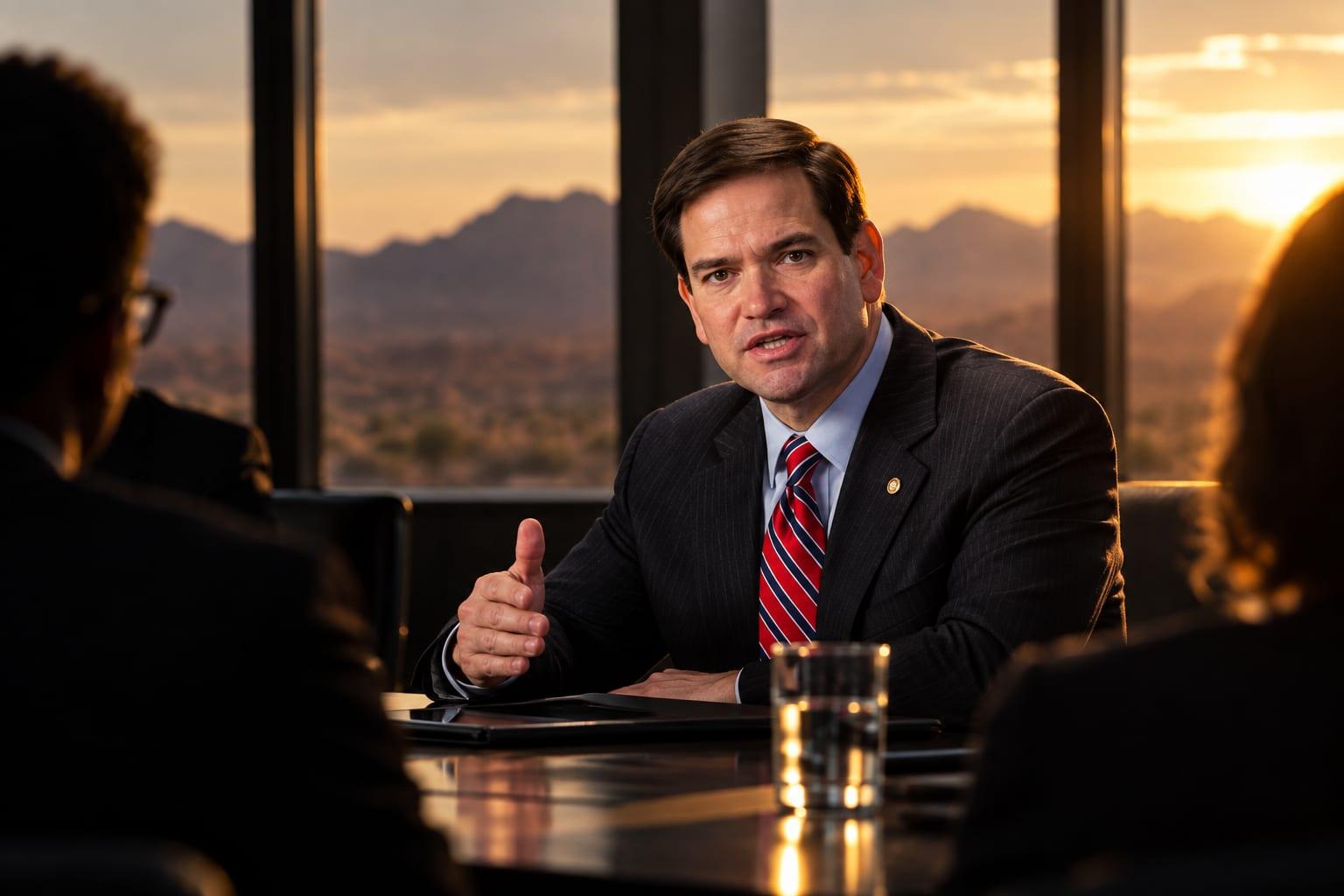
Secretary of State Marco Rubio said the Saudis have come under attack from the Iran-backed Houthis and have a right to defend themselves, remarks carried by the conflict-monitoring account @clashreport and delivered as a Saudi-led coalition announced an air campaign against the rebels along Yemen's Red Sea coastline.
"The Saudis have come under a completely attack," Rubio said. "And we can see the threat that that poses. And they have a right to defend themselves."
The secretary went on to describe what he cast as a coming counteroffensive by Yemen's internationally recognized government, which the AP reported was announced the same day the Houthis said they had captured more territory in the southwestern part of the country. "And obviously, the Yemeni forces are going to try to retake territory that they were ousted from," Rubio said, before closing his remarks: "We've got to get going. We're late for tomorrow. Why?"
The @clashreport post, published shortly before noon Eastern on Sunday, put the exchange in front of an audience well outside the briefing room. The account paired Rubio's comments with a second post from the AP, which reported that the Saudi-led coalition fighting the Iran-backed Houthi rebels said an air campaign was underway against the rebels in Yemen along the Red Sea coastline. According to the AP, the coalition's announcement came just after the rebels said they had captured more territory in the southwestern part of Yemen.
Taken together, the two posts sketch a widening conflict on the Arabian Peninsula's southern flank: a rebel movement claiming fresh gains on the ground, a coalition answering from the air, and the top American diplomat publicly aligning the United States with the Saudi position. The rub.
Yemen's internationally recognized government launched a full-scale military campaign to recapture Houthi-held territory after weeks of escalating conflict between the Iran-backed group and Saudi Arabia, according to reporting on the offensive. The Saudi-led "Coalition to Support Legitimacy in Yemen" pledged full support for that operation, stating that Yemen's government had announced the start of a major military offensive aimed at rolling back recent gains by the Iran-backed Houthi movement.
The coalition's statement of support was itself a signal that Riyadh intends to stay in the fight rather than stand down after a stretch of cross-border attacks. Riyadh has for years described the Houthis as an Iranian proxy force, and the coalition's full-throated backing of the Yemeni government's campaign follows a pattern in which the Saudis have tied their own security directly to the outcome of Yemen's civil war.
The White House has been moving on a parallel track. Senior Trump administration officials met at Camp David on Friday to discuss a path forward on Iran, according to reporting on the meeting. Vice President JD Vance, Secretary of State Marco Rubio and Defense Secretary Pete Hegseth were among the officials to take part — a roster that puts the administration's top national security voices in the same room just days before the coalition's air campaign was announced.
Coverage from Fox News Digital tied the fighting in Yemen to a broader contest over oil shipping routes in the Middle East. "The US and Iran battle over oil shipping routes in the Middle East has the Yemeni government seeking to root out Houthi terrorists final territory with a full-on military campaign," that report stated, adding that President Donald Trump and Israel weigh retaliation on Iran after a thwarted FlyDubai terrorist attack. The same report noted that the Middle East oil supply looms over the midterms.
The sequence runs in one direction: the Yemeni government announces a major campaign, the Saudi-led coalition pledges full support, Houthi forces claim new ground in the southwest, the coalition answers with an air campaign along the Red Sea coast, and the American secretary of state tells an interviewer that the Saudis have every right to hit back.
For American readers, the practical stakes sit on two tracks. The first is the Red Sea corridor, where the Fox News Digital report placed the U.S. and Iran in a contest over oil shipping routes — as a result, an escalation in Yemen has a direct line to energy prices at home with the midterm elections in view. The second is the administration's posture toward Iran. The Camp David meeting of Vance, Rubio and Hegseth shows that the Yemen campaign is being weighed alongside a wider set of options that include retaliation after a foiled FlyDubai terror attack.
Rubio's brief remarks did not spell out what the United States is prepared to do beyond backing the Saudi right of self-defense. He did not announce any American military role, nor did he set terms for the Yemeni government's campaign. What he did was state, on camera, that the Houthis had put the Saudis under attack and that the kingdom can respond — the diplomatic green light that Riyadh had been seeking.
Worth noting: the account @clashreport has been the vehicle carrying Rubio's remarks, and the AP post it shared has been the vehicle carrying the coalition's air campaign announcement. Neither the secretary's phrasing nor the coalition's claim was presented with an accompanying transcript or press release from the administration.
Next News Network could not independently verify the claim that the Houthis captured additional territory in southwestern Yemen, or the coalition's claim that an air campaign is underway along the Red Sea coastline. Both have been described here as what is being claimed, not as what has been confirmed.
More from the region as it develops.
Our Take
Rubio is doing what a secretary of state should do: saying plainly that an armed movement firing on the kingdom of Saudi Arabia is not a neutral party, and that the people on the receiving end of those attacks have the right to hit back. The Houthis are not a local grievance — they are the forward edge of Iran's effort to hold the world's most important waterway hostage, and the Biden-era experiment in treating them as anything other than that cost American shipping and American credibility. This administration's willingness to say the obvious, and to convene the vice president, the secretary of state and the secretary of defense at Camp David while Yemen's government moves, is the correct posture. What the midterms will decide is whether that posture gets treated as strength or spun as escalation. The American people should understand one thing: when the Red Sea is a shooting gallery, the price shows up at the pump at home, and the people responsible for it are not in Riyadh.
