
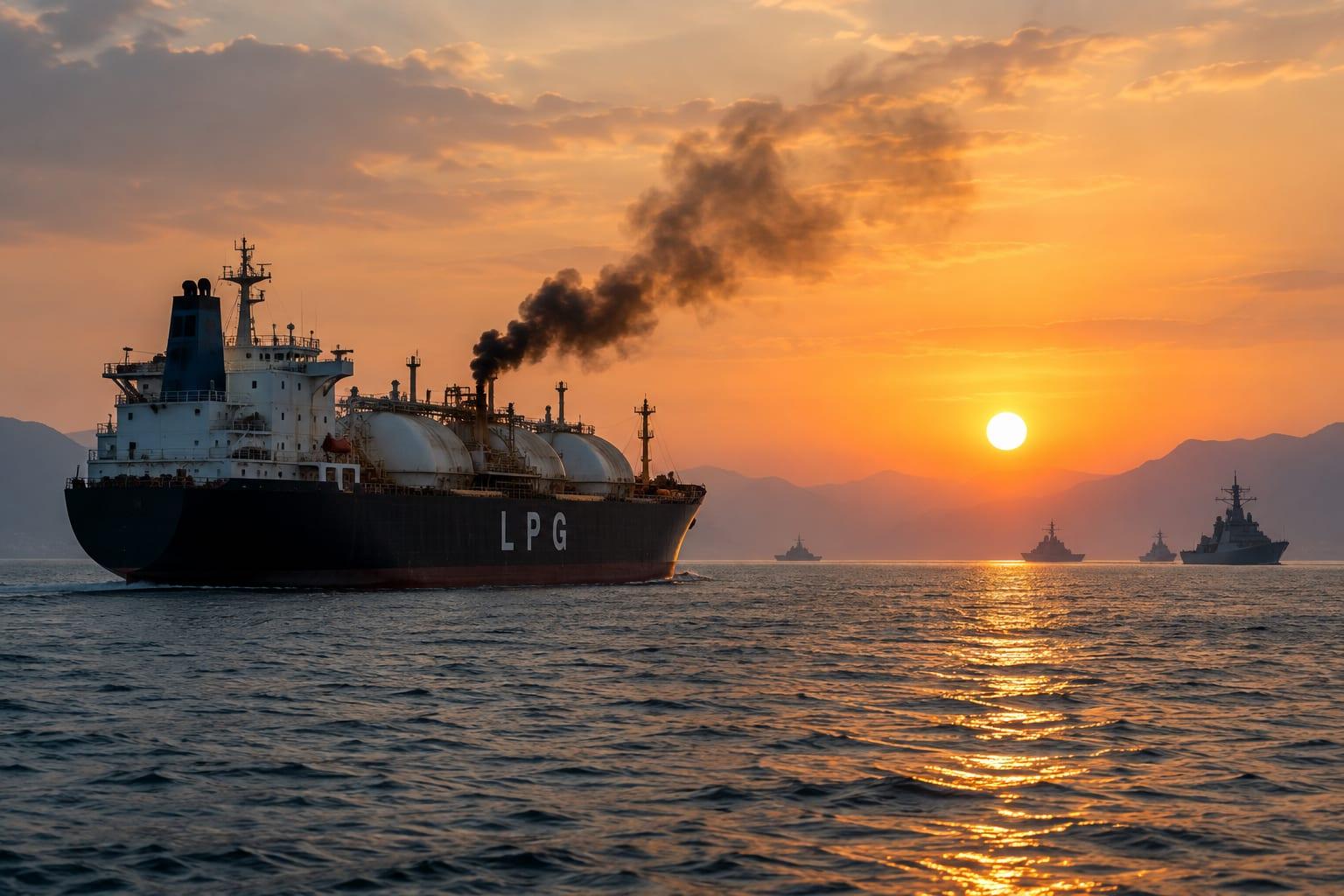
A United Kingdom maritime warning center says an inbound liquefied petroleum gas tanker was struck by a projectile in the Strait of Hormuz, a claim circulating through shipping and security channels as the United States moves additional forces into the Middle East.
The United Kingdom Maritime Trade Operations, known as UKMTO, issued the warning Monday afternoon, according to the account @FirstSquawk, which monitors financial and geopolitical headlines. "UKMTO WARNS INBOUND LPG TANKER STRUCK BY PROJECTILE IN STRAIT OF HORMUZ," the account wrote at 2:24 p.m. Coordinated Universal Time.
Regional coverage of the same incident, carried by Iran's Mehr News Agency, reported the projectile struck a tanker and damaged its engine room. The Mehr account, dated the prior day, attributed the announcement to UKMTO and noted the British maritime authority did not specify when the strike occurred. Reuters and other outlets carried similar language, describing an unknown projectile and an engine room hit.
The reported target was an LPG carrier, a vessel type that moves pressurized petroleum gases rather than the liquefied natural gas that dominates the Strait's export traffic. The distinction matters little to the mariners who transit the narrow waterway between Iran and the Arabian Peninsula, where a single projectile can disable a ship's power plant and leave it adrift in one of the world's most crowded shipping lanes.
UKMTO, which operates under the British Royal Navy and tracks maritime security incidents across the Gulf region, did not identify the vessel's flag, owner or crew nationality in the statement as relayed by the reporting accounts. It is not yet known who fired the projectile, whether the strike was deliberate, or what condition the vessel and its crew are in.
The timing of the claim landed beside a second, seemingly contradictory data point. Reuters reported at 1:50 p.m. Coordinated Universal Time Monday that more Qatari liquefied natural gas cargoes are continuing to transit the Strait of Hormuz despite what the outlet described as ongoing risks. The Reuters account, citing tracking data, suggests commercial traffic through the chokepoint has not halted even as security warnings accumulate.
Those two threads -- a reported attack and rising cargo volumes -- have accompanied each other for weeks. Iranian media and regional shipping monitors have documented a series of tanker incidents in the Strait, even as Saudi Arabia has pushed Middle East oil exports past levels seen before the most recent conflict cycle. Analysts who track the waterway have described the pattern as attacks that raise insurance costs and reroute some traffic without shutting the corridor down.
Roughly twenty percent of global petroleum liquids and a substantial share of the world's liquefied natural gas move through the Strait of Hormuz on any given day. Qatar, the largest LNG exporter in the world, ships almost exclusively through it. The Reuters account on continuing Qatari cargoes indicates that exporters, so far, are absorbing the risk rather than pausing deliveries.
The White House is pressing ahead with a large military buildup as the reported attacks continue. The Washington Times reported Monday that the United States is deploying nine thousand additional troops and multiple aircraft carriers to the Middle East as peace negotiations stall. The account, carried by @WashTimes, said Iranian officials are pushing for a ceasefire in the Strait of Hormuz while the White House continues to demand full denuclearization.
That account frames the diplomatic picture as a stalemate: Tehran seeking a de-escalation arrangement focused on the Strait, Washington holding to a broader demand about Iran's nuclear program. The State Department and the Pentagon have not issued public statements elaborating on the negotiating positions described by the Washington Times account.
The order of events, as reflected in the accounts, ran from the diplomatic impasse to the force deployment to the reported strike. The Washington Times account appeared at 1:01 p.m. Coordinated Universal Time; Reuters on Qatari LNG traffic at 1:50 p.m.; and the UKMTO warning on the LPG tanker at 2:24 p.m.
The accounts carrying the projectile claim quickly multiplied across the shipping and security monitoring ecosystem. @FirstSquawk transmitted it to financial markets. Mehr News Agency carried it to Iranian audiences over the weekend. Reuters and other wire services confirmed the UKMTO language. Each outlet reproduced the same core elements -- an inbound LPG tanker, a projectile of unknown origin, damage to the engine room -- while noting the absence of identifying detail.
That absence is not unusual in the first hours of a maritime security incident. UKMTO advisories are often terse, designed to warn mariners rather than inform the public, and are frequently revised as more information reaches the British naval staff who compile them. The lack of a named vessel, a stated time of impact, or a claim of responsibility leaves the central questions open.
The broader security environment provides the context. The Strait of Hormuz has functioned for years as a pressure point in the confrontation between Iran and the United States and its Gulf partners. Tanker seizures, drone strikes on shipping, and mining incidents have each appeared in past cycles. Each time, the pattern has followed a similar course: a reported attack, a round of warnings, a rise in insurance premiums, and eventually a return to normal traffic because the alternative route around the Arabian Peninsula adds thousands of miles and substantial cost.
Next News Network could not independently verify the claim that an LPG tanker was struck by a projectile in the Strait of Hormuz, the identity or condition of the vessel, or the circumstances of the reported strike.
What is confirmed is the movement of forces and the continuation of trade. The United States is sending additional troops and carriers into the region, per the Washington Times account. Qatari LNG cargoes are still transiting the Strait, per Reuters. And the warnings from UKMTO and the accounts carrying them are multiplying, describing a waterway where the traffic never quite stops and the danger never quite clears.
The next signal to watch is whether the reported strike changes the calculation for insurers and shippers, or whether the cargoes keep moving the way they have through every previous warning. The accounts that carried the claim Monday will carry the answer Tuesday.
Our Take
The Strait of Hormuz is the single most important piece of water on the planet for the price of everything Americans buy, and for two days the pattern has been the same: a reported attack, a round of warnings, and a flow of cargoes that has not stopped. That is not stability. That is a market and a military stretched across a chokepoint, absorbing punishment and calling it normal.
Consider what the three accounts tell us when read together. Washington is sending nine thousand more troops and multiple carriers. Qatar is still shipping LNG through the same waterway where a projectile, per UKMTO, just hit an LPG tanker's engine room. Tehran wants a ceasefire scoped to the Strait. The White House wants denuclearization. Those positions are not close, and the force deployment says the administration knows it.
The striking thing about the reported attack is how little anyone can say about it. No named vessel, no time, no claim of responsibility, no condition of the crew. UKMTO warnings are written for mariners, not for the public, but after years of incidents in these waters the absence of detail should itself be treated as a data point about how routine this has become.
The real question is whether the denuclearization demand and the ceasefire offer can be bridged at all, or whether the troop surge is the actual policy and the talks are the cover. If Qatari LNG keeps moving through a shooting gallery, the answer is that everyone has decided the risk is tolerable -- until the day it isn't, and the engine room that takes the hit belongs to a ship that can't be replaced on a schedule.
