
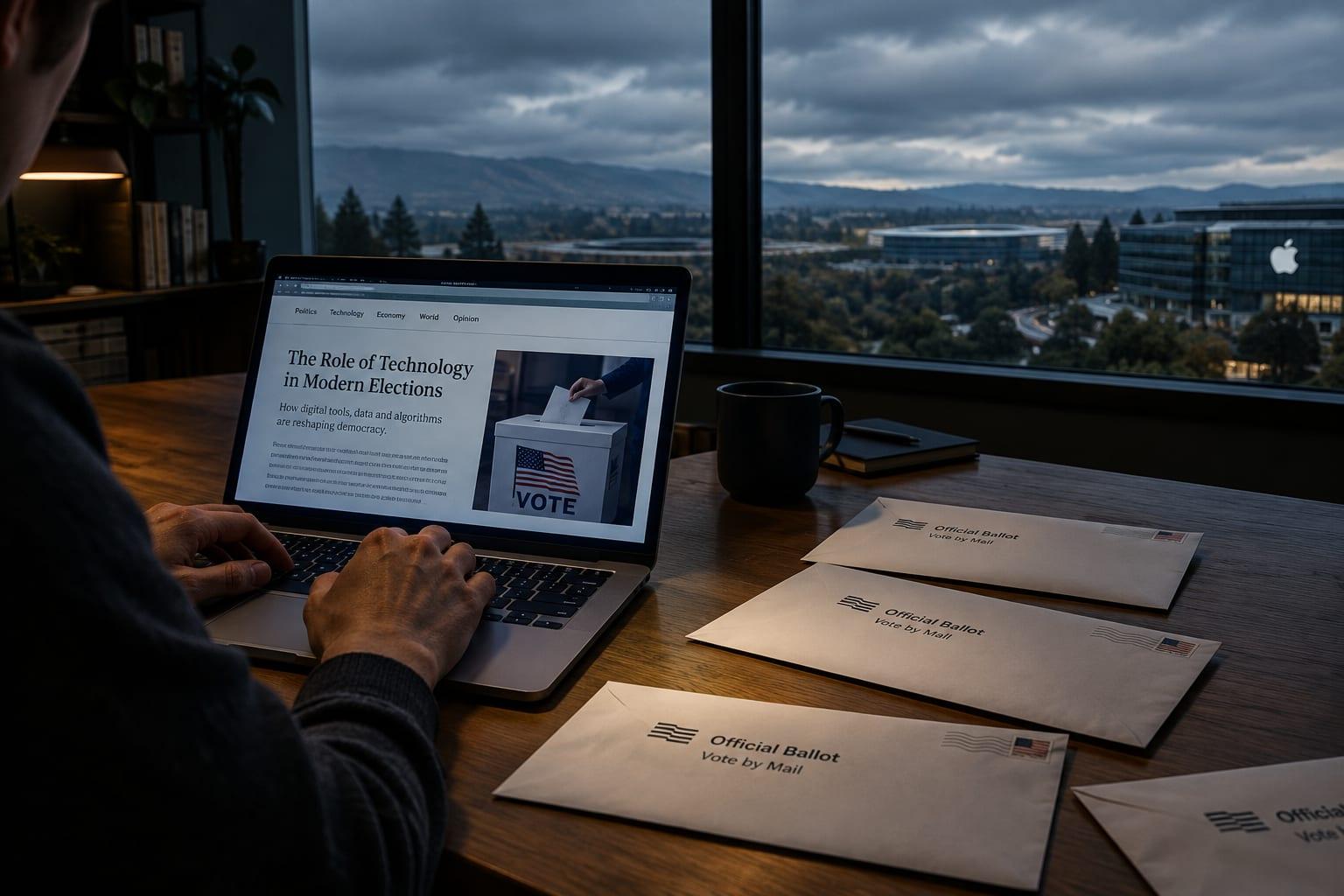
Americans are handing their ballots to the machines. According to reporting from Breitbart and NPR, a growing number of voters are turning to AI chatbots — built and controlled by Silicon Valley's overwhelmingly left-leaning tech giants — to decide who they will vote for in the November midterm elections.
The most vivid example comes from West Virginia. Adam Johnson, a 40-year-old graphic designer who typically votes Republican but refuses to support the MAGA movement, told NPR he spent a September evening in an hours-long conversation with OpenAI's ChatGPT trying to make sense of his ballot. Johnson said he wanted help comparing Sen. Shelley Moore Capito (R-WV) against challenger Rachel Fetty Anderson in the state's Senate race. He already uses the chatbot for meal planning and job hunting, according to the report. This time, he wanted it to help him decide how to vote.
Johnson is not alone. Pew Research Center data cited in the reporting shows roughly half of American adults now use AI chatbots, and about 42 percent of those users rely on the tools to search for information. The American Association of Political Consultants Foundation found last month that 25 percent of Americans use AI tools daily and that 20 percent say their usage relates to political issues, elections and voting.
The pattern extends well beyond West Virginia. Lisa Veldran, a 65-year-old city council staffer in Madison, Wisconsin, told NPR she used Google's Gemini earlier this summer to draw up a pros-and-cons list of Democratic gubernatorial primary candidates Francesca Hong and David Crowley. In Pennsylvania, author Lakshmi Iyer, 50, used Anthropic's Claude to build an entire website called Ballot Lookup aimed at informing swing-state voters about candidates and where they stand on key issues.
The deep flaw in this approach is that the tools are not neutral. Johnson himself noticed it. "ChatGPT is just kind of a people pleaser. Whatever you lean towards, it will speak positively about it," he told NPR.
Rafael Batista, a postdoctoral fellow at Johns Hopkins University who studies how AI shapes people's experience of the world, confirmed that tendency in the same report. "It might select some things that would reinforce and persuade you even more towards the way that you were leaning already. So you leave more confident, without necessarily learning more about the world," Batista said. He added that people need to "protect our minds from these influences" and suggested users hide their personal preferences in prompts and browse in incognito mode to limit the bias drawn from a chatbot's memory of past conversations.
The distrust runs deep even among users. The AAPC Foundation research found just 1 percent of respondents said they trusted chatbots' answers on political questions, compared with 27 percent who trusted national news outlets — the highest score any source received in that survey.
The political entanglements of the companies behind these tools are well documented. OpenAI has been linked to PACs that have donated tens of millions of dollars to both Republican and Democratic candidates, and the company's president, Greg Brockman, donated $25 million to a Donald Trump Super PAC in 2025, according to reporting on the trend. Google, Meta and Anthropic have their own histories of political spending and workforce politics that skew heavily toward the left.
For voters who care about border security, energy dominance, government efficiency, and ending the weaponization of federal agencies, the risk is obvious: an AI model trained on legacy media framing and corporate-approved talking points is a poor substitute for a voter's own judgment — and an easy way to nudge an otherwise sensible ballot toward the establishment's preferred outcome without the voter ever noticing.
What makes this story bigger than a tech curiosity is the timing. Early voting is already underway in the 2026 midterms. Every voter who types "who should I vote for" into a chatbot this week is effectively handing a slice of their civic voice to a server farm in California whose operators have their own agendas, their own donors, and their own preferred candidates.
Our Take
Let's be blunt, patriots: this is what happens when people outsource their thinking to machines built by the same crowd that gave us censorship-happy content moderation, DEI mandates, and endless promises that the next model will finally be "safe and fair." If you're asking ChatGPT how to vote, you're not researching — you're being groomed.
The tech elites of Silicon Valley do not share your values. They do not want secure borders, they do not want American energy dominance, and they certainly do not want a government that answers to We the People instead of to their boardrooms. Their AI tools are trained on the same legacy media narratives that spent a decade lying about President Trump, smearing his supporters, and pretending the border crisis was a myth. Feed your ballot into that machine and you should not be surprised when it spits out the establishment's answer.
Voting is not a task to be automated. It is the one moment when the citizen is the boss. Do your own homework: read the candidate's record, check their votes, look at who funds them, talk to your neighbors, and trust your own judgment over a chatbot that flatters whatever you already believe.
The real question this November is simple: are you going to cast a ballot — or is a chatbot going to cast it for you?
