
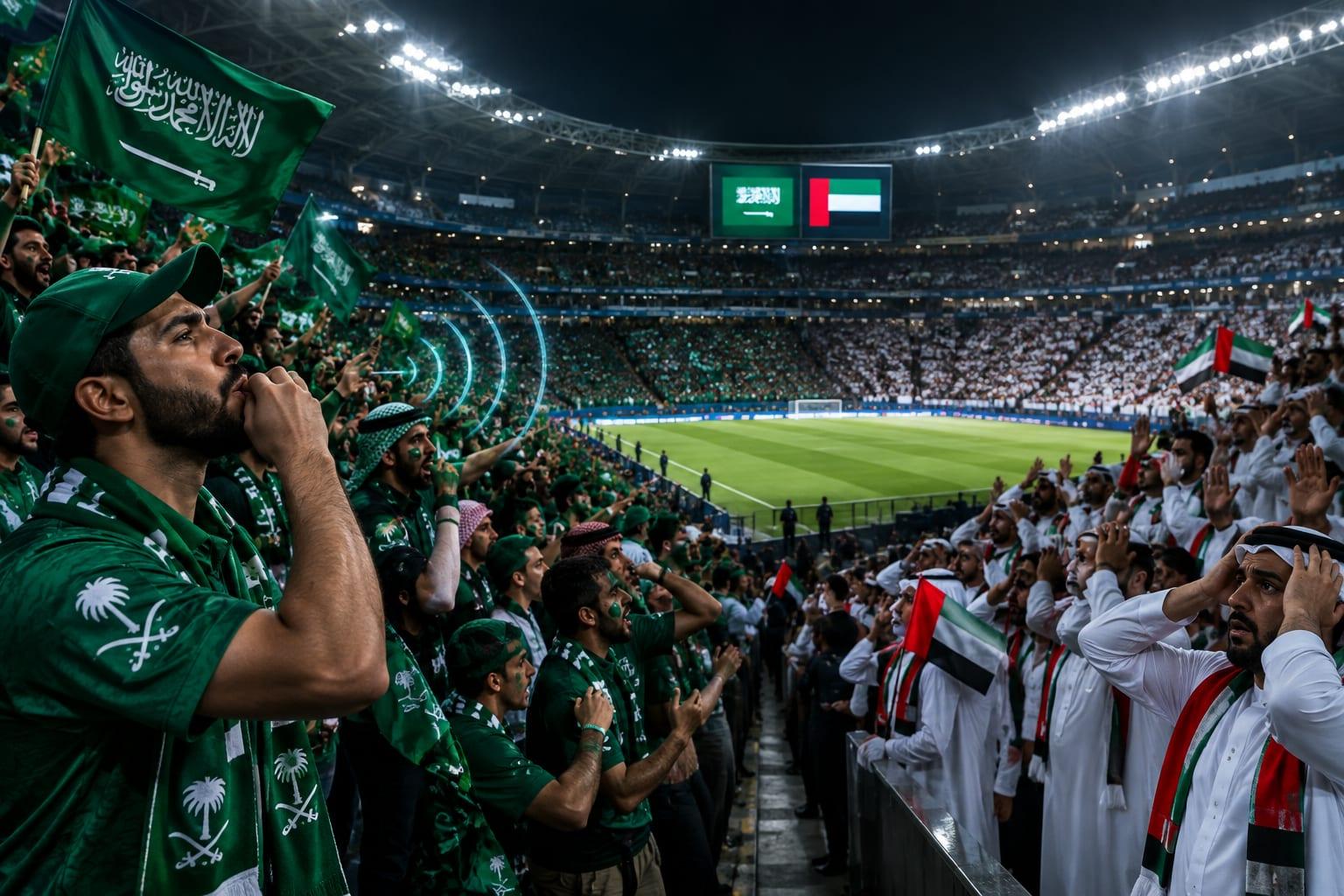
Saudi fans whistled and chanted through the United Arab Emirates national anthem before the Gulf Cup final in Jeddah on Tuesday night, according to the account @clashreport, which posted footage of the pre-match ceremonies and reported that UAE captain Khalid Eisa was visibly furious, reportedly mouthing the words "shame, by God, shame" during the anthem.
The Gulf Cup final matched Saudi Arabia against the United Arab Emirates before a home crowd in Jeddah, the culmination of a tournament that had been anticipated across the region for days. In the hours before kickoff, Saudi coverage framed the match as a statement opportunity for the host nation. The Saudi Arabia duo: We do not fear the UAE and our goal is the title, one regional report said, describing a Saudi camp with a burning desire to finish the job and lift the title in front of their own fans.
What the UAE side encountered when it lined up for the anthem is the subject of the video circulating Tuesday night. According to @clashreport, whistles and chants from the Saudi stands carried through the UAE national anthem, and Eisa, the UAE captain, was captured on camera reacting. The account reported that Eisa was visibly furious and reportedly mouthed "shame, by God, shame" during the anthem.
The reaction from Eisa is the moment that has traveled furthest. The clip of the UAE captain during the anthem was carried by the account @clashreport, whose post paired the anthem footage with the observation about Eisa's demeanor and the reported lip-reading of his words. That post is what other accounts have picked up as the night progressed, each pass adding the same core claim: that the anthem was disrupted and that the UAE captain did not hide his anger about it.
It is worth being precise about what is and is not established at this hour. The whistling and chanting are described in the @clashreport post as having happened before the final in Jeddah, and the account reported Eisa's reaction to it. The specific words attributed to Eisa are described by the account as something he reportedly mouthed, which is a reading of on-camera behavior rather than a spoken statement captured on a microphone. Next News Network could not independently verify the claim that the anthem was disrupted, nor the reported content of Eisa's reaction.
Gulf Cup finals are among the most heavily attended fixtures on the regional calendar, and Saudi Arabia hosting the final in Jeddah had been the subject of extensive organizational preparation. Pre-match coverage described arrangements for the crowds and the challenges that come with a match of that size, and both federations had spent the preceding days framing the final as the most important fixture of the tournament. Tuesday's match followed that buildup, with the Saudi side having publicly stated its ambition to win in front of its home supporters. The final result, per match coverage, was Saudi Arabia 2-0 United Arab Emirates.
That context matters for how the anthem episode is being received. A Gulf Cup final between two Gulf states is a fixture with a built-in audience and a built-in set of sensitivities, and the anthem is the portion of the pre-match program that carries the most protocol weight. Whatever happened in the stands during the UAE anthem, the video circulating afterward has focused attention less on the match itself than on the exchange between the crowd and the UAE captain.
The spread of the claim has followed a familiar pattern. The @clashreport post carried the footage and the reported reaction. Regional accounts then passed the clip along, adding their own framing, with the result that by Tuesday night the anthem episode was being discussed as its own story, separate from the final score. The accounts carrying it have been consistent on the core elements -- the whistling and chanting during the UAE anthem, and Eisa's visible anger -- while varying in how much weight they place on the reported words.
No statement from the Gulf Cup organizing committee, the Saudi federation, or the UAE federation regarding the anthem was available at the time of writing. It is not yet known whether any formal complaint has been filed, whether match officials addressed the matter, or whether either federation intends to comment. The video itself, as carried by @clashreport, shows the anthem ceremony and the UAE captain's reaction to the crowd noise during it.
For American readers unfamiliar with the Gulf Cup, the tournament is a regional championship contested by the Arab states of the Persian Gulf and is followed with the intensity of a major international competition in the countries involved. Finals are typically played before capacity crowds, and the pre-match anthem ceremony is treated as a formal diplomatic as well as sporting moment. When that ceremony becomes the story, it tends to travel well beyond the stadium.
That is what appears to have happened Tuesday night in Jeddah. The match ended 2-0 in Saudi Arabia's favor, but the clip drawing attention afterward was from before the first whistle -- the UAE captain, the anthem, and the reported words "shame, by God, shame." The accounts carrying the claim have not, as of this writing, produced additional corroboration beyond the original footage and the reported lip-reading. Next News Network could not independently verify the claim that the UAE anthem was disrupted or the reported content of Eisa's reaction. Any further developments -- statements, complaints, or clarifications from the parties involved -- would change the picture; none had surfaced by Tuesday night.
Our Take
There is a version of this story in which the anthem episode is a footnote to a 2-0 final, and there is the version that actually played out, in which the loudest moment of the night came before kickoff and involved a visiting captain's face rather than a goal. That tells you something about what the Gulf Cup final actually is: not just a soccer match but a stage on which national pride is performed in front of a home crowd that knows exactly what the anthem moment means. If the reports are accurate, Saudi fans used that moment to send a message, and the UAE captain answered it on camera in a way that no one had to transcribe to understand. The tournament organizers have said nothing, the federations have said nothing, and the footage speaks for itself only up to a point -- which is why the caveats in this piece are not throat-clearing but the actual state of the evidence. What is not in doubt is the appetite for the clip. Within hours, accounts across the region were passing it along, each one adding its own framing, because the audience understood immediately what the UAE captain's reaction was reacting to. Sports rivalries in the Gulf are not polite affairs, and the anthem is not a neutral part of the program; it is the part everyone watches. If a home crowd can turn that moment into a statement, and a visiting captain can turn his response into a second statement, then the final was never only about the score. The 2-0 result will be in the record books. The anthem footage is what people will remember.
