
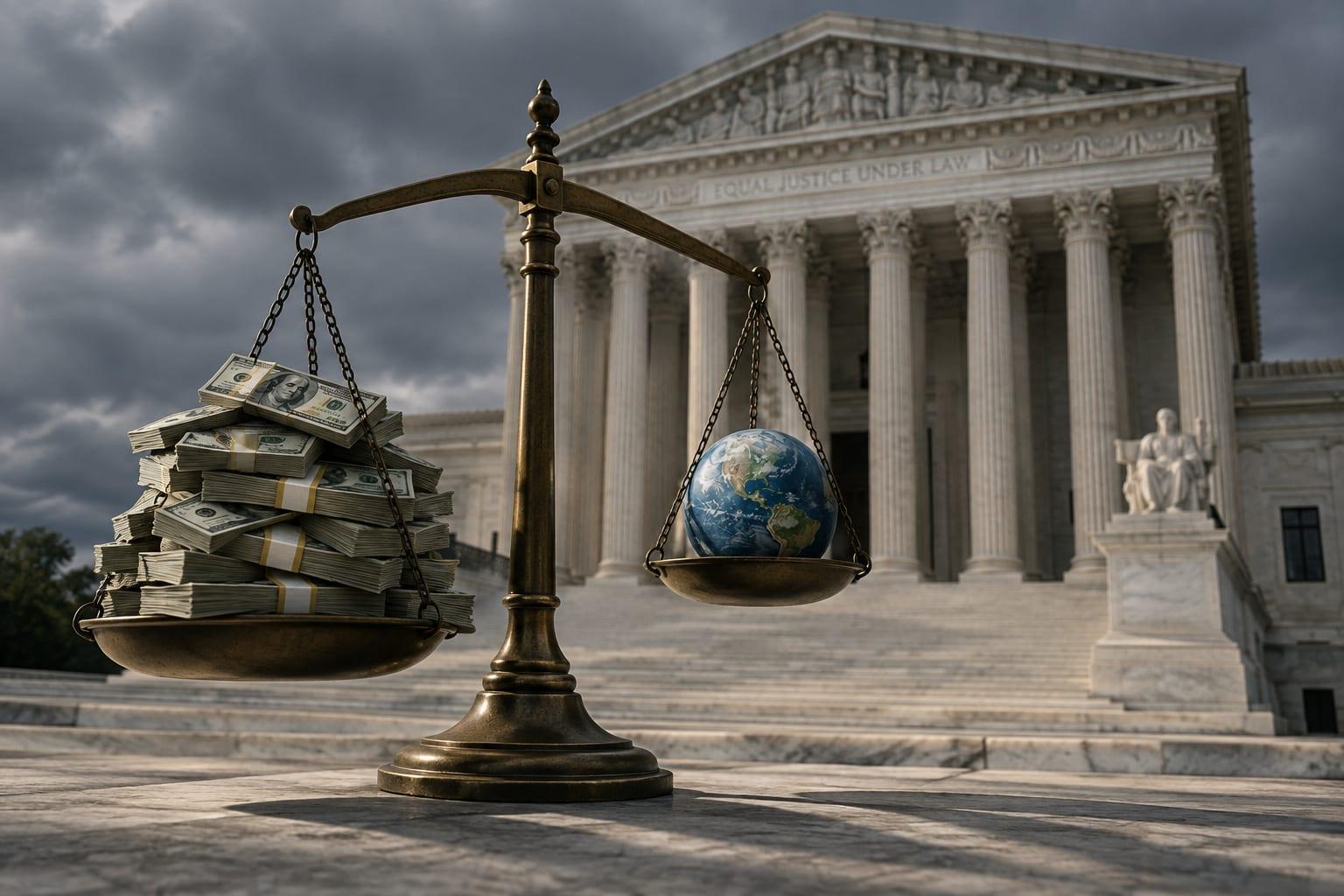
The Supreme Court opened its new term Monday with a case that could reshape how climate litigation works in America, hearing arguments over whether Boulder County's climate lawsuit against Suncor Energy and ExxonMobil belongs in state or federal court.
At issue is whether local and state governments can pursue civil damages — potentially totaling billions of dollars — against energy companies in state courts, or whether federal law preempts those claims and routes them to federal court, where similar suits have been dismissed. The Trump administration is backing the energy companies, arguing the litigation is an attempt to impose emissions regulations through the courts, according to The Associated Press.
The case arrived at the high court with an unusual wrinkle: Justice Samuel Alito recused himself after calls for him to step aside over his stock holdings in oil companies, according to Fox News. That left eight justices hearing nearly two hours of argument — and created the possibility of a 4-4 tie, which would leave the Boulder case to proceed in state court without resolving the broader legal questions.
Chief Justice John Roberts, widely seen as the deciding vote, pressed both sides. According to Fox News, Roberts questioned why this case should be treated differently from other disputes where states are allowed to hear claims over conduct that happened elsewhere.
"There are a lot of familiar situations where conduct outside of the state has broad effects among other states, and yet we allow state courts in a particular state to bring litigation," Roberts said. "I guess I'm not quite sure what makes this situation different from all those other ones, where we've allowed them to proceed in state court."
Roberts also raised the question of scale, telling Boulder's attorney, per NBC News: "Presumably, if you prevail, the next day a municipality in every single state will file a lawsuit."
The court's three liberal justices leaned the other way. Justice Elena Kagan challenged the companies' position directly, per Fox News: "This is the same kind of lawsuit against the same kind of actors for the same kind of harm. Where does this principle come from, that states can't regulate in the air and water space?"
Justice Brett Kavanaugh, according to Fox News, appeared to speak for several of his conservative colleagues in focusing on the implications of letting multi-jurisdictional lawsuits play out in individual state courts.
Boulder County argues the companies misled consumers about the climate impacts of greenhouse gases produced by their products and should help cover costs tied to wildfires and other disasters. Exxon and Suncor deny the allegations and warn that if the Boulder suit and more than two dozen similar cases around the country move forward, energy companies could face damages running into the billions, according to NBC News.
The companies argue climate change is inherently a national and international issue that cannot be handled through state-court litigation. The Trump administration agrees, telling the court the suits amount to a power grab aimed at regulating emissions outside the democratic process.
It was not clear after Monday's public session how the court will rule, and with Alito absent, a 4-4 split remains a real possibility. That outcome would let the Boulder case move ahead in state court while leaving the underlying legal questions unresolved for another day.
The climate case is just one item on a term stacked with major disputes. The justices will take up Second Amendment challenges to state bans on semiautomatic rifles like the AR-15 in December, along with cases on religious rights and President Trump's immigration enforcement, according to the AP. Roughly a dozen states have banned such rifles, arguing they are disproportionately used in mass shootings; challengers say the bans violate the Second Amendment and that the weapons are among the most commonly owned guns in the country.
The new term also unfolds against the backdrop of a court that has expanded gun rights in recent years — and a political environment in which the Trump administration has made clear it will weigh in on cases touching federal authority, energy policy and the reach of the administrative state.
Our Take
Here's what Monday's argument really comes down to, folks: whether a single county in Colorado — or any of the dozens of other municipalities lining up behind it — gets to set national energy policy through the courthouse instead of through Congress.
The Left knows it can't pass a carbon tax or a Green New Deal through a Republican-controlled Washington, so it has shifted strategy: sue the oil companies into submission in friendly state courts, where juries and judges are picked from a single political jurisdiction, and let the damages do what legislation couldn't. That's not justice. That's regulation by litigation, and it's exactly the kind of end-run around the democratic process the Trump administration is right to fight.
Chief Justice Roberts asked the question that should worry every American who believes in a national economy: if Boulder wins, what stops every other county in every other state from filing its own suit the next day? The answer is nothing — and the result would be a patchwork of state-court rulings effectively dictating what energy Americans can buy and at what price.
The companies have a point that climate change is global by nature. You can't solve a planetary issue with a county courthouse verdict, and you can't let one locality's lawsuit set the terms for everyone else.
With Alito recused and a 4-4 tie possible, the court could punt — leaving Boulder to proceed and the larger questions open. Patriots should be watching this one closely. The justices have a chance to affirm that federal authority, not activist local prosecutors, governs national energy questions. If they don't, expect the lawsuit floodgates to open wide.
What do you think — should one county be able to sue America's energy industry into oblivion? Let us know in the comments.
