
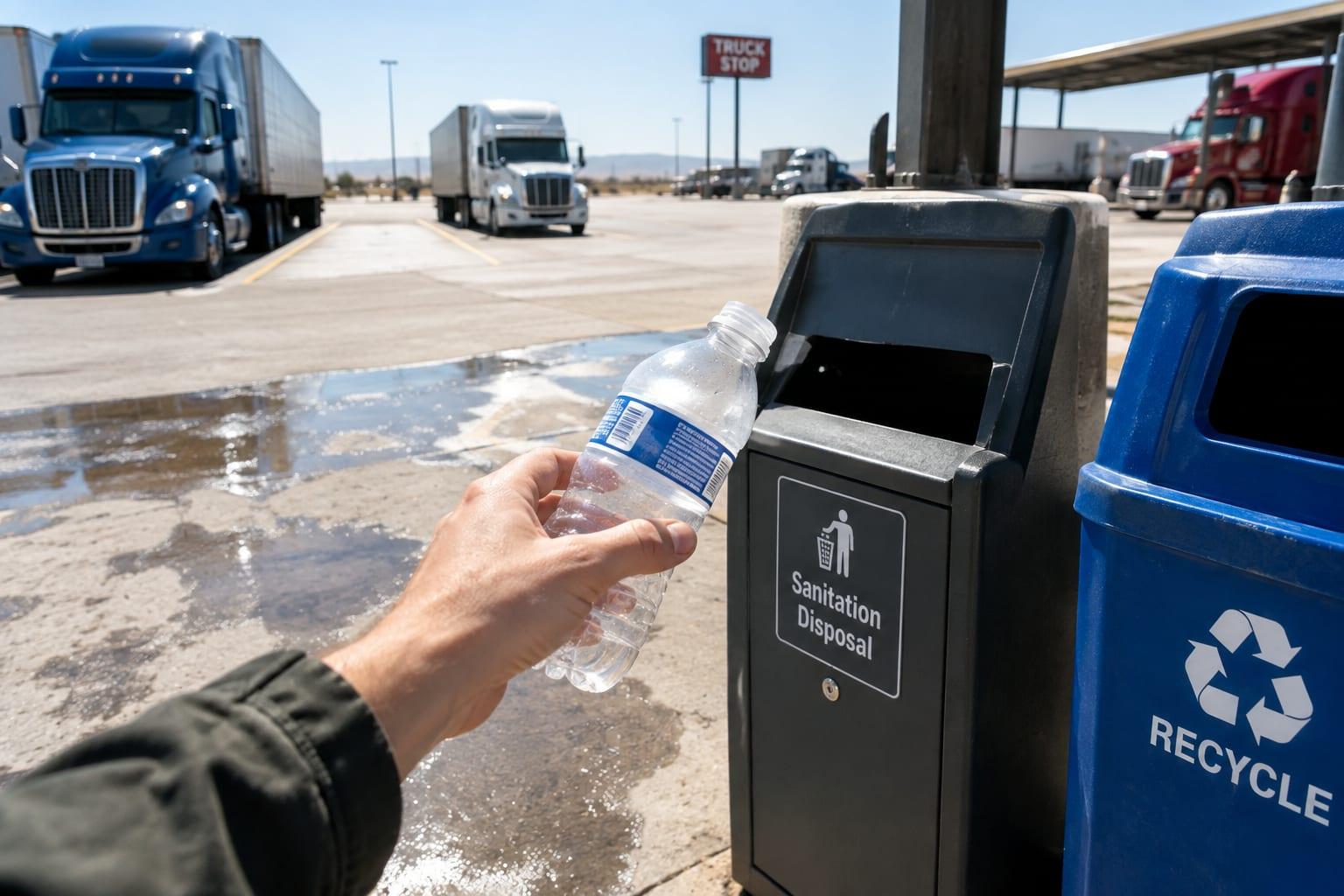
A former truck driver of eighteen years is making the case that the sanitation crisis on America's freight corridors deserves the same attention the industry gives electric trucks and emissions technology — and he says he built a company to do something about it.
Mark Reiland, the founder behind a venture called Pee Dispose, laid out the problem in an interview carried by the freight industry outlet FreightWaves, which posted his comments along with a written summary of his mission.
"As a driver, I was out on the road, and whenever I stopped somewhere, whether it be a truck stop, rest area, staging area at a company, I realized people are dropping bottles everywhere, or dumping them, and that, to me, yeah, it was just, it was terrible," Reiland said in the first FreightWaves video.
He described arriving at stops in the middle of Texas and Oklahoma in the middle of summer. "You smell it, you smell it right away," he said.
The problem did not end at the lot line, according to his account. Reiland said drivers were conducting pre-trip inspections while dumping bottles in the back of their trailers, behind their trailers, and, in his words, "whatnot."
"I realized it doesn't bode well for us, it doesn't show that we're good stewards, and I said to myself, there's gotta be a better way," he said.
FreightWaves, in its written post accompanying the interview, framed the issue around the same image: truck stops smelling in the summer heat and discarded bottles everywhere. The outlet's post added the reason drivers end up in that position — tight delivery schedules that force them into tough choices.
Reiland made the same point in more vivid terms on camera. He noted that simply letting drivers use bathrooms would not resolve the underlying bind, because the business model keeps them moving. "I gotta make money, because this is the way we've set up this crazy business," he said, before comparing the resulting pace to a college stunt: "like you're in a fraternity, trying to do 100 shots of beer in 100 minutes, without breaking the seal."
He also said he has never seen a truck driver carry a bottle of urine across a truck stop, and that he would not do it himself. The point, in his telling, is that drivers lack any dignified place to resolve the problem once they are parked.
FreightWaves summarized the mission this way in its Saturday evening post: "Every truck stop, staging area, and rest stop should have a safe, clean way for drivers to dispose of waste." The outlet quoted Reiland saying that driver sustainability and dignity are just as crucial as environmental tech.
In a second FreightWaves video, the conversation turned to what the company is ultimately for. Reiland answered from what he described as personal investment. "As a driver, I basically came out and said, you know, I got tired of seeing it," he said. "I think we're better, our drivers are better, our communities, our owner-operators are better people."
He sketched out where he believes disposal points belong: anywhere a truck is parked, including company staging areas, where drivers finish their week and start a thirty-four-hour reset, and at every truck stop and rest area.
"It just means we're better, we're more accountable," Reiland said. He argued the trucking community has focused heavily on truck sustainability — electric vehicles and the like — while leaving out the human side. "What about driver sustainability?" he asked. "We as drivers had to be sustainable, and we can do it, but we can do it in a way that gets rewards and does something positive, not just talking about it."
The two FreightWaves posts and the two interview clips gathered a combined forty-five replies from other accounts, and the story has not jumped beyond FreightWaves to other outlets in the days since the posts went up. Trucking publications routinely cover driver amenities — parking shortages, rest area funding, shower access — but proposals aimed specifically at onboard waste disposal have drawn relatively little national attention, and the FreightWaves segments are currently the main place the Pee Dispose effort has been aired.
What the company would actually install, what it would cost, and who would pay for it at thousands of private staging yards and publicly funded rest areas is not spelled out in the posts or the interviews. Reiland did not describe a timeline or any agreements with truck stop operators, trucking companies or state transportation departments. Whether any of those operators have expressed interest is not known.
Next News Network could not independently verify Reiland's account of conditions at truck stops, rest areas and staging yards, or the details of the Pee Dispose operation as he describes it. His comments are his own claims about what he saw during eighteen years on the road, and the FreightWaves posts present that account as the basis for the effort.
What is clear from the exchange is the shape of the argument: a longtime driver turning a widely recognized annoyance into a request that the industry treat the people behind the wheel as part of its sustainability ledger, not just the equipment they operate.
Our Take
Reiland is pointing at something the freight industry has mostly treated as background noise. Anyone who has walked a truck stop parking lot in July knows the smell and knows the bottles, and the drivers themselves know it better than anyone. His diagnosis is not complicated: schedules are tight, stops are short, and the only place a driver can relieve himself with any privacy is inside the cab. Once that is true, the bottle is not a character flaw, it is the logical end of a supply chain that measures minutes and never measures dignity. That is why telling drivers to simply use the restroom misses the point he is making — the clock is the problem, and the sanitation failure is the symptom.
Where we part company with the reflexive politics of this is the assumption that a mandate or a federal program is the answer. Reiland's own framing is better than that. He is not asking for a regulator; he is asking the industry — truck stop chains, staging yards, carriers — to put a disposal point where the trucks already park. That is a facilities decision, not a legislative one, and it is the kind of thing private operators can do without a new office in Washington. A clean, enclosed, safe disposal station at every major stop is cheap compared with the cost of an EV charging corridor, and it would do more for driver retention than another recruitment bonus.
The environmental angle practically sells itself. Bottles dumped behind trailers, in staging lots and along the shoulder are somebody's cleanup bill and a genuine public health annoyance. Giving drivers a legitimate way to dispose of waste is the rare case where dignity and sanitation point the same direction: less litter, less smell, fewer hazards for the people who work around these lots, and a job that treats its workforce like adults. It is hard to find a conservative objection to that, and Reiland is not asking anyone to find one.
The open questions are the ones he has not answered publicly. What is the unit? Who pays? Do the truck stop chains sign on, or does this stay a niche product for a few forward-leaning carriers? Those answers will decide whether Pee Dispose is a real shift or a good pitch. But the diagnosis is sound, and the man making it spent eighteen years earning the right to make it. American freight runs on drivers, and drivers deserve a place to go. That should not be a controversial sentence.
