
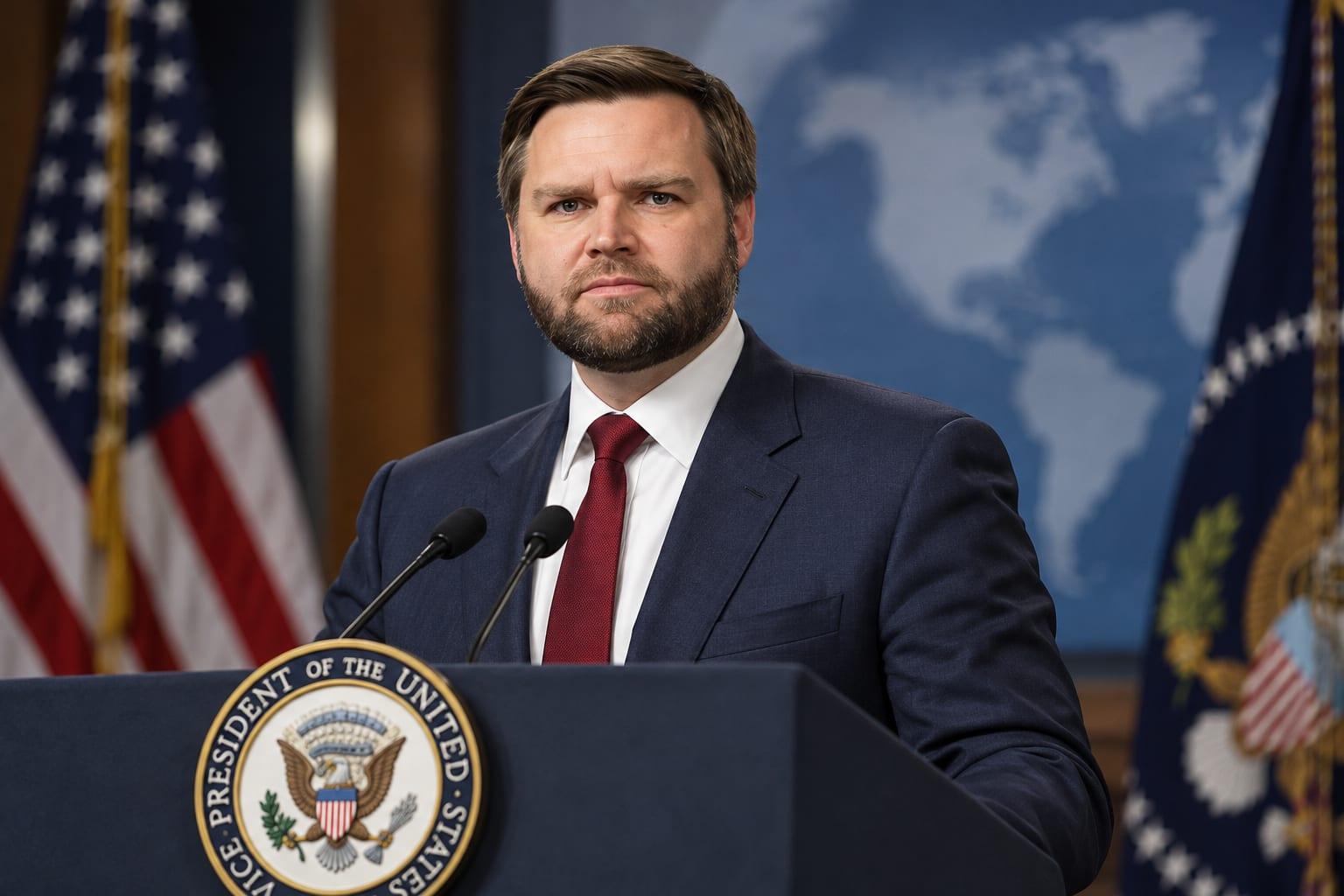
Vice President JD Vance said the United States is negotiating with Iranian President Masoud Pezeshkian and Foreign Minister Abbas Araghchi, but that Washington is unsure how much authority they hold or who ultimately makes decisions in Tehran, according to a Reuters interview published Monday.
Vance said Iran must make a "meaningful" reduction in its nuclear enrichment capacity to end the seven-month war, arguing that Tehran cannot claim it does not want a nuclear weapon while enriching uranium to sixty percent. The vice president said the United States remains open to a deal but wants concrete nuclear concessions, declaring, "We're not going to trade words for actions."
The interview, conducted in Fairbanks, Alaska, by Reuters correspondent Jacob Bogage, was carried by outlets including the Straits Times and Terre Haute radio station WBOW. It marks the most detailed public accounting to date of the administration's position as the conflict with Iran approaches its eighth month.
According to the Reuters account, Vance framed the enrichment demand as the central condition for any halt to hostilities, describing a "meaningful" reduction as the threshold Tehran must cross to satisfy American demands. The vice president's emphasis on verifiable action over diplomatic language echoed a posture he has struck in prior statements on the conflict.
The vice president's remarks come as the administration continues military operations against Iranian drone manufacturing infrastructure. President Trump said Monday that the United States "still has to finish it off," adding that Iran's drone-making capacity is "soon to be gone." Trump also said the "biggest problem is that nobody knows who is running the country," a remark that dovetails with Vance's stated uncertainty about the authority of the Iranian officials with whom Washington is negotiating.
The parallel comments from the president and vice president appear to reflect a shared assessment inside the administration: that the Iranian chain of command remains opaque even as diplomatic channels are open. Trump's description of the drone program as near elimination suggests the military track continues alongside the negotiating track, with no indication from either official that operations have paused to accommodate talks.
Separately, Vance said he is undecided about a presidential run, according to a source interview. The remark was not tied to the Iran discussion in the available material, but it lands as the vice president takes a leading public role in articulating the administration's war aims and its terms for ending the conflict — a profile that would matter in any future campaign.
The comments from both officials rippled across financial and news wires Monday evening. The account @FirstSquawk carried the vice president's Iran remarks in a series of rapid-fire posts beginning shortly before midnight Greenwich Mean Time, the sort of continuous wire-style relay that trading desks and political reporters monitor for breaking statements from senior officials. The same account carried the president's earlier comments on the drone program and the uncertainty inside Iran's leadership.
Coverage of the interview spread through aggregators and regional outlets within roughly two hours of publication. The Straits Times framed the remarks around the energy-market strain accompanying the war, while WBOW in Terre Haute carried the Reuters byline and the vice president's "meaningful reduction" formulation. GV Wire also reported the interview with an emphasis on the enrichment demand as the path to resolving the conflict. The common thread across the coverage was the administration's insistence on concrete nuclear steps rather than verbal assurances.
No specifics were provided in the available material about the scope of the reduction Washington is seeking, the timeline for compliance, or what verification mechanism would be acceptable. It is not yet known whether the negotiations with Pezeshkian and Araghchi have produced any interim arrangements, nor whether the Iranian officials involved have responded directly to the enrichment demand. The available material also does not indicate whether any further rounds of talks are scheduled.
The president's assessment that Iran's drone-making capacity is "soon to be gone" raises questions about the sequencing of military and diplomatic pressure that the available material does not resolve. It is not known whether the administration views the degradation of that capacity as a precondition for a deal, a parallel objective, or a bargaining chip to be traded away. What is clear from the two officials' public statements is that Washington is pressing on both fronts at once.
Asked about the war's energy dimension, the coverage noted that markets are feeling strain from the seven-month conflict. The vice president's interview did not, according to the available accounts, offer a specific mechanism by which an enrichment deal would relieve that strain, though the coverage linked the two.
Next News Network could not independently verify the claims described in this report.
In a related energy development, Shell said it is actively monitoring Invest 92L, naming the Stones, Mars, Olympus, Ursa, Vito and Appomattox assets as a precautionary measure and adding that there are currently no other impacts to operations across the Gulf of America. The storm watch was announced separately from the Iran developments.
Our Take
The vice president's admission that Washington cannot tell who calls the shots in Tehran is the most candid sentence to come out of this administration on Iran, and it is also the most damning. Seven months of war and the United States still does not know whether the men across the table can deliver anything. That is not a negotiating position; it is a warning sign. Vance is right to demand deeds over words — "we're not going to trade words for actions" should be the default posture of every American administration dealing with the Islamic Republic, which has spent four decades perfecting the art of talking while centrifuges spin. But a demand for a "meaningful" reduction needs a number, a deadline, and a verification regime, or it is just another word the Iranians can pocket. Trump's line that "nobody knows who is running the country" cuts both ways: it justifies maximum pressure, and it also means any deal signed by Pezeshkian or Araghchi may not be worth the paper it is printed on. The administration should keep the military track hot until Tehran proves it has a single authoritative voice — and one that is prepared to verifiably dismantle its enrichment program, not merely slow it down.
