
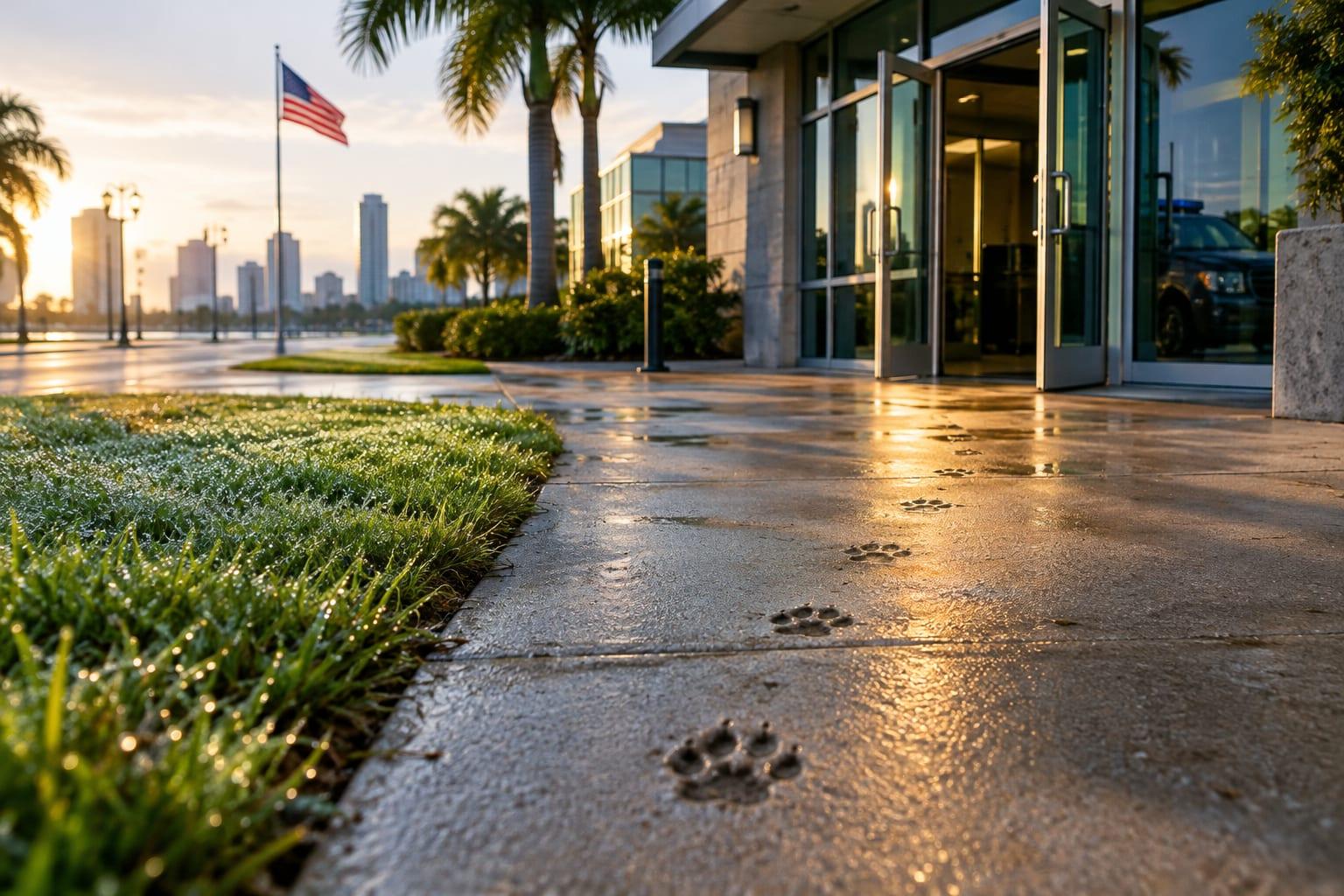
A German shepherd who had wandered away from his home turned up at a Florida police station, where an officer helped reunite the pooch with his tearful owner, according to accounts of the episode circulating from Tampa to Baltimore.
The Tampa Police Department said security footage captured the "unexpected K-9 applicant" strolling up to the local station's front doors and greeting the officer who opened the door on Sept. 30. In the department's telling, the dog may not have gotten the job, but he "definitely stole our hearts."
The story moved quickly across regional newsrooms. WBAL in Baltimore carried it, as did WSVN 7News out of Miami and Fort Lauderdale, both describing a German shepherd who walked into a Tampa police station and was identified through his microchip. The New York Post's account of the same episode called the animal a "clever" dog and noted that German shepherds are known for their intelligence and trainability — a breed widely used in law enforcement because of its ability to learn commands, follow complex tasks and work alongside handlers.
According to the department's account, the officer found the dog and kept him in his van before the two ever sat down for a formal interview. Body camera footage, as described in the coverage, catches the exchange that followed.
"Hi, how are you?" the officer asked, with the dog still in his van.
"Yeah, just wanted to make sure because he ran up to the police department, so I had him in the car," the officer said.
From there, the officer explained the steps he took before anyone could claim the position. "I took him to the vet, I checked his chip and I was finally able to find out he has owners," he said. "I wanted to make sure it wasn't like somebody didn't want him."
The microchip is the hinge the whole reunion turns on. The officer ran it, found a name and a phone number attached to the animal, and made the call. What followed, according to the department's account of the body camera video, was a tearful owner hugging the dog and welcoming him home, thanking the officer for bringing him back.
The woman told the officer, in the account of the reunion, that the German shepherd likes to play outside a lot — which is how he ended up on the department's front step in the first place rather than at home.
The department did not share the dog's name. It did use the moment to remind pet owners to have their animals microchipped, noting that the technology can help identify lost pets and reunite them with their families. That advice has been the practical takeaway attached to the story in several of the regional write-ups.
The Tampa episode lands in the middle of a run of similar reunions that have made national news this year. Last month, a Chicago woman was reunited with her chihuahua, Flor, twelve years after the dog disappeared. In March, a Philadelphia family was reunited with their dog, Forty, nearly eleven years after he was stolen from their backyard. The terrier mix, whose full name is 40Cal, was taken alongside another dog from the family's home in May 2015.
Those cases share the same mechanism as the Tampa one: a chip, a scanner and a phone call. The difference is the time elapsed — years rather than hours — and the fact that the Tampa dog did the reporting himself, walking up to the station rather than waiting to be found.
The department's social post and the local coverage frame it as a light moment, and the syndication reflects that. A Facebook video posted by the Tampa Police Department is what carried the footage to the wider audience, with the department's own caption supplying the "K-9 applicant" line that other outlets then picked up and repeated. The clip shows the dog approaching the station doors and the officer opening up to greet him; the body camera material covers the conversation in the van afterward.
Surrounding coverage has included other dog-reunion stories as well, such as a Leawood, Kansas police officer who was patrolling a neighborhood when he spotted a small dog walking alone in the middle of the road — a separate incident that has circulated alongside the Tampa clip as part of the same run of feel-good animal stories.
What the record does not contain, at this point, is a name for the dog, a name for the owner, or any detail about where in Tampa the animal lives or how far he traveled to reach the station. The department's public account is the source of the sequence of events — the walk-up, the van, the vet, the chip, the reunion — and no independent party has confirmed the account on the record.
Next News Network could not independently verify the account of how the dog came to be at the station or how the reunion unfolded.
What is verifiable is the geography of the reaction: a Tampa department post that turned into a local story, then a regional one, then a national one carried by outlets from Miami to Baltimore within a day. The dog did not get the job. The story, for now, has legs anyway.
Our Take
There is nothing wrong with a dog story. In a news cycle full of border fights, spending battles and courtroom dramas, a German shepherd who walks himself into a police station and gets a ride home is the kind of thing readers actually want to click — and the outlets carrying it know that, which is why it went from a Tampa Facebook post to Baltimore and Miami within twenty-four hours.
But the same instinct that makes these stories spread is the one that makes them worth being careful about. The entire narrative — the walk-up, the van, the vet visit, the chip scan, the tearful hug — rests on the department's own account and its own footage. That is a legitimate source. It is also a single source, with a clear interest in presenting its officers well, and the surrounding coverage has largely repeated it without adding independent reporting. That is how a local post becomes national news in a day, and it is worth saying plainly that nobody outside the department has confirmed it.
The other thing worth watching is what the story is being used to sell. Buried under the cute footage is a real public-policy point: microchipping works, and it is the reason this dog is home instead of in a shelter. Chicago's Flor and Philadelphia's Forty — twelve years and eleven years gone, respectively — are the strongest argument for it. That message is being delivered by a police department rather than a politician, which is probably why it is landing. Conservatives have spent years arguing that the family is the first and best institution, and a dog returned to a tearful owner is a small, unforced reminder of exactly that. Nobody had to legislate it. A scanner and a phone call did the job.
The story is worth enjoying. It is also worth reading as what it is: a department's account, spread by newsrooms that liked it, of a dog nobody can yet name whose owner nobody has yet heard from directly. Happy endings are real. So is the difference between a report and a press release.
