
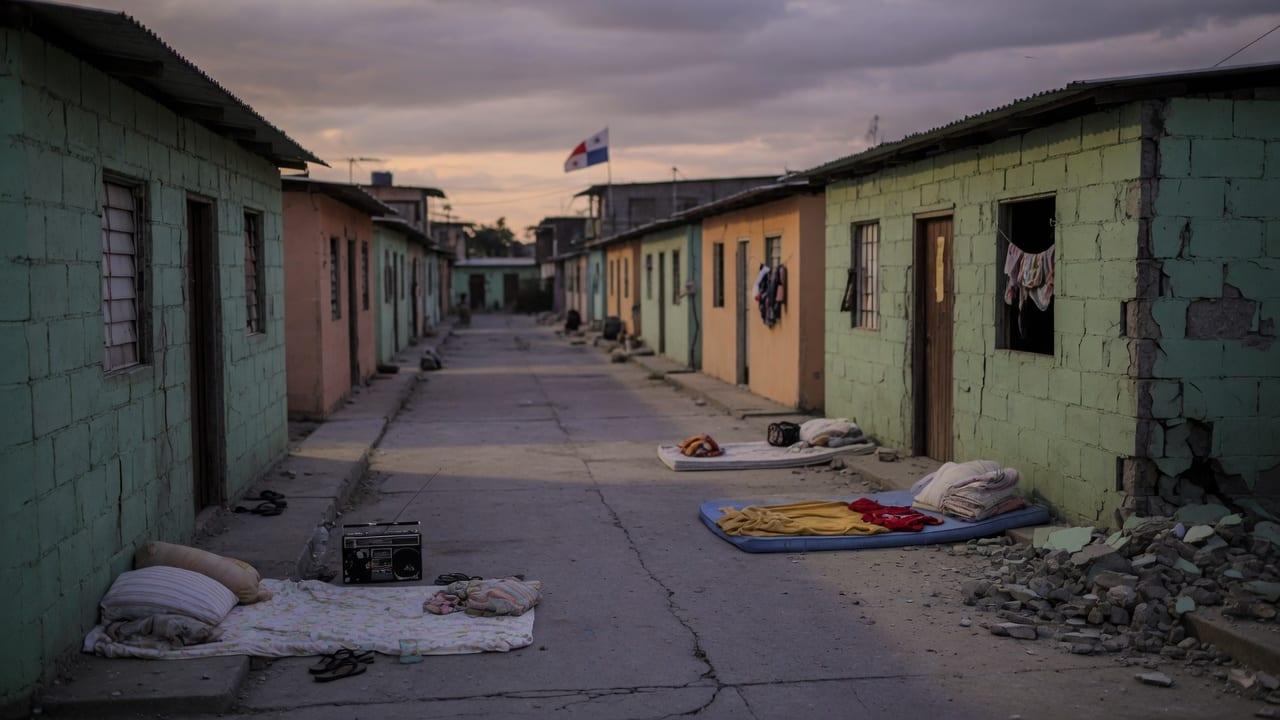
Residents of rural Panama spent Saturday night on the streets of their own towns, unwilling to go back inside after two powerful earthquakes and more than 100 aftershocks shook the country for hours.
The 7.7- and 6.6-magnitude quakes struck Friday, centered roughly 10 kilometers (6 miles) southwest of Pitaloza Arriba, a remote community in the central province of Herrera, according to the U.S. Geological Survey. The larger quake hit at a depth of about 6 miles and was felt as far away as neighboring Colombia.
In La Villa de Los Santos, a colonial-era community about 40 miles northeast of the epicenter, homes and the historic Church of San Atanasio collapsed. Families who slept outdoors were still waiting Saturday for government guidance on what to do next, according to the Associated Press.
Panama's government declared a state of emergency Saturday. Presidential Minister Juan Carlos Orillac announced the order at a news conference in Panama City, saying homes, schools, healthcare facilities, roads and hotels were among the damaged structures. Officials reported damage in all 10 of Panama's provinces and two Indigenous territories.
The numbers are staggering for a country that escaped the worst. Malitzie Rivera, deputy director of the National Civil Protection System, told reporters there were 27 reported injuries, mostly minor to moderate. The agency tallied roughly 420 damaged homes and about the same number of public schools, along with seven hotels, at least 13 churches and nine bridges. Omar Smith of the National Civil Protection Service said one person was struck by debris from a partially collapsed structure in Penonomé, roughly 150 kilometers from the capital, and confirmed a partial collapse and cracks at the city's cathedral, plus damage to the governor's office building and the Dos Continentes hotel.
Seismologists at the University of Panama recorded dozens of aftershocks, including three measuring magnitude 5.8, 5.5 and 5.2. Rivera said the count topped 100. No deaths have been attributed to the quakes.
Carlos Valdés, head of the Seismology Department at the National Autonomous University of Mexico, told the AP that the notably lower toll may be due to Panama's strict building codes, particularly those governing skyscraper construction in the capital. There were no reports of damage in Panama City.
The disaster lands in a region already battered. Two back-to-back 7.2 and 7.5 magnitude earthquakes struck Venezuela's La Guaira state in June, killing more than 6,500 people and leaving 17,000 homeless. A 7.4 magnitude quake in Colombia in August killed at least 289 people.
For now, the story out of central Panama is one of collapsed churches, cracked government buildings and families who do not trust the ground beneath them. The emergency declaration unlocks government resources, but it does not answer the question residents were asking Saturday: when is it safe to go home?
Our Take
Here is what Americans should take from a disaster 2,000 miles away: preparedness is not a catchphrase, it is a body count. Panama's building codes saved lives this week. Venezuela's did not.
That is the entire argument for strong construction standards, functioning civil protection agencies and governments that treat infrastructure as a core duty rather than a line item to cut. It is also a reminder that when the earth moves, no bureaucracy moves fast enough for the family sleeping on a sidewalk in La Villa de Los Santos waiting for someone to tell them what comes next.
Our prayers go out to the people of Panama. And for folks here at home watching this unfold, ask yourself one question: if a 7.7 hit your town tomorrow, would your family know where to go, what to grab and how to get out? If the answer is no, tonight is the night to fix that. Not next week. Not after the next headline.
