
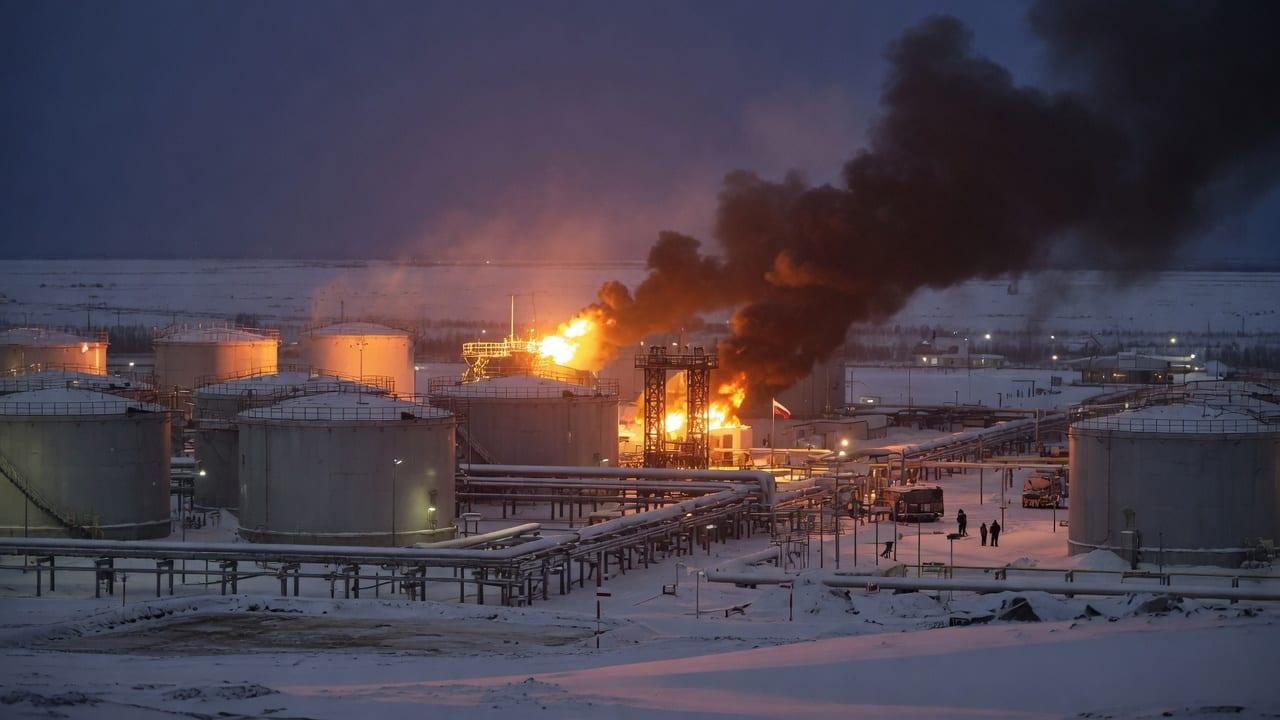
Ukrainian forces struck a linear oil dispatching station in the settlement of Prosvet, in Russia's Samara region, according to a statement from Ukraine's General Staff carried by the financial news service FirstSquawk. The same account reported hours earlier that Ukraine had hit a Russian oil pumping station in Samara, and in a separate bulletin quoted the General Staff saying it targeted an oil pumping and storage plant in the province.
The reported target sits deep inside Russia, hundreds of miles from the Ukrainian border, in an industrial corridor that feeds the country's domestic fuel network. According to FirstSquawk's summary of the Ukrainian statement, the operation was described as a strike on "a linear oil dispatching station in Prosvet," with the General Staff characterizing the site as an oil pumping and storage facility. A separate report from Ukraine Top News, a channel that tracks the war's daily developments, said the General Staff also confirmed the destruction of four oil storage tanks at the site. That detail has not been independently corroborated.
The strikes, if confirmed, would mark at least the second Ukrainian operation against the same Samara node. FirstSquawk's first bulletin of the day, posted shortly after ten in the morning UTC, stated flatly: "UKRAINE: IT HIT RUSSIA'S SAMARA OIL PUMPING STATION." Roughly an hour later, the account followed with a longer dispatch describing the Prosvet strike as "another strike on Russian energy infrastructure located deep" inside the country.
Other conflict monitors described continuing fires at the site. The Daily Kos blog "Russian stuff blowing up," in a post published about nineteen hours before the FirstSquawk bulletins, reported that "refinery infrastructure in Samara is still burning," alongside strikes on refineries in the distant cities of Omsk and Ukhta. The same post noted that Ukraine has been targeting Russian data centers, framing the campaign as retaliation. The blog's language — "Burn, baby, burn" — reflects the tone of open-source war tracking channels rather than official confirmation.
The Samara region, which sits along the Volga River in southwestern Russia, hosts a cluster of refineries and pipeline infrastructure that has been a repeated target of Ukrainian long-range drones. Prosvet is a small settlement in the region's Volzhsky district. The oil dispatching station there functions as a hub for routing crude and refined products through the pipeline network, which makes it a logical target for an interdiction campaign, though the precise damage from the reported strike has not been described by any party to the conflict.
The timing of the reported strike places it within a broader wave of Ukrainian attacks on Russian fuel infrastructure. The Mirror US reported that Ukraine struck an oil facility in Russia's Rostov region with drones "just hours after President Donald Trump announced a deal with Vladimir Putin to ease diesel sanctions." The Mirror characterized the deal as having "immediately backfired," though the causal link between the diplomacy and the strike is an interpretation, not a stated Ukrainian position.
Alongside the energy strikes, Al Jazeera reported that Ukraine is pushing Russian forces back in the Donetsk region, with Russia "fighting for settlements it once firmly held" and having "retreated from many others." That reporting describes a ground war that continues to grind through eastern Ukraine even as both sides trade long-range blows. The Al Jazeera account also noted rising military and civilian casualties, without providing a figure in the available summary.
Moscow has not issued a public statement acknowledging the Prosvet strike at the time these reports circulated. Russian authorities routinely do not comment on Ukrainian claims about strikes on domestic infrastructure, and local emergency services in the Samara region have not confirmed damage. The absence of a Russian response is not evidence either way; it is simply the state of the public record.
FirstSquawk, which describes itself as a financial news wire, has carried a running series of bulletins on the Samara operation, including the initial terse alert and the follow-up quoting the General Staff. Ukraine Top News, in a report published roughly fourteen minutes before the later FirstSquawk bulletin, offered the most specific accounting of the target, stating that Ukrainian Defense Forces "carried out another strike on the Samara oil pumping and dispatch station near the settlement of Prosvet" on the night of October tenth. The account attributed the confirmation of four destroyed oil storage tanks to the General Staff.
Next News Network could not independently verify the claims made by Ukraine's General Staff or the accounts carrying them.
The broader pattern is one of a Ukrainian campaign against Russian refining and pipeline capacity that has stretched from the border regions to industrial centers deep in the interior. Omsk, in Siberia, and Ukhta, in the northern Komi Republic, are among the farthest-flung sites named in recent reporting. If the Prosvet strike is confirmed, it would extend that reach further into the Volga industrial belt, where several refineries are concentrated.
The reaction across open-source channels has been rapid, with conflict blogs and wire-style feeds amplifying the General Staff's statement within hours. FirstSquawk's two bulletins and the Ukraine Top News dispatch form a cluster of accounts carrying the same claim, each attributing it to Ukrainian military authorities. The Daily Kos post, published earlier, placed the Samara fires in a wider context of strikes on refineries and data centers.
None of the accounts reporting the strike has published satellite imagery, local video, or an on-the-ground assessment of the damage. The Ukrainian General Staff's statements are the primary source for the claim, and they have been relayed rather than independently checked by the outlets repeating them. That is standard for wartime reporting from either side of the conflict, where access to the target area is impossible for outside observers.
What is clear is that the Samara node has become a recurring target. FirstSquawk's first bulletin was terse and immediate; its second added the location and the "again" framing; Ukraine Top News added the storage tank detail. Together they describe a campaign that Ukrainian military authorities are actively publicizing, and that open-source monitors are tracking in near-real time.
Russian officials have said in the past that Ukrainian drone attacks on refineries are a form of terrorism and that air defenses intercept most incoming projectiles. No such statement accompanied the Prosvet reports, and no Russian damage assessment has been made public.
Our Take
Ukraine is not just hitting Russian oil infrastructure — it is advertising the hits, and the advertising is the point. The General Staff wants Moscow's own citizens to see smoke over Samara, Omsk, and Ukhta, and it wants Western audiences to see that the aid dollars and euros are producing visible results deep inside the country that invaded. The reporting cluster around the Prosvet strike shows how effectively that message travels: a terse wire alert, a General Staff quote, a war blog's gallows humor, and a Mirror headline about Trump's diesel deal backfiring, all within hours. The White House should take note that the diesel sanctions relief it reportedly floated with Putin is being undercut not by diplomacy but by drones. If the administration wants leverage in any future talks, it needs to stop offering concessions that Ukraine's military can render meaningless overnight. The Samara campaign is a reminder that this war is still being fought, and still being won in places Vladimir Putin would rather not discuss.
