
America is pouring hundreds of billions of dollars into data centers to win the artificial intelligence race. Lawmakers, lobbyists and trade hawks fight endlessly over who gets to fabricate the chips inside those buildings — TSMC in Taiwan, Intel in Ohio, whoever gets the next round of federal subsidies. Almost nobody asks who makes the components that connect those chips to each other and to the outside world. According to a Breitbart exclusive by Aiden Buzzetti, that oversight is a national security problem, because the answer to that question is: China.
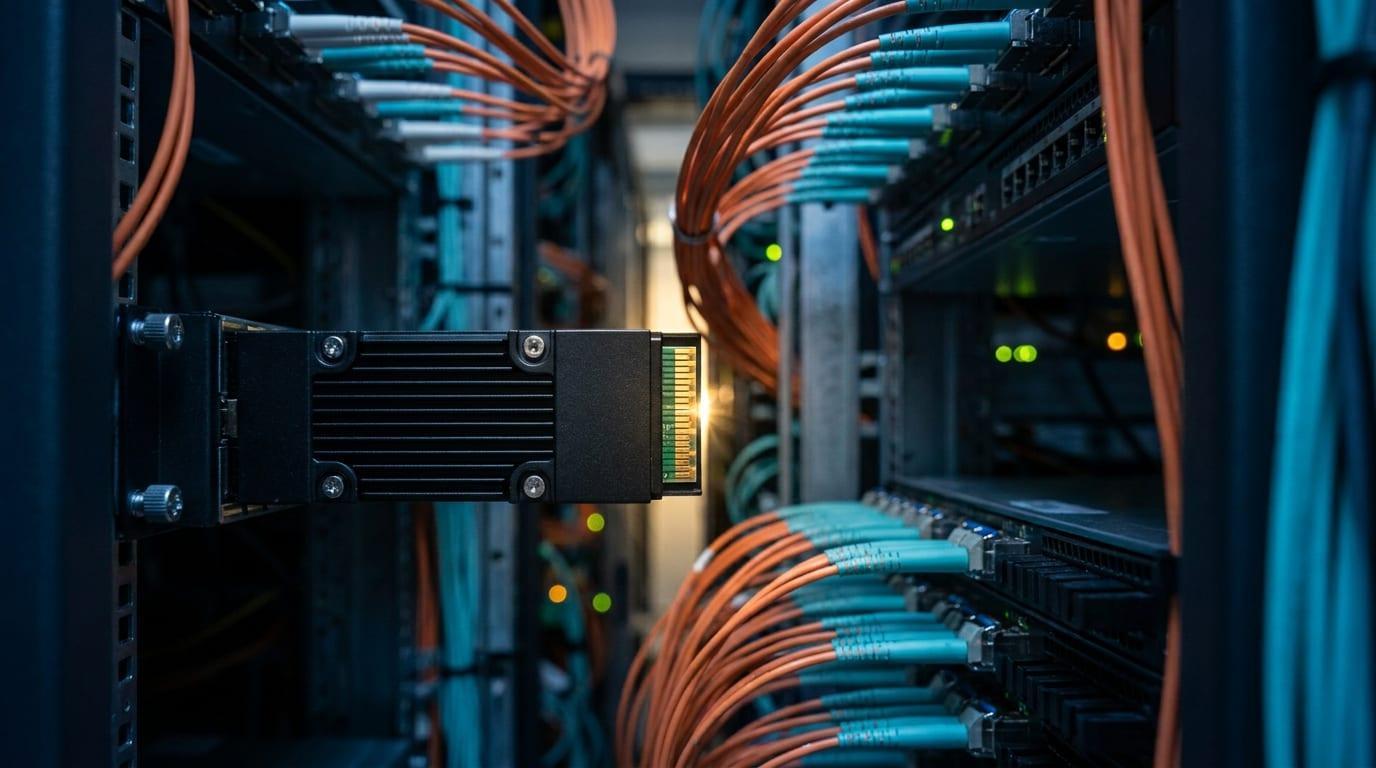
Optical transceivers are the circulatory system of modern data center infrastructure. They convert electrical signals to light and back again, moving high-speed data between servers, racks and entire facilities. Nearly every major AI cluster in the United States depends on them to function, and China is the dominant supplier.
How dominant? Johns Hopkins associate professor Yury Dvorkin told Breitbart that China supplies roughly two-thirds of the global optical transceiver market. Chinese firms Innolight — added this year to the Department of War's Chinese Military Companies list — and Eoptolink are among the leading suppliers, according to Breitbart.
Buzzetti, writing for Breitbart, puts the question bluntly: would any serious country allow an adversary to dominate an industry on which it is increasingly reliant? His answer is that none of this is an accident. China's industrial strategy, he argues, is well documented — subsidize research into critical technologies with state money, undercut foreign competitors until they fold, then use the captured market as leverage.
That playbook already burned rural America once. Small carriers across the country bought cheap Huawei and ZTE networking equipment for years because it was affordable and it worked. When Congress finally recognized the espionage risk, it allocated $5 billion in taxpayer money to rip the gear out and replace it — a program that is still not finished, per Buzzetti's account.
His warning is that optical transceivers are the sequel, at a much larger scale. Chinese manufacturers have also gotten more sophisticated at evading existing rules, increasingly routing goods through third countries to dodge tariffs. The White House itself has estimated that transshipment strategies have cost the U.S. between $19 billion and $26 billion, according to the Breitbart piece.
There are signs Washington is beginning to move. Over the summer, it was reported that the Federal Communications Commission [the remainder of that sentence was cut off in the available coverage]. Buzzetti's core argument stands on its own: the chip war gets the headlines, but the connective tissue of the AI buildout is where dependence has quietly accumulated — and dependence on an adversary is leverage handed over for free.
Our Take
This is the Huawei scandal all over again, just with a bigger bill and higher stakes, and the American people should be furious that it took a Breitbart op-ed to drag it into the light.
Think about the absurdity of the last three years. Washington threw billions at semiconductor fabs, slapped export controls on advanced chips, and turned the AI race into a full-blown cold war — all while the optical transceivers carrying every one of those signals were being stamped out in Chinese factories. We secured the engine and left the fuel line running straight through Beijing.
And we know how this movie ends, because we already watched it in rural America. Hundreds of small carriers bought Huawei and ZTE gear because it was cheap. Then Congress had to spend $5 billion of your money to tear it back out — and still hasn't finished the job. The lesson was supposed to be: never again. Instead, we scaled the mistake up to cover the most strategically important infrastructure project of the century.
The transshipment game is the tell. The White House's own estimate — $19 to $26 billion lost to goods routed through third countries — shows China has zero intention of playing by any rule we write. Tariffs get dodged. Blacklists get circumvented. Every loophole gets exploited. This is not a trading partner behaving in good faith; it's an adversary running an industrial war plan while our lobbyists argue about fab subsidies.
So here's the question patriots should put to every member of Congress between now and November: if China controls two-thirds of the components that connect America's AI clusters, what exactly did we win? Because you can't claim to lead the AI revolution while Beijing holds the wiring.
American companies can build optical transceivers. American workers can staff those lines. What's been missing is the political will to treat the supply chain the way we treat the chips themselves — as a matter of national survival, not quarterly earnings. The FCC reportedly started moving over the summer. Good. It's late, but not too late.
Contact your representatives. Demand domestic sourcing requirements for data center infrastructure funded with American dollars. We bailed out rural carriers once to undo a Chinese foothold. Do we really want to find out what the tab looks like when the foothold is the entire AI economy?
