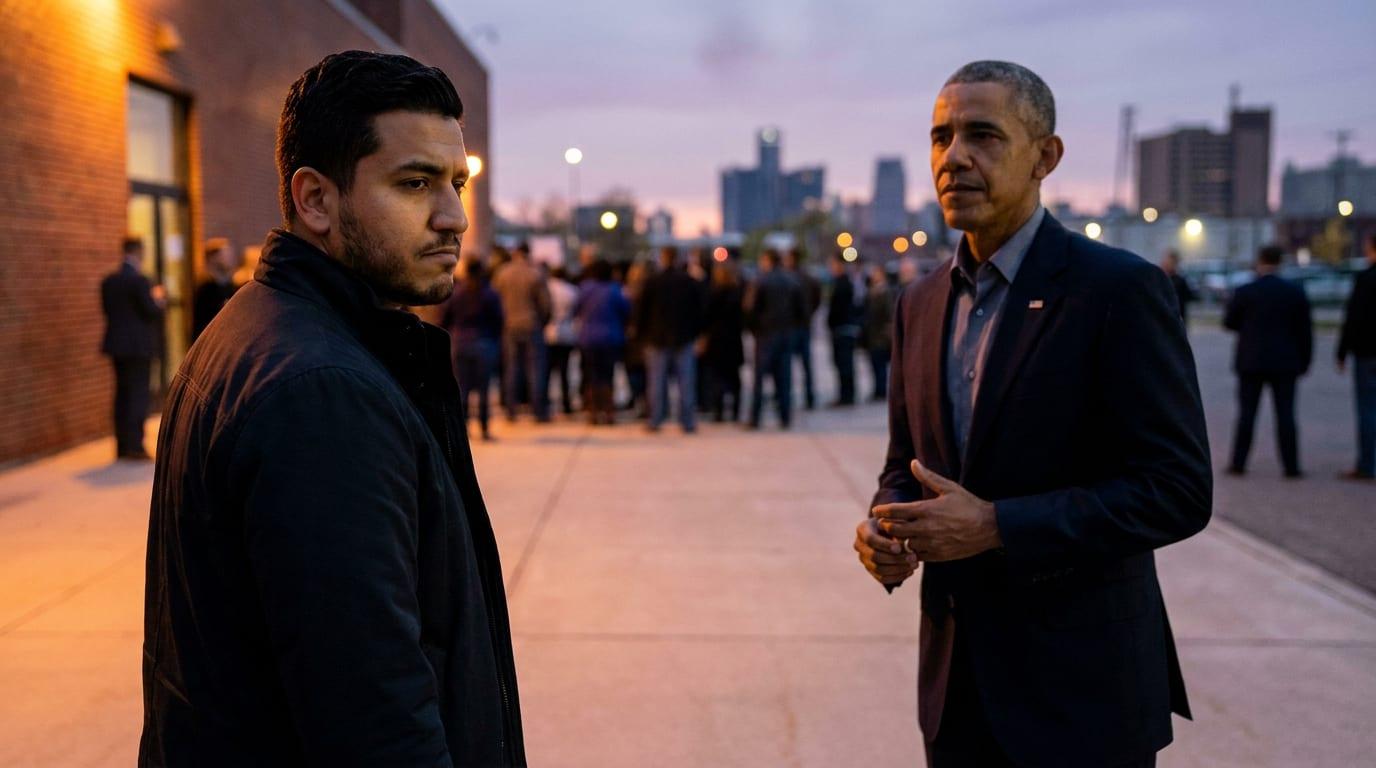
Michigan Democratic Senate nominee Abdul El-Sayed went on NBC's Meet the Press Sunday and blamed his own past attacks on former President Barack Obama on being "younger" and "angry," according to the Washington Examiner. The walk-back comes just weeks before Obama is scheduled to headline a Detroit rally with El-Sayed on October 24.
In 2012, El-Sayed accused Obama of having "perpetuated war" and "violated civil liberties," adding that "the list of his failures goes on," per reporting from the Washington Examiner. Host Kristen Welker pressed him on those remarks directly.
El-Sayed's response: "I know that President Obama was handed a really difficult set of circumstances, and he did his best." He then compared his past criticism of Obama to disagreements with his own father, telling Welker, "I wouldn't have my life but for my dad's efforts... At the same time, there's a lot of things about my dad I would do differently, right?"
Before that comparison, El-Sayed asked Welker whether her parents were still alive. She replied, "They are, thank goodness," according to the Washington Examiner's account of the exchange.
The Obama rally in Detroit is set to include Michigan Secretary of State Jocelyn Benson, the Democratic nominee vying to succeed Gov. Gretchen Whitmer, according to the Washington Examiner.
THE SYNagogue COMMENT
The Obama questions weren't the only controversy El-Sayed addressed. Welker noted that in March, after an attack at a Michigan synagogue, El-Sayed condemned the shooting but also said "hurt people hurt people" while noting the attacker had lost relatives in an Israeli strike on Lebanon, per the Washington Examiner and AOL's coverage.
Michigan Attorney General Dana Nessel publicly criticized that remark. El-Sayed later apologized, saying, "What I was trying to do was offer context for why it happened, but it wasn't the time for context."
He apologized again on Meet the Press Sunday and said he had spoken with Sen. Slotkin, who is Jewish, about the comment. "I regret anytime, you know, if I step on somebody's grief, of course I regret that," he said, according to AOL's report of the interview.
The pattern here is clear. El-Sayed built a political brand on tearing down the last Democratic president and cozying up to anti-Israel rhetoric when it suited his base. Now that he needs Obama's star power to close a Senate race, the old firebrand is a distant memory.
"Younger" and "angry" is a convenient scapegoat. It lets El-Sayed disavow a decade of his own words without ever explaining why he said them, or what changed besides his need for votes.
Obama, for his part, is reportedly still all-in. The former president will headline the October 24 Detroit rally alongside El-Sayed and Benson — a pairing that raises an obvious question for Michigan voters: which version of Abdul El-Sayed shows up on the ballot, and which one shows up if he wins?
El-Sayed is running for the open Michigan Senate seat, and the rally with Obama alongside Benson signals Democratic leadership is consolidating behind him despite his record. Whether Michigan's Jewish community — and the broader Democratic coalition he once thrilled with anti-establishment rhetoric — buys the new packaging is the test between now and November.
Our Take
Let's be honest about what happened Sunday. Abdul El-Sayed sat down with NBC, got asked about his own words, and offered the oldest dodge in politics: "I was younger and angry." He was a grown man in 2012, not a teenager venting on social media. He accused a sitting president of his own party of perpetuating war and shredding civil liberties — real accusations, made deliberately, in public.
Patriots understand what this really is. It's a candidate doing damage control because Barack Obama — the man El-Sayed trashed — is the only Democrat who can still fill a room in Detroit. You don't get to torch a president for a decade, then stand on his stage three weeks before an election and pretend it never happened.
The synagogue comment is worse, and no amount of apologizing fixes it. "Hurt people hurt people" is not context; it's excuses dressed up as empathy. Michigan's Jewish families heard it clearly the first time, before the consultants got involved.
Michigan voters have a choice to make, and it isn't complicated. If El-Sayed is telling the truth now, then everything he believed at 27 was wrong. If he's lying now, he'll say anything to get elected. Either way, voters deserve a straight answer — not a lecture about how he's grown.