
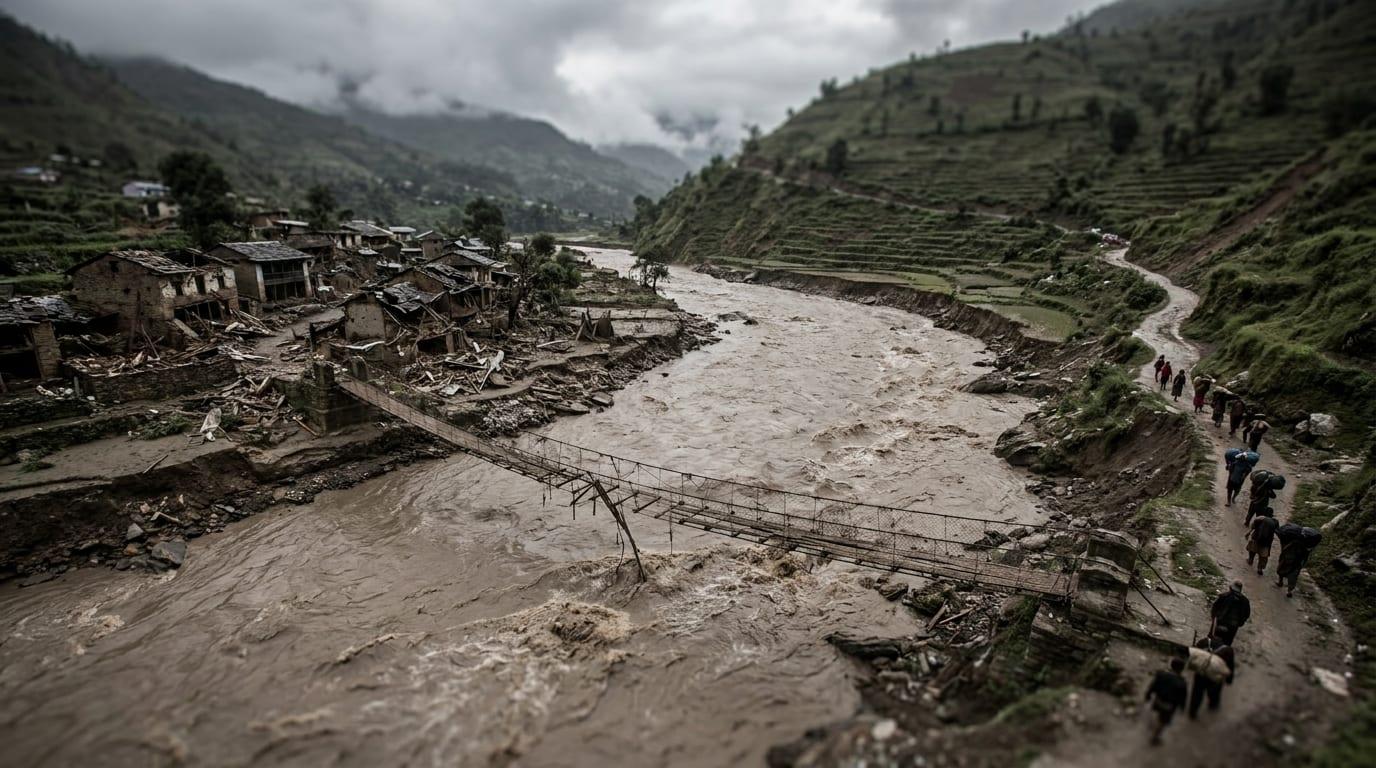
Nepali authorities ordered villagers to evacuate after a landslide triggered flash flooding in the Budhi Gandaki River valley in Gorkha district, sweeping away homes and suspension bridges and leaving at least four people missing, according to reports from the region.
The flooding struck Chumnubri village in Gorkha district after a dry landslide blocked the Budhi Gandaki River, sending black, debris-filled water surging downstream, according to coverage of the event. The government issued alerts that prompted evacuations in Arughat, a riverside community along the main highway connecting Kathmandu with other parts of the country, News18 reported.
Authorities urged downstream villagers to leave immediately as rescue teams monitored the situation closely to prevent casualties, according to reports. The Independent reported that the flooding swept away three bridges and dozens of homes, with four people unaccounted for. ABC News reported that a dry landslide in north-central Nepal triggered the flash flooding that prompted the evacuations.
The Gorkha flash flood comes less than two months after a massive flood killed nearly 1,500 people, with 5,000 still missing, according to the account @MarioNawfal. In a post on X, the account wrote: "Nepal hit by ANOTHER flash flood. Black, debris-filled water surged through the Budhigandaki River valley in Gorkha, eating up houses and bridges in its path. It comes less than two months after a massive flood killed nearly 1,500 people with 5,000 still missing. They just".
The post did not complete its final sentence, but the account's message circulated widely as news of the flooding spread. The claim of a prior disaster of that magnitude is not independently confirmed by Next News Network.
Reports of the flooding spread across multiple outlets within hours. ABC News reported that Nepal urged villagers to evacuate after the landslide triggered flooding. The Independent reported that Nepal issued evacuation orders after flash floods left four people missing. News18 reported that Nepal ordered mass evacuations after homes and bridges were swept away by the surging Budhi Gandaki River.
The Budhi Gandaki River flows through Gorkha district in north-central Nepal, an area prone to landslides and flash flooding, particularly during and after the monsoon season. The region's steep terrain and river valleys make downstream communities vulnerable to sudden water surges when landslides block rivers and then give way.
The flash flooding reportedly occurred in the Chumnubri village area after the water level increased in the Budhi Gandaki River, according to coverage of the event. The landslide that blocked the river was described as a dry landslide, meaning it was not triggered by rainfall at the time of the slide. The mechanism of a dry landslide blocking a river and then releasing a surge of water downstream is a known hazard in mountainous regions.
Rescue teams were monitoring the situation closely, according to reports, as authorities worked to prevent casualties. The evacuation orders in Arughat and other downstream communities were issued as a precautionary measure. The main highway connecting Kathmandu with other parts of the country runs through Arughat, making the area a critical transport corridor.
The reports of the Gorkha flood have not been independently verified by Next News Network. The account @MarioNawfal's claim that a prior flood killed nearly 1,500 people with 5,000 still missing is not confirmed by the coverage reviewed. The number of homes and bridges destroyed varies across reports, with some saying dozens of homes and three bridges, and others saying houses and suspension bridges.
Nepal is no stranger to natural disasters. The country's mountainous terrain, combined with seasonal monsoon rains and seismic activity, makes it vulnerable to landslides, floods, and earthquakes. In recent years, the region has experienced repeated disasters that have strained local resources and prompted calls for improved early warning systems and infrastructure resilience.
The evacuation orders and rescue efforts are ongoing. Authorities have not released a final tally of missing persons or destroyed structures. The situation remains fluid as water levels and weather conditions change.
Our Take
Once again, the people of Nepal are facing the devastating consequences of a natural disaster that has swept away homes, bridges, and livelihoods. The flash flooding in Gorkha district is a sobering reminder of the fragility of life in regions prone to landslides and sudden water surges. The evacuation orders issued by Nepali authorities are a necessary step to protect lives, but they also highlight the ongoing vulnerability of communities in the Budhi Gandaki River valley.
The fact that this flooding comes less than two months after a disaster of catastrophic proportions, if the reports are accurate, raises serious questions about the adequacy of early warning systems and disaster preparedness in the region. The international community must do more to support Nepal in building resilient infrastructure and improving its capacity to respond to such emergencies. The loss of even one life is a tragedy, and the missing are a reminder that the full toll of this disaster is not yet known.
Our thoughts are with the people of Gorkha and all those affected by this unfolding situation. We will continue to monitor the reports and bring you updates as they become available. The priority now must be the safety of those in the path of the floodwaters and the swift delivery of aid to those who have lost everything.