
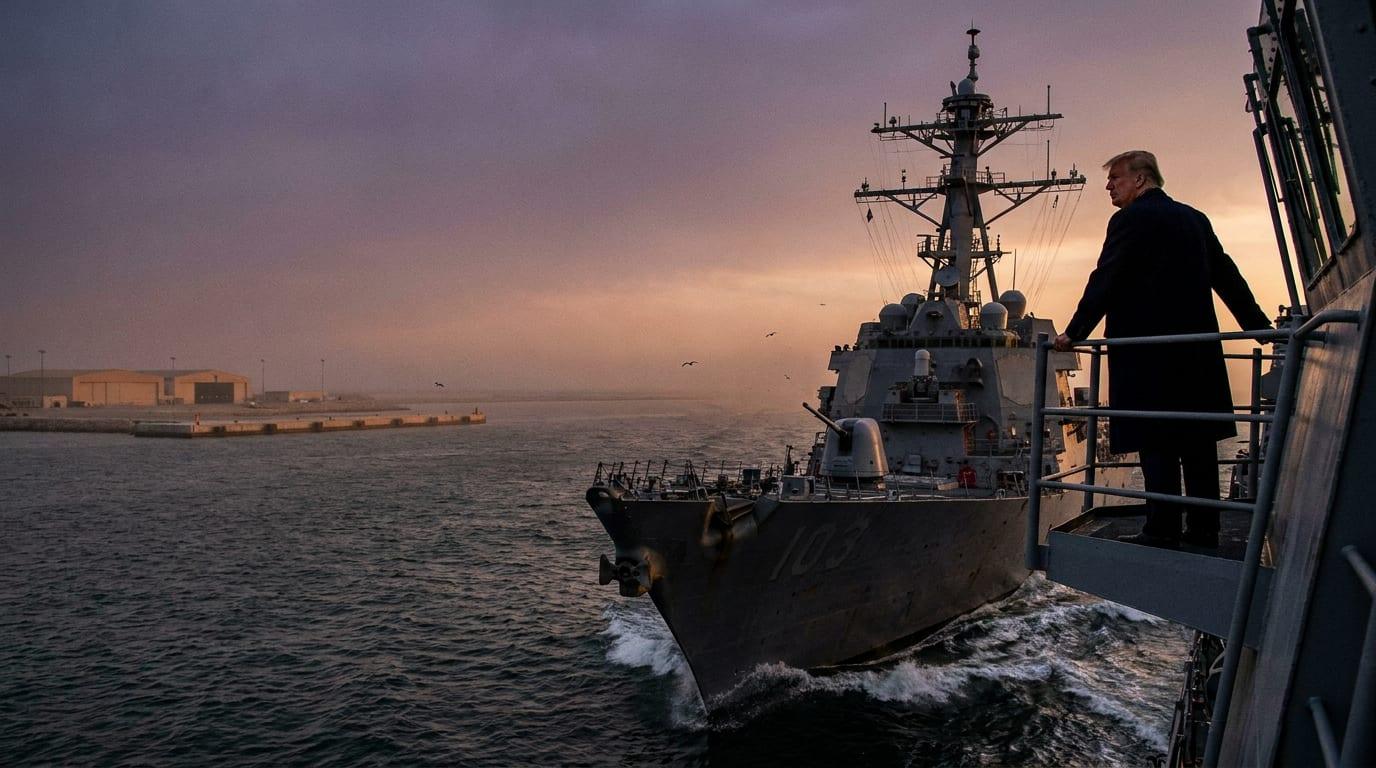
The debate over whether the United States should rebuild, downsize or abandon its bases in the Persian Gulf has moved to the forefront after a Washington Examiner op-ed claimed that Iran "blew the hell out of Bahrain" and, in the process, blew up President Trump's Gulf strategy.
The op-ed, circulated by the Examiner's official account @dcexaminer, describes a war that has forced the U.S. Navy from the Persian Gulf and ended decades of American maritime dominance around the Strait of Hormuz. According to the outlet's own summary, the decision about whether the Navy returns to the Gulf "is no longer Washington's alone to make," because Iran has acquired what the piece describes as a newfound ability to impede access to the strait and, therefore, what it calls a vote in that decision.
The article frames the choice facing U.S. officials in stark terms: rebuild the damaged facilities, reduce their size, or walk away from them entirely because of their vulnerability to Iranian missile attack. It points specifically to NSA Bahrain, a longtime hub of American naval operations, as one of the installations left exposed. Before those options can be weighed, the piece argues, Washington must first confront a difficult new reality produced by the war.
That framing did not stay confined to the opinion pages. The Democratic Senatorial Campaign Committee's account, @dscc, answered the piece by tying the Iran conflict directly to domestic costs, saying in a post that "Mike Collins supports Trump's Iran War that has skyrocketed costs for Georgia families." The DSCC's post names Collins, a Georgia Republican, and frames his support for the administration's Iran policy as a burden on households in his state. The post does not list specific prices or programs affected, nor does it offer a dollar figure for the increased costs it describes.
The exchange marks the second front in a political fight that began with the Iranian missile attacks on American positions in the Gulf. The DSCC's response shows how quickly the argument moved from a strategic question about naval access in the Middle East to a domestic pocketbook attack aimed at a single Senate candidate. The Washington Examiner's op-ed supplies the strategic predicate -- an American naval presence that, in its telling, has been pushed out of the Gulf -- while the DSCC supplies the political consequence it wants voters to see at home.
The two posts together illustrate the sequence: first, an argument that the U.S. has lost its ability to guarantee freedom of navigation through Hormuz on its own terms; second, an attempt to attach that outcome to a Republican candidate and to family budgets in Georgia. Nothing in either post disputes that American installations were struck, and nothing in either post offers an alternative plan for what should happen to the bases now.
At the center of the strategic question is the Strait of Hormuz, the narrow waterway through which a substantial share of the world's seaborne oil passes. For decades, the U.S. Navy's Fifth Fleet, headquartered in Bahrain, underwrote the free movement of commercial shipping through that chokepoint. The Examiner's op-ed asserts that the Iranian attacks changed that arrangement by demonstrating a capability to interfere with access to the strait. If that assertion holds, the practical effect would be to give Tehran leverage over any future American decision to return naval forces to the Gulf in force.
That is the logic behind the op-ed's insistence that the decision is no longer Washington's alone. A return to the Gulf would have to account for the risk that Iranian missiles could target the same facilities again. That risk, in turn, raises the question the piece poses at the outset: whether to rebuild NSA Bahrain and other damaged sites, to shrink the American footprint there, or to leave altogether. The op-ed does not endorse any of those options; it argues only that U.S. officials must confront the new conditions before choosing among them.
The political reaction captured by the DSCC's post takes a different path. Rather than debating the merits of base reconstruction or naval deployment, it treats the war itself as the issue and Collins's support for it as the liability. By naming a specific candidate and a specific state, the DSCC signals that it intends to contest the Iran policy in domestic political terms rather than in strategic ones. The post does not specify which costs have risen, by how much, or over what period, and it does not name a policy the committee would prefer instead.
The claim that Iran "blew the hell out of Bahrain" and drove the Navy from the Gulf has not been confirmed by Next News Network, and the underlying event remains a matter of assertion rather than independently verified fact. The Washington Examiner's op-ed presents it as the premise of its argument, and the DSCC's post treats it as established in the course of attacking Collins. Neither post provides documentation, casualty figures, or a timeline for the attacks it references.
What is clear from the material available is that a strategic argument and a political argument are now running on parallel tracks. The Examiner's op-ed asks whether the United States can still choose to return to the Gulf on its own terms. The DSCC asks whether voters in Georgia will hold a Republican candidate accountable for the conflict that, in its account, produced the situation. Both questions are now part of the same debate, and both will be answered in public before they are answered in policy.
Neither @dcexaminer nor @dscc has responded publicly to the other's post, and no additional statements from Collins or from the administration were included in the material reviewed.
Our Take
The Washington Examiner is right to force a conversation about what the United States does next in the Persian Gulf, but the DSCC's response shows exactly how the left will use any admission of vulnerability: not as a spur to rebuild deterrence, but as a cudgel against a Republican candidate. If Iran truly has a vote over whether the Navy returns to Hormuz, that is a failure of deterrence that should be reversed, not accepted as a new normal. The answer to vulnerable bases is not to abandon them and hand Tehran a permanent veto over the world's most important oil chokepoint; it is to restore the kind of military presence that makes an attack on American installations unthinkable. Democrats would rather talk about Georgia family budgets than about the Strait of Hormuz, because the former wins elections and the latter requires hard choices. Conservatives should make the case that a strong Gulf presence is what keeps oil flowing and prices down in the first place -- and that the road back to that position runs through a defense posture, not an apology tour.
