
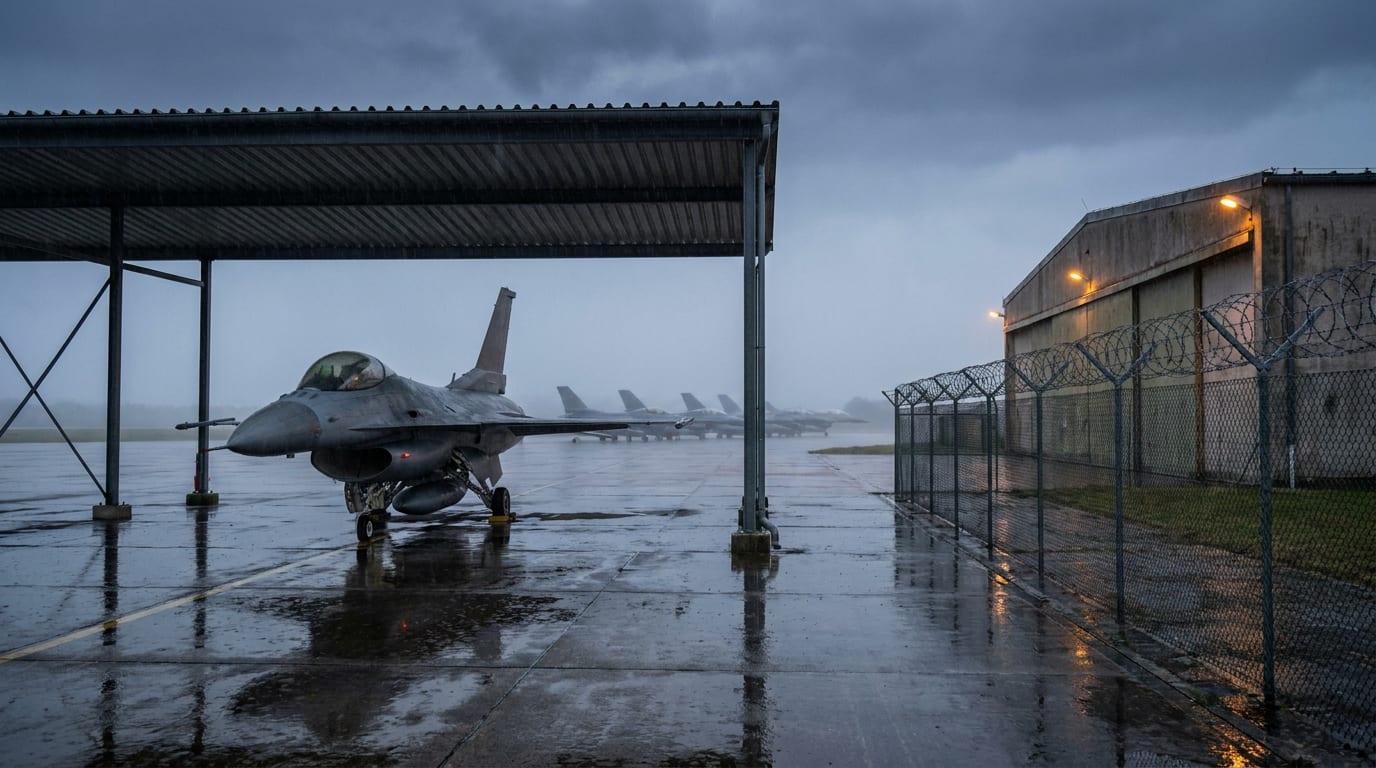
NATO's top military commander warned Monday that the alliance would destroy "anything and everything" supporting an attack on allied territory and "break" the warfighting systems of any adversary that strikes a member state.
US Air Force Gen. Alexus Grynkewich, NATO's supreme allied commander in Europe, delivered the warning at the Warsaw Security Forum in Poland, speaking on a panel titled "Theory of Victory: How Do We Achieve Military Success Against Russia in Deterrence and Defence?"
"Should the adversary choose to press the attack or commit his reserves, we will break the warfighting system engaged against us," Grynkewich said, in an apparent message directed at Moscow. "This includes not just the attacking force itself, but anything and everything that supports, sustains, and controls that force."
The commander laid out a three-pronged strategy of "blocking, blunting and breaking" enemy forces, describing an alliance that presents itself as defensive but is prepared to respond decisively if any of its thirty-two members is assaulted.
The New York Post's account, @nypost, carried the remarks to its readers with the headline "NATO warns Russia: 'We will break' forces, destroy 'anything and everything' if you attack," framing the general's language as a direct threat to the Kremlin. The @nypost post appeared on the social media platform on October 13, 2026, according to the timestamp on the item.
Grynkewich also stressed alliance unity at the event. "We stand here together in Poland today stronger than ever united in our common vision of a more balanced, more ready and more lethal alliance," he said, describing NATO as a "lethal alliance."
The warning lands amid a period of heightened friction between NATO and Moscow. European officials have accused Russia of waging a campaign of hybrid warfare that includes sabotage, arson and cyberattacks, alongside increasingly provocative military activity near NATO territory.
Those accusations have been accompanied by reported airspace incidents. In 2025, multiple Russian drones entered Polish airspace during a large-scale attack on Ukraine, prompting a response from Polish and allied aircraft. Romania has likewise reported Russian drone incursions, while Estonia has accused Russian military aircraft of violating its airspace.
Grynkewich's remarks came on the heels of a tense weekend between Russia and Ukraine, with Moscow launching fresh strikes against Ukrainian energy infrastructure despite diplomatic efforts to reduce hostilities. Ukrainian President Volodymyr Zelensky accused Russia of continuing attacks on Ukrainian energy facilities and cast doubt on prospects for a broader ceasefire.
On September 30, Russia issued a warning to NATO, according to the coverage.
The general's comments generated a wave of coverage across international outlets. Al Jazeera reported the story under the headline "NATO says will do 'anything and everything' if alliance is attacked," noting that the commander issued his warning as European officials have called for vigilance over potential Russian attacks.
Additional coverage framed the remarks in similar terms. One report carried the headline "NATO Commander Grynkewich Warns Russia Attack Would Be 'Utterly Futile.'" Another summarized the message as "NATO commander threatens to destroy 'everything' if Russia attacks," describing the alliance's top commander as prepared to destroy "anything and everything" necessary in the event of an attack.
Across those accounts, the through-line was the same: a senior NATO commander, speaking publicly in Warsaw, describing what the alliance says it would do if its territory were struck. The story traveled through the @nypost account and other outlets within hours, each carrying the general's language about breaking an adversary's warfighting system and destroying the supporting infrastructure behind it.
What remains constant across the reporting is that the claim originates with Grynkewich's remarks at the forum, and that the described scenario — an attack on NATO territory and the alliance's response — is a stated contingency, not an event that has occurred. The warnings from European officials about hybrid warfare and airspace violations are likewise claims made by those officials.
Next News Network could not independently verify the remarks or the incidents described.
Our Take
Grynkewich's language is worth reading carefully, because it is not the boilerplate of deterrence. "Blocking, blunting and breaking" is a warfighting doctrine, and the commander was explicit that it extends past the attacking force to "anything and everything that supports, sustains, and controls that force" — logistics, command nodes, the systems that keep an army moving. That is a description of what NATO would dismantle, delivered on a public stage in Poland, the country most exposed on the alliance's eastern flank. The setting was not accidental, and neither was the panel title, which asked openly how military success against Russia is achieved. For an alliance that insists it is defensive, this is the sound of a posture being advertised rather than merely maintained.
The context matters just as much as the quote. European officials are describing a campaign of sabotage, arson, cyberattacks and airspace probes — drones over Poland, incursions over Romania, Estonian airspace violations — and those are precisely the kinds of low-level provocations that sit below the threshold of Article 5 while eroding the confidence that the threshold means anything. Grynkewich's answer is to raise the cost of crossing it. Whether that deters Moscow or simply invites a more careful form of aggression is the open question, and it is the question the Warsaw forum was convened to debate.
What Americans should take from this is that the alliance is talking about warfighting systems and supporting infrastructure in the same breath as deterrence, and that the officials making these statements are the ones who would execute them. That is a significant escalation in rhetoric, even if it is calibrated. The proper response from Washington is not to cheer the toughness of the language but to insist that the strategy behind it be defined, funded and explained to the public whose sons and daughters would be asked to carry it out. Strong words are cheap. A plan for what happens the day after the first shot is not.
