
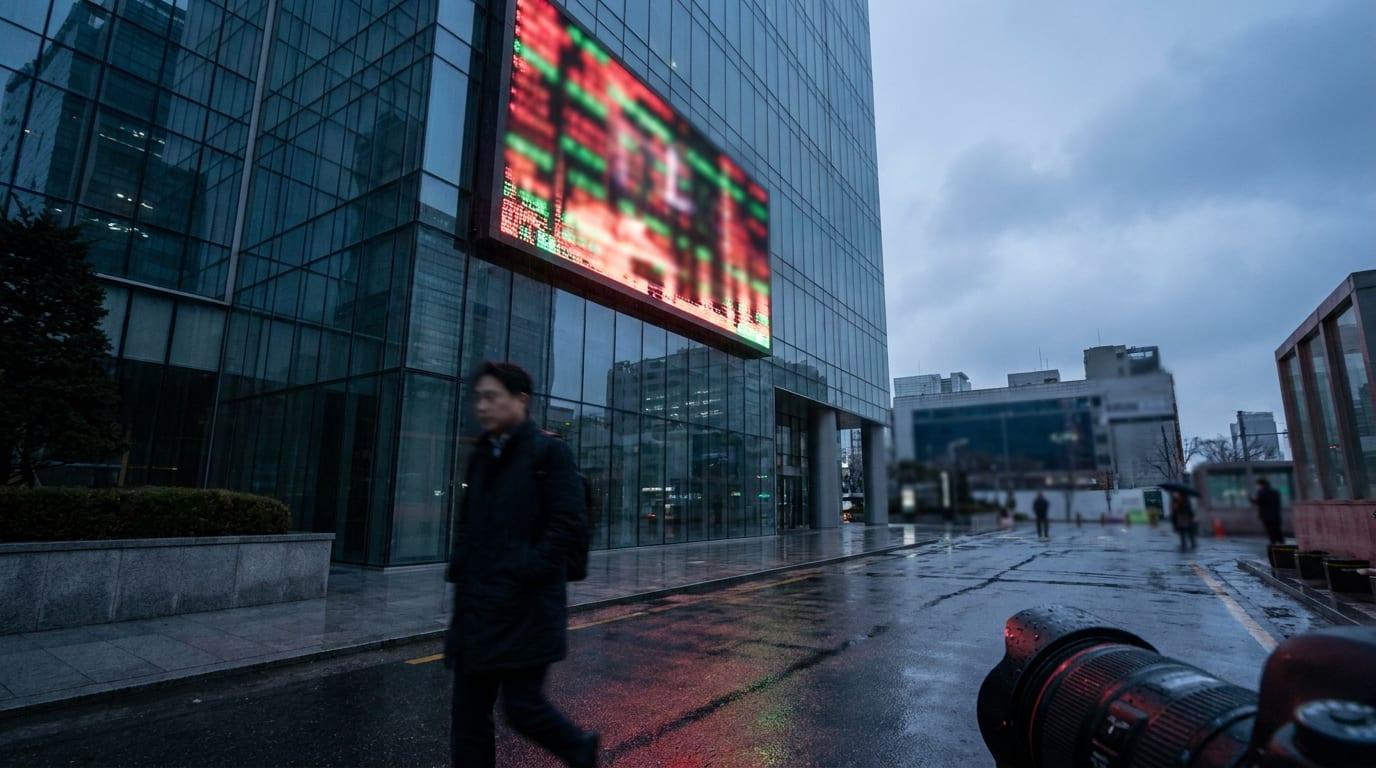
South Korea's KOSPI index fell more than seven percent Tuesday morning, dropping to 5,936.36 as foreign investors stepped up selling in semiconductor giants Samsung Electronics and SK Hynix, according to market data reported by KED Global and WSB-TV. The Korea Exchange activated a sell-side circuit breaker at 9:47 a.m. local time, the first such intervention in nearly two months, according to BigGo Finance.
The drop below the 6,000-point threshold represents a significant psychological marker for Asian markets and followed a 3.65 percent decline the prior day, when the index closed at 6,384.25, according to TradingKey. Japanese markets were closed Monday for a public holiday, leaving South Korean equities particularly exposed to the wave of selling that accelerated into Tuesday's session.
The reaction from financial commentators on social media was immediate and pointed. The account @zerohedge, a widely followed markets commentary feed, posted at 2:45 a.m. Coordinated Universal Time: "Someone remind them to shut it down," followed by the data point that the KOSPI had fallen seven percent to 5,936.36. The terse phrasing reflected a sentiment common across trading desks: that the decline had reached the kind of velocity that prompts exchange-level intervention.
Within half an hour, the account @MarioNawfal, known for aggregating international news and viral content, pivoted sharply away from Asian markets and toward South America. At 3:15 a.m. Coordinated Universal Time, the account posted about Iguazú Falls on the Argentina-Brazil border, claiming that torrential rains had sent the Iguazú River surging to more than twelve thousand cubic meters of water per second and that Argentine authorities had shut down tourist access as a result. The post described the falls as having "turned into an absolute MONSTER" and asserted the flow was "nearly nine times" normal levels.
The juxtaposition was jarring but illustrative of how financial and environmental anxiety were circulating simultaneously across the same social media channels. While @zerohedge focused narrowly on the mechanics of the Korean market decline, @MarioNawfal's post suggested that extreme weather events in South America were part of the same broader atmosphere of disruption. Neither account provided sourcing for its claims beyond the figures asserted in the posts themselves.
The Korean sell-off was not isolated. According to KED Global, the Kospi's dip below 6,000 prompted the first sell-side curb in nearly two months as foreign investors stepped up selling in Samsung Electronics and SK Hynix. The semiconductor sector has been a particular point of vulnerability for Korean equities, with both companies experiencing drops of over four percent during Monday's session, according to TradingKey.
WSB-TV reported that the Kospi's more than seven percent drop was driven specifically by a sell-off of chip shares, and that Asian shares mostly declined after U.S. stocks ended mixed. The S&P 500 futures were flat ahead of bank earnings, according to live updates from financial media, with JPMorgan, Goldman Sachs, Citigroup and Wells Fargo all slated to release their results before the open on Tuesday.
The convergence of these developments -- Korean market turmoil, U.S. bank earnings, and social media amplification of both -- created a feedback loop that financial commentators were quick to note. The @zerohedge post, while brief, captured the sense that the KOSPI's decline had entered territory where exchange mechanisms themselves were being deployed as a brake. The reference to "shut it down" was not a literal call for market closure but a wry acknowledgment that the sell-side circuit breaker had already done so temporarily.
The @MarioNawfal post about Iguazú Falls, meanwhile, carried no direct connection to the Korean market decline. It appeared in the same early-morning window but addressed an entirely different subject: the claimed swelling of the Iguazú River to more than twelve thousand cubic meters per second and the Argentine decision to close tourist access. The post asserted that this flow rate was "nearly nine times" something -- the sentence trailed off in the original post -- but the implication was that it represented a dramatic departure from normal conditions.
Neither the claim about Iguazú Falls nor the precise cause of the Korean market decline was independently verified by Next News Network. The figures cited in the social media posts and in the aggregated coverage represent what is being claimed or alleged by those sources, not what has been independently confirmed by this outlet.
The broader market context, however, is documented. The Kospi's decline below 6,400 points on Monday, its closure at 6,384.25, and its further plunge below 6,000 on Tuesday are all reported by multiple financial outlets. The activation of the sell-side circuit breaker at 9:47 a.m. is similarly reported by BigGo Finance and KED Global. The involvement of foreign investors in selling Samsung and SK Hynix is consistently cited across coverage.
What remains unclear, and what the social media posts do not establish, is the underlying cause of the selling pressure or whether the Iguazú Falls situation is connected in any way to the market movements. The @zerohedge and @MarioNawfal posts appeared in close temporal proximity but addressed separate subjects. The fact that they circulated in the same window does not establish a causal relationship.
The Korean market's trajectory will be watched closely as U.S. bank earnings are released Tuesday morning. The flat S&P 500 futures suggest that American markets were not, at least in early trading, mirroring the Korean decline. Whether the Kospi's circuit breaker halts the selling pressure or merely pauses it remains to be seen.
For now, the reaction on social media reflects a broader anxiety about market stability and environmental disruption that transcends any single index or waterfall. The accounts carrying these claims -- @zerohedge and @MarioNawfal -- are not financial regulators or official government sources. They are commentary feeds, and their posts should be read as such.
Our Take
The Korean market's seven percent plunge is a real event with real consequences, documented by multiple financial outlets and marked by the first sell-side circuit breaker in two months. That is not in dispute. What is striking is how quickly the conversation migrated from the mechanics of the decline to broader narratives of disruption. The @zerohedge post was terse and market-focused. The @MarioNawfal post was expansive and environmental. Together, they illustrate a media environment in which financial panic and natural disaster are consumed as part of the same feed, often without distinction. Conservatives should be cautious about drawing sweeping conclusions from either. The Kospi's drop is significant, but it is a market movement, not a verdict on an economy. The Iguazú Falls claim, however dramatic, is a single post from an aggregator account and remains unverified. The real story is the selling pressure on Samsung and SK Hynix, the foreign investor retreat, and what it signals about semiconductor demand. That is where attention belongs.
