
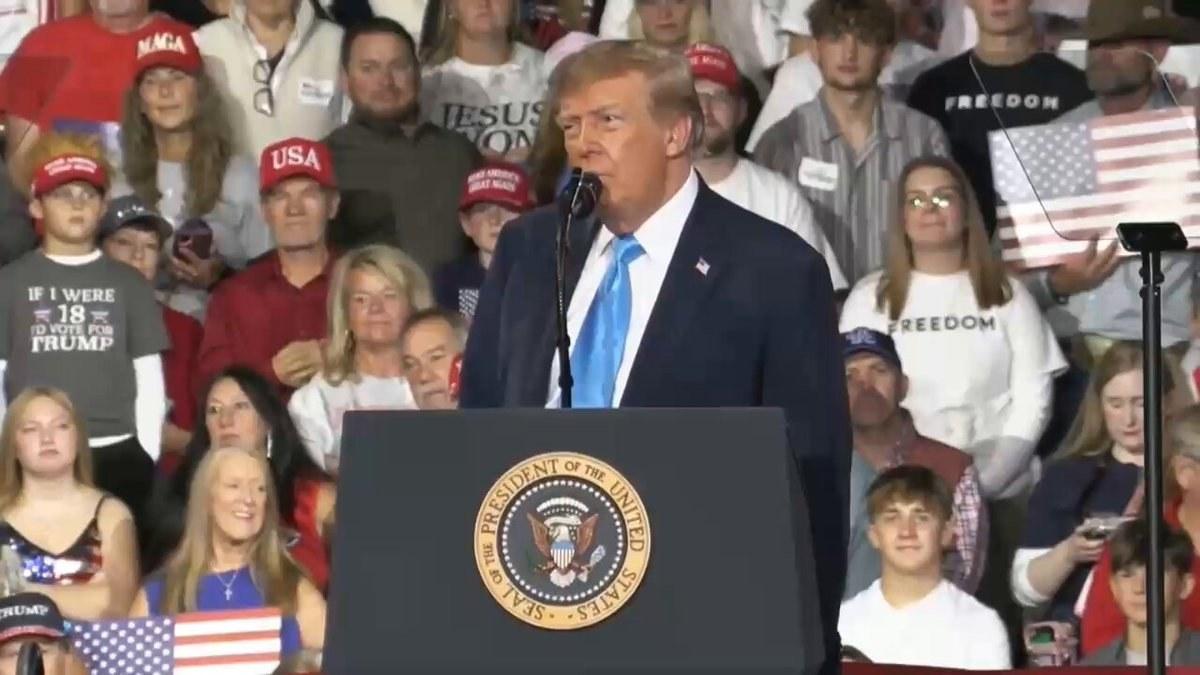
President Trump slammed radical Democrats over border security and the economy during a speech in Kentucky, telling supporters that his administration has achieved what he called the strongest border in American history.
"We inherited the worst border in American history by far and we turned it into the strongest and most secure border in the history of our country," President Trump said. "In the past 17 months, zero illegal aliens have been admitted into the United States through our southern border."
Trump Contrasts Democrat Failures on Inflation and Border
The president warned that if Democrats win in the midterms, they would repeat the failures of their last time in power.
"The last time the radical Democrats had power, they gave us the worst inflation in American history, the highest energy prices in American history, the worst trade deficit in American history," President Trump said. "They allowed 25 million people to pour across our borders from all over the world they came. It was an invasion. It was like a military invasion."
He added that his administration is still removing the worst offenders among illegal immigrants, but that "we've got most of them out of here."
Manufacturing and Jobs Announcements
President Trump touted recent investment announcements in Kentucky, including Ford's $2 billion investment in its Louisville Assembly Plant creating more than 4,000 jobs, and GE Appliances' $1 billion expansion creating 5,000 new jobs.
He also announced that if Republicans win, the Department of War will invest $80 million in the pharmaceutical company Anthea to revitalize a drug manufacturing facility in Winchester, Kentucky. "We are bringing our critical supply chains back to America," he said.
Record Employment Despite Federal Job Cuts
On the economy, President Trump highlighted record employment figures even after reducing the federal workforce by more than one million employees.
"More Americans are working today than at any time in the history of our country — and that's despite the fact that we let go of over one million federal employees," he said. "We had ten people doing one job. We need federal employees — but we don't need ten for every job."
