
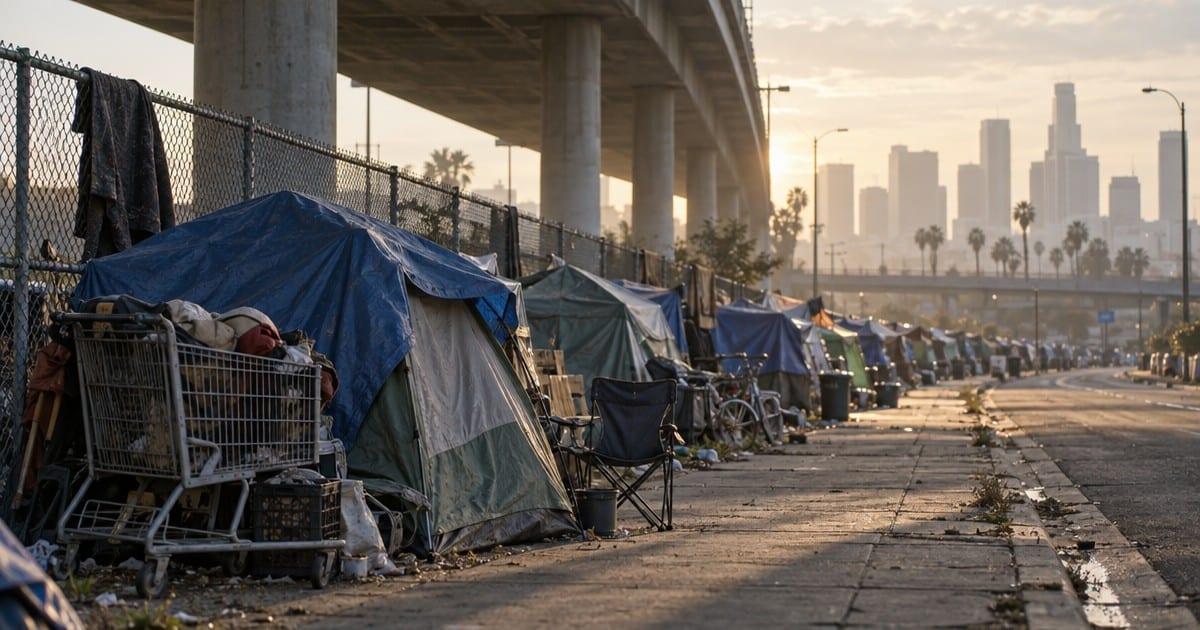
Steve Hilton, the Republican candidate for California governor, said every homeless encampment in the state will be cleared by the end of 2027, unveiling a plan at a San Diego news conference Saturday that centers on a network of what his campaign calls Homeless Recovery Centers.
The New York Post, a tabloid with 4.2 million followers, carried the pledge under the headline “California gubernatorial candidate Steve Hilton makes ambitious homelessness pledge: ‘every encampment will be cleared.’” The story was built from reporting by the California Post, which described the plan as using the Sunbreak Ranch project in San Diego County as its prototype.
According to the campaign, the centers would provide beds, meals, showers, medical care, drug treatment, psychiatric care and job training. Each person would be assigned someone responsible for helping them get into stable housing, with continued care for those who need it.
Hilton pointed to federal housing estimates that California has 181,934 homeless people, including 115,583 living without shelter, and said the state has allocated almost $24 billion to homelessness and housing in recent years even as the state auditor found it failed to consistently track spending and results.
Under the timeline Hilton described, he would meet with mayors and county leaders in his first month as governor to set public deadlines for clearing encampments, with a Labor Day 2027 deadline for local leaders and a final deadline of Dec. 31, 2027, for every encampment to be cleared. He also plans to declare a homelessness emergency to waive permitting barriers, enforce public camping bans once suitable facilities are available, and audit homelessness spending through what his campaign calls Operation Zero Waste to redirect money from failing programs. If local leaders do not act, Hilton said the state would step in.
“Leaving people to deteriorate in tents is a disgrace,” Hilton said.
KSWB-TV, the CBS affiliate in San Diego, reported that Hilton wants to use Sunbreak Ranch, which it described as a controversial homelessness solution, as the prototype for the state. The station’s coverage noted the announcement was made at a Saturday news conference in San Diego.
The pledge also traveled through regional and aggregator coverage. CommsTrader described the scene in some detail: Hilton at a podium on a bright Saturday morning in San Diego, with the ocean visible in the distance and a row of cameras in front of him, making “a declaration that cut straight through the polite language of politics.” Another headline, carried in aggregate feeds, framed the announcement simply as “Gubernatorial candidate Steve Hilton unveils plan to end homelessness by end of 2027.”
The reaction extended beyond the announcement itself. A separate report, “Steve Hilton bets California is ready for something different in the governor’s office,” described Hilton taking his campaign across the state and arguing for change in a state long dominated by Democrats — a sign the encampment plan is being read as part of a broader argument about one-party rule in Sacramento rather than as a standalone policy proposal.
Hilton’s opponent, former U.S. Secretary of Health and Human Services Xavier Becerra, did not immediately respond to a request for comment Saturday, according to the California Post. No reaction from Becerra’s campaign was included in the reporting.
The scope of the proposal is notable for a state where, by the campaign’s own figures, more than a hundred thousand people are unsheltered. The plan’s deadlines are fixed and public: local leaders would be held to Labor Day 2027, and the state would take over if they fail to act by the final deadline of Dec. 31, 2027. The enforcement mechanism Hilton described depends on facilities being available first — public camping bans would be enforced “once suitable facilities are available,” in the campaign’s phrasing — which ties the clearing timeline to the construction and operation of the recovery centers.
The spending audit piece, branded Operation Zero Waste, is aimed at redirecting money from programs the campaign characterizes as failing. The state auditor’s finding that California failed to consistently track homelessness spending and results is the factual hook the campaign is using for that argument.
Next News Network could not independently verify the claims and figures attributed to the Hilton campaign, including the federal count of 181,934 homeless people in California and the nearly $24 billion in state homelessness and housing allocations.
Our Take
For years, California’s political class has answered the state’s homelessness crisis with more money and fewer measurable results, and the state auditor’s finding that spending was not consistently tracked is the clearest admission of that failure. Hilton’s plan at least starts from an honest premise: leaving people to deteriorate in tents is a disgrace, and the public has a right to deadlines, audits and consequences when local leaders do not deliver. The details will be fought over — the cost of the recovery centers, the timeline, the role of the state in overriding local decisions — but the direction is right. Californians have watched nearly $24 billion go out the door while encampments spread, and a candidate who says the era of open-ended spending without accountability is over is speaking to something real.
