
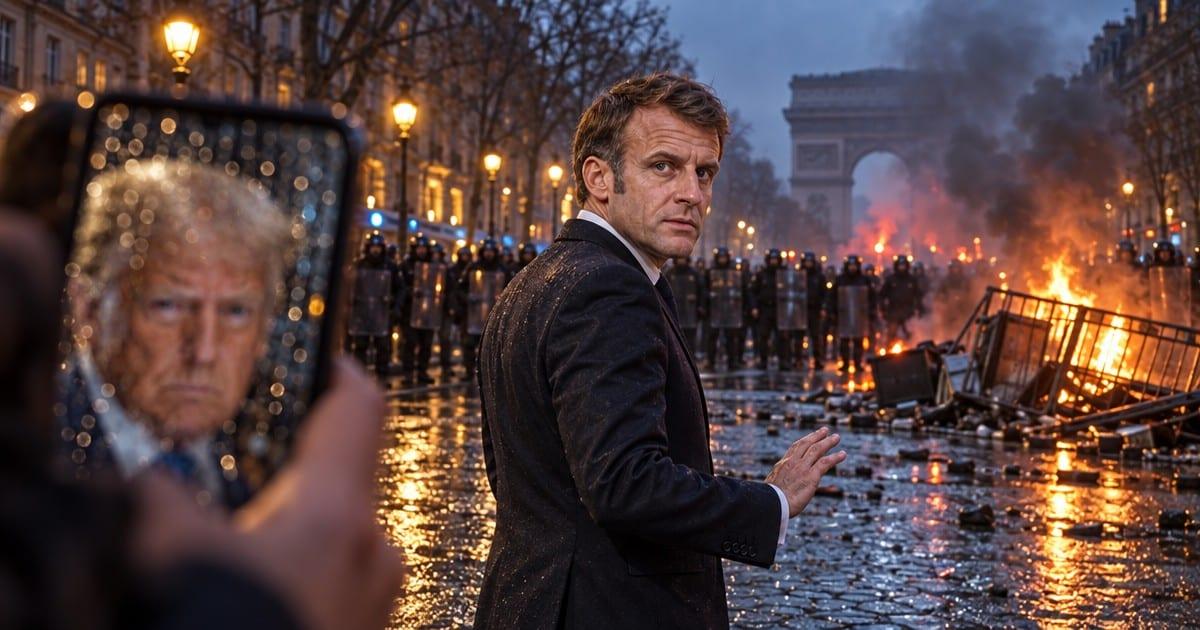
French President Emmanuel Macron said the unrest sweeping his country should not be allowed to blur the line between citizens protesting fuel prices and the looters and rioters who have hijacked the demonstrations, and he tied the price spike to a war in the Persian Gulf that France was not part of.
"We should never mix up those people," Macron said. "There's men and women who protested peacefully with looters and writers. Because there are people out there who, rightfully, feel that the price of fuel is going to higher price, which is increased because of what is up in the Persian Gulf, a war that France was not part of."
The remarks circulated widely on X. Mario Nawfal, whose account carries 3.9 million followers, posted the clip and summarized it as Macron blaming the riots on Trump, adding the line "It's because of the Iran war." Clash Report, an account with 895,000 followers, posted the same passage shortly before, framing it simply as remarks from the French president. Both accounts carried video of the same statement, and the transcripts of the two clips match.
The phrasing drew attention because it places the fuel price increase at the door of a conflict France stayed out of, while the president simultaneously defended the motives of ordinary protesters. In the passage as transcribed, Macron does not name Trump; the attribution to the American president appears in Nawfal's summary of the clip rather than in the transcript of the video itself.
Macron's comments come amid nationwide unrest that has tested his government. The Independent reported that at least two thousand people have been arrested over the protests and that Macron said the country collectively feels "anger and shame" after what it described as unprecedented violence. The Guardian, reporting on the same days of unrest, said ministers, officials and police are under pressure over the response, with the government holding crisis talks amid what it characterized as a colossal failure of the state.
Euronews reported that Macron pledged to capture all those who incited the chaos and hold them accountable for the crimes committed, and quoted Prime Minister Lecornu stressing that limited public funds cannot endlessly go toward funding the damage vandals cause. The network's headline captured the president's line that there is "no room for violence" after rioters and looters hijacked peaceful demonstrations across the country.
Coverage has also focused on who is being blamed for stoking the disorder. One day before the latest statements, reports circulated that the French government had accused the far-left of fueling the riots, which have included clashes with police, looting and arson of government buildings.
Macron's latest remarks, as carried by Nawfal and Clash Report, try to hold two ideas at once: that the anger over fuel costs is legitimate, and that the violence surrounding it is not. The president's wording concedes that the price of fuel is rising and offers an external cause, the Gulf conflict, while insisting that France took no part in that war. Whether that framing settles anything with a public facing higher pump prices, or with an opposition looking for a scapegoat, is a separate question from what the president actually said.
The sequence online followed a familiar pattern. Clash Report carried the president's words first, presenting them as a straightforward quote. Nawfal then posted the clip with a sharper frame, describing the statement as Macron blaming the riots on Trump and closing with the Iran war. From there the passage traveled as a claim about who the French president holds responsible, even though the transcript records him pointing to the Persian Gulf conflict and France's absence from it.
Next News Network could not independently verify the claim that fuel prices are rising because of the Iran war, or that the war is the cause of the French unrest.
The broader unrest has produced a mounting toll. The arrest figure of at least two thousand, reported by The Independent, spans the nationwide protests. Macron has spoken of anger and shame felt across the country, and his government has faced questions over its response as the crisis talks proceeded. The prime minister's warning about public funds reflects the cost of repairing damage from looting and arson, which has included government buildings.
For American readers, the exchange is a reminder of how quickly a foreign leader's remarks about fuel, war and protest can be repackaged for a domestic audience. The clip itself is short, the transcript is narrow, and the surrounding coverage is dominated by arrest counts, damage assessments and accusations among French officials. What Macron said is on the record. What it means for the politics of his country, and for how his words are used abroad, is still being argued.
Our Take
There is a telling gap between what Macron said and how his statement is being sold. The transcript has the French president pointing at a Gulf war his country sat out, and at the same time telling his people not to confuse the man angry about fuel prices with the man throwing a brick through a window. That is not a confession and it is not an apology; it is a leader trying to keep a lid on a country that is boiling over while refusing to take ownership of the price at the pump. The Nawfal framing, that Macron blames Trump, is an interpretation layered onto a quote that never names him, and readers should treat the summary and the transcript as two different things. What is not in dispute is the scale of the disorder: two thousand arrests, looted stores, burned government buildings, and a prime minister warning that the public purse cannot absorb the damage forever. The French president wants the world to see peaceful protesters with legitimate grievances and a war he did not join. What much of France appears to see is a government that lost control of its streets and is now looking for somewhere else to point. The fuel price is real, the anger is real, and the question of who pays for the cleanup is being answered by French taxpayers, not by Washington and not by Tehran.
