
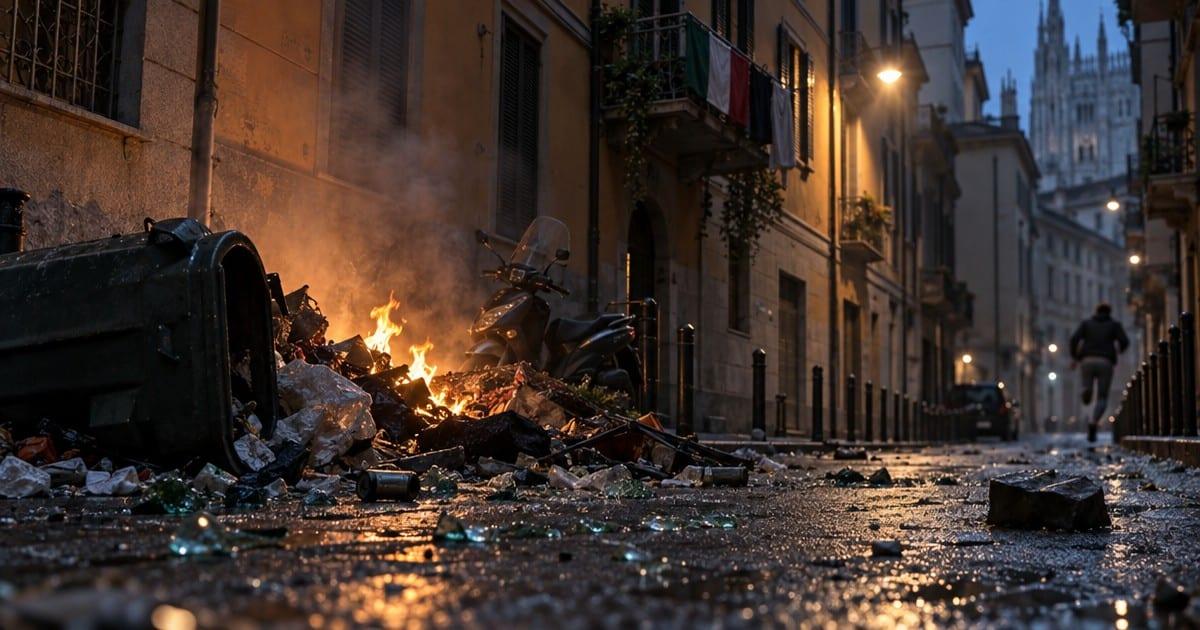
Italian Prime Minister Giorgia Meloni condemned the violence that broke out in Milan during a protest over rising living costs, saying that demonstrating is a right but that setting cities ablaze is not. The office of the prime minister issued the statement as police worked to restore order in the city's main square, where demonstrators looted shops and set barricades on fire.
One America News, the network with 2.3 million followers on X, reported the prime minister's remarks, quoting her as saying, “Demonstrating is a right. Setting our cities ablaze is” before the post cut off. The condemnation came as footage circulated of clashes between security forces and protesters in Milan and Bologna, where police deployed tear gas and water cannons after demonstrators threw stones at officers.
Visegrád 24, an account with 2.1 million followers that covers Central and Eastern European affairs, offered a different account of the unrest. In a breaking post published shortly before the prime minister's remarks circulated widely, the outlet claimed that “young second and third-generation migrants started looting stores in Milan, Italy around 2 hours ago,” and that the unrest was “inspired by France.” The outlet added that “international mainstream media isn’t showing just how bad things are in Europe.”
The claim that the violence was driven by young people of migrant background and modeled on French disturbances was not attributed to any named official, police statement or local reporting in the post. The KESQ material reviewed for this article did not include sourcing for the assertion, and no Italian authority quoted in the coverage identified the participants in those terms.
The unrest in Milan follows a wave of demonstrations across Europe over housing costs and the price of living. The Guardian reported that protests had spread to Lisbon, where hundreds gathered at a tent camp demanding action, and that Meloni said the march in Italy had been exploited by “hooligans.” AP News and ABC News both reported that rioters clashed with police, looted stores and set fires in Milan's main square during a protest against wars and rising living costs. The Times of India reported that police fired tear gas in Milan and deployed water cannons in Bologna on Saturday as demonstrations turned violent in several Italian cities, with protesters throwing stones at security forces, prompting arrests and emergency measures.
OANN's post appeared at 12:48 p.m. Eastern on October 18, and Visegrád 24's post followed within minutes, at 1:29 p.m. Eastern. The sequence shows how the Milan story moved through outlets with distinct audiences: a mainstream cable network carrying the prime minister's condemnation, and a European affairs account framing the same unrest as a migration and media coverage story.
The Milan unrest was not the only major story competing for attention that afternoon. The New York Times, with 53.9 million followers, reported at 1:31 p.m. Eastern that four soldiers were killed and dozens of others injured in an army base fire in Canada, according to Prime Minister Mark Carney. CNN, with 61.8 million followers, carried the same account at 1:13 p.m. Eastern, reporting that four service members were killed and dozens injured after a fire Saturday at a military base in Alberta.
The Washington Times, with 490,000 followers, reported at 12:45 p.m. Eastern that President Donald Trump endorsed embattled Israeli Prime Minister Benjamin Netanyahu for reelection. First Squawk, an account with 567,000 followers, reported at 1:21 p.m. Eastern that Lebanese Deputy Prime Minister Tarek Mitri said Washington had not yet exerted enough pressure on Israel to fulfill its obligations.
Taken together, the posts trace a news cycle in which European domestic unrest, a deadly fire at a Canadian military installation, American electoral intervention in Israel and Lebanese diplomatic complaints all surfaced within roughly an hour of one another. The Milan story, carried first by OANN with the prime minister's words and then by Visegrád 24 with a claim about who was responsible, became the vehicle for a broader argument about European stability and media coverage.
Meloni's statement, as relayed by OANN, drew a line between the right to protest and the destruction of property. The prime minister did not, in the portion of her remarks carried by the network, address the question of who participated in the looting or what motivated it. Italian police have not issued a public accounting of arrests by nationality or background in the material reviewed.
The Guardian's reporting placed the Milan march in the context of a continent-wide squeeze on housing and living costs, noting that the Lisbon tent camp and the Italian demonstrations shared demands for government action. That framing differs from the Visegrád 24 post, which presented the looting as a migration-driven phenomenon and criticized mainstream outlets for underreporting it.
Next News Network could not independently verify the claim that young second- and third-generation migrants were responsible for the looting in Milan, or that the unrest was inspired by events in France.
The competing accounts leave readers with a documented set of facts—a protest over living costs, looting and fires in Milan's main square, police action in Milan and Bologna, and a prime minister's condemnation—and a contested set of claims about who was involved and why. The coverage reviewed for this article confirms the unrest and the official response; it does not confirm the characterization of the participants advanced by Visegrád 24.
Our Take
The Milan riots are a warning. When the cost of living climbs and governments fail to respond, streets become tinder, and the people who pay the price are the shopkeepers and residents who had nothing to do with the policies that produced the squeeze. Meloni is right to draw a hard line: protest is a right, arson and looting are crimes, and the distinction matters.
What conservatives should notice is the pattern. Visegrád 24's claim that the unrest was inspired by France and driven by young people of migrant background fits a narrative that European capitals have spent years avoiding, and the outlet is correct that much of the mainstream press has been slow to describe the scale of what is happening on the continent. But a claim is not a confirmation, and the responsible thing is to report what is known—fires, looting, arrests, a prime minister's condemnation—while pressing Italian authorities to tell the public who was actually in the square. The public deserves answers, not spin from either direction.
