
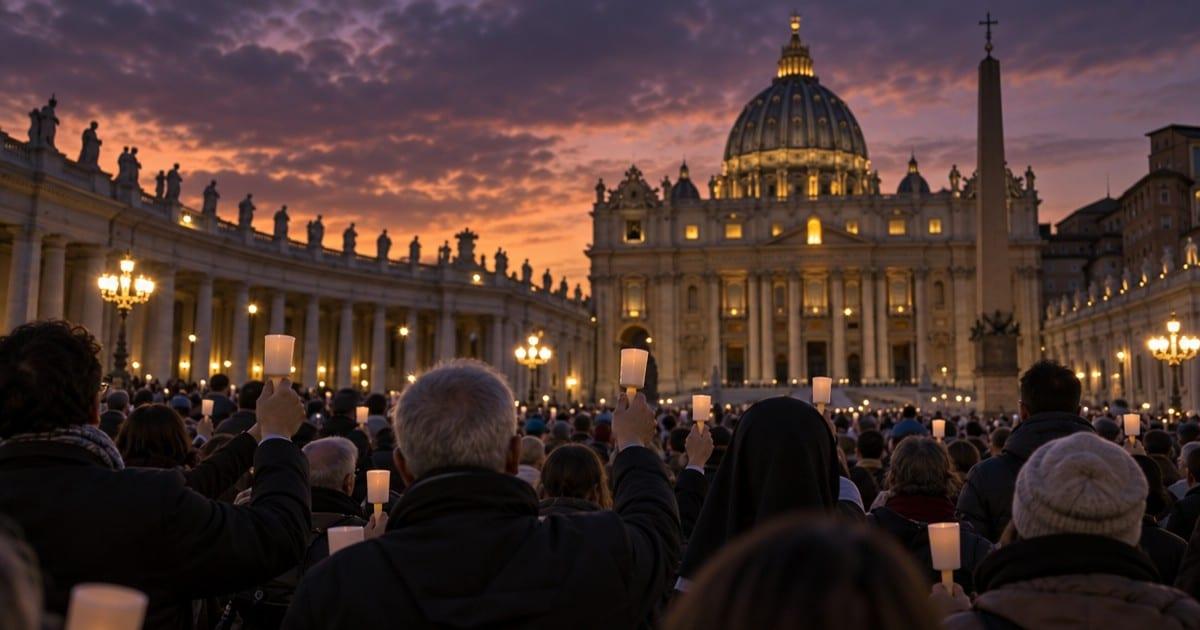
Pope Leo XIV greeted crowds at the Vatican on Sunday in his first public event since undergoing surgery for lung cancer, appearing at the same spot in St. Peter's Square where he had earlier announced he was going in for an operation.
Reuters reported the pontiff's appearance, and coverage of the event spread quickly across international outlets. The New York Times reported that Leo had been treated for lung cancer at Gemelli Hospital in Rome, and CNN described the Sunday prayers as his first major public appearance since the surgery. The Mirror reported that tourists from the United States and around the world had arrived in St. Peter's Square to hear the Pope for the first time since his operation, following a diagnosis of adenocarcinoma. CBS News reported that Leo thanked thousands of faithful gathered in the square and said he would "gradually resume my activities."
According to CBS News, the pontiff's remarks came one day after he was discharged from the hospital. The Mirror's account placed the crowd in the square ahead of the appearance, describing visitors who had traveled internationally for the moment.
The sequence of events, as carried in the coverage, ran from the announcement of the operation, to the treatment at Gemelli Hospital, to his discharge, to Sunday's appearance before the crowds. CNN noted that the spot where he appeared was the same location where he had announced he was going in for the operation, a detail that framed the return as a deliberate bookend to the hospital stay.
The scale of the reaction is best measured by the range of outlets that carried the story within hours. Reuters, with its tens of millions of followers, moved the initial line. The New York Times, CBS News and CNN each followed with their own reporting on the Pope's condition and his remarks. The Mirror focused on the crowds in the square and the international travelers among them, and Devdiscourse carried the Reuters account for its readers. The result was a single event reported simultaneously to audiences across the United States, the United Kingdom and international wires, each emphasizing a different element: the medical history, the pontiff's own words, the composition of the crowd, or the symbolic location.
What the Pope said, as reported by CBS News, was brief and forward-looking. He thanked the faithful gathered in St. Peter's Square and indicated that he would resume his activities gradually rather than immediately. The phrasing suggested a continued period of recovery even as he returned to public view. The Mirror's reporting on the crowd described tourists from the United States and other countries arriving to hear him, an indication that the appearance had drawn pilgrims and visitors rather than only local Romans.
The medical background, as reported by the New York Times, is that Leo was treated for lung cancer at Gemelli Hospital in Rome. The Mirror's account identified the diagnosis as adenocarcinoma. The coverage does not describe the details of the surgery itself, and the Pope's public remarks, as carried by CBS News, did not address clinical specifics.
Next News Network could not independently verify the claims surrounding the Pope's medical condition and his appearance.
The story's reach extended beyond the traditional outlets. Social media users and commentators picked up the Reuters line and the accompanying coverage, and the event became a subject of discussion well outside the usual circles of Vatican reporting. The accounts carrying it spanned wire services, legacy newspapers, broadcast networks and international digital outlets, a distribution pattern that put the same set of claims before several distinct audiences on the same day. Where those audiences differed was in emphasis: some led with the Pope's own statement about resuming his activities, others with the hospital and the diagnosis, and still others with the scene in the square itself.
For readers following the story, the practical takeaway from the coverage is that the Pope has returned to public view after treatment and has said he will resume his activities gradually. The coverage attributes the medical details to reporting by the New York Times and the Mirror and the Pope's remarks to CBS News. The event drew crowds to St. Peter's Square, according to the Mirror's account, and the location carried symbolic weight, according to CNN, because it was where the operation had been announced.
Our Take
The remarkable thing about Sunday's scene is not that a pope appeared before a crowd. It is that the same basic set of facts produced two entirely different stories depending on which outlet a reader happened to open. The wire services gave the event a single sentence; the networks gave it the Pope's own words; the tabloids gave it the travelers in the square; and the international aggregators gave it a headline and a link. That fragmentation is the story beneath the story. A pontiff recovering from lung cancer surgery, telling the faithful he will resume his duties gradually, ought to be a moment of shared attention. Instead it arrived as a dozen slightly different versions of the same afternoon, each shaped by the priorities of the outlet carrying it.
There is also a lesson in what the coverage did not do. It did not manufacture a controversy, and it did not pretend the Pope's health was a political battleground. It reported what was known, quoted what was said, and left the clinical details to the outlets that had them. That is how a story about a man and a crowd should be handled. The public can follow it without being told what to feel about it, and the faithful who traveled to the square can be trusted to know why they came.
