
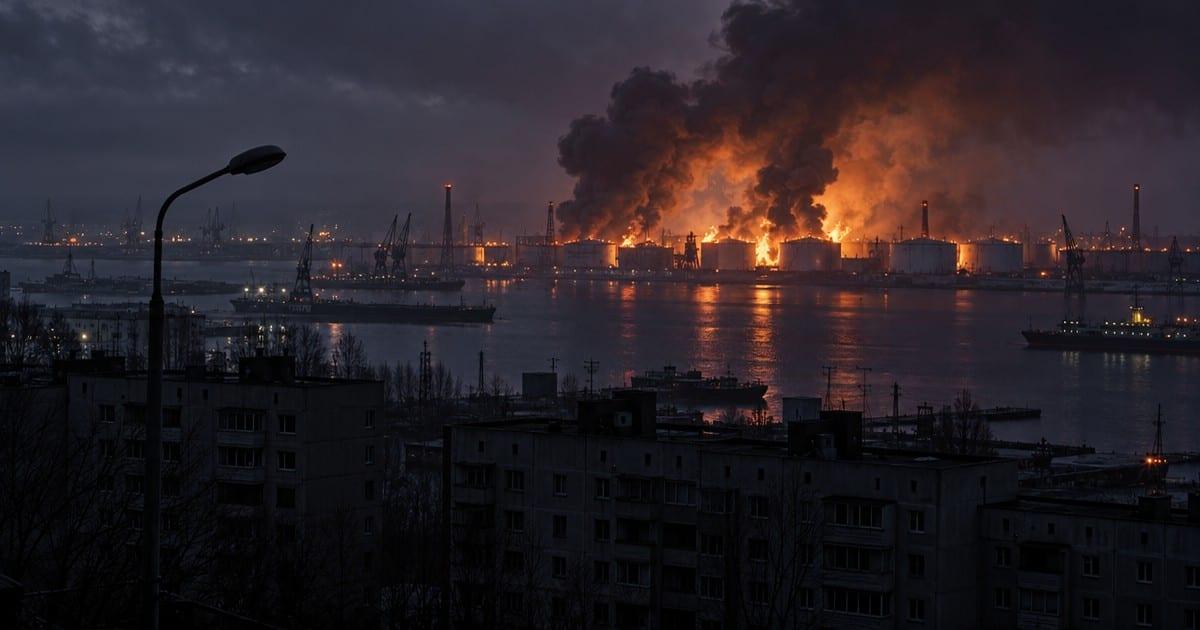
Ukrainian drones struck Saint Petersburg overnight, hitting Russia's largest Baltic oil terminal, a VK data center and a power substation, according to claims carried by First Squawk, a news account with 567,000 followers on X.
The same account reported that the strikes sparked fires at the Petersburg Oil Terminal and cut power to twenty thousand people. A separate post from First Squawk described a major fire at an Ozon logistics hub in Saint Petersburg following the overnight drone attack, saying the seventy-nine-thousand-square-meter facility on Sofiyskaya Street in the Kolpinsky district was hit and that officials reported no casualties.
The claims spread quickly across social media and were picked up by outlets including UNITED24 Media, which reported that Ukraine launched a long-range drone attack on Russia's Petersburg Oil Terminal, a key export facility, causing a fire and impacting energy infrastructure. Archynewsy reported a massive drone attack striking an oil terminal and warehouse in flames, describing a Ukrainian drone offensive against Russian infrastructure in St. Petersburg, the Leningrad region and remote Western Siberia. RT Russia & Former Soviet Union reported that a blaze broke out at an oil terminal in St. Petersburg as a result of a major Ukrainian drone attack on the city, citing the local governor.
St. Petersburg Governor Alexander Beglov confirmed the attack, according to the coverage, reporting fires at the St. Petersburg Oil Terminal, the Ruchyi oil depot and industrial warehouses in the Kolpinsky district.
The reports come amid ongoing hostilities between Russia and Ukraine, now in their fourth year, in which both sides have increasingly relied on long-range drone strikes against infrastructure targets. Ukraine has sought to bring the war to Russian territory, targeting energy facilities and logistics hubs, while Russia has continued strikes on Ukrainian industrial and military targets. TASS reported one day earlier that Russian forces hammered Ukrainian metallurgical enterprises in an overnight strike, saying the facilities were used for the needs of Ukraine's military-industrial sector and the Ukrainian army.
First Squawk's posts, which circulated in the early morning hours, presented the claims as fact, describing the strikes and their consequences in sequence. The account first reported the strikes hitting the oil terminal, the VK data center and a power substation, then followed with details about fires and power outages affecting twenty thousand people, and separately described the fire at the Ozon logistics hub.
UNITED24 Media, a Ukrainian state-backed outlet, framed the attack as a significant blow to Russia's energy infrastructure, calling the Petersburg Oil Terminal a key export facility. Archynewsy described the strikes as a "massive drone attack" and reported fires at multiple locations.
RT's coverage, citing Governor Beglov, confirmed a blaze at the oil terminal but provided no further details on the extent of the damage or the number of casualties.
The Ozon logistics hub fire was reported by First Squawk as having caused no casualties, though the extent of damage to the facility was not specified. The seventy-nine-thousand-square-meter facility on Sofiyskaya Street in the Kolpinsky district is one of the largest logistics hubs in the region.
The VK data center, operated by VKontakte, Russia's largest social media platform, was also reportedly struck, though the extent of any damage or service disruption was not detailed in the reports.
The reported strike on the power substation, which First Squawk said cut power to twenty thousand people, would mark one of the more significant disruptions to civilian infrastructure in the St. Petersburg area since the conflict began.
Next News Network could not independently verify the claims, including the reported targets, the extent of the damage, the number of people affected by power outages, or the official confirmation attributed to Governor Beglov.
The reports of the attack follow a pattern of increasing Ukrainian drone activity deep inside Russian territory, though the scale and success of such operations remain difficult to confirm independently from the battlefield.
Our Take
The mainstream media will treat these reports with the usual skepticism when they come from Russian officials but will amplify them without question when the sourcing is a Ukrainian outlet or an anonymous news account on X. Notice what is missing from most of the coverage: any independent confirmation of what was actually hit, what was damaged, or whether the stated targets were military, industrial or civilian in nature. The American people deserve better than a steady diet of unverified claims dressed up as reporting, especially when those claims are being used to justify continued blank-check funding for a war that has no clear end and no clear strategy. If the strikes happened as described, that is a significant escalation. If they did not, the reporting is irresponsible. Either way, the public should demand verification before the narrative hardens, and should ask why the same outlets that spent years chasing down every detail of a domestic political story suddenly lose their fact-checking instincts when the story involves a foreign conflict they have decided to support.
