
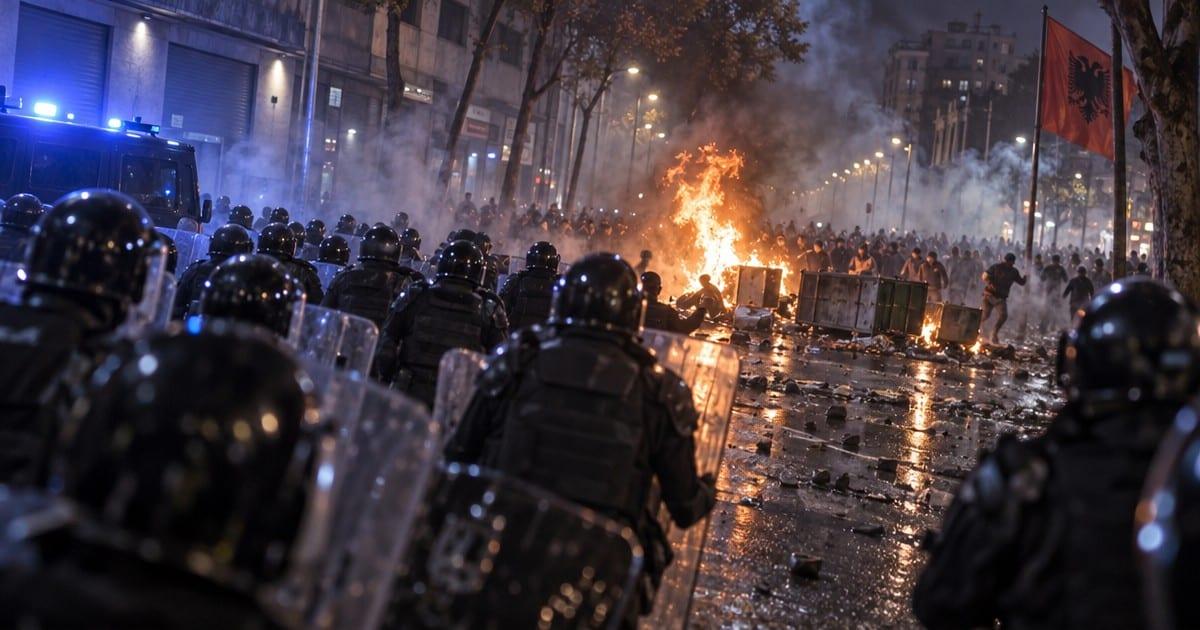
Violent clashes between police and protesters have rocked Albania's capital, Tirana, as student-led demonstrations against the government of Prime Minister Edi Rama continued into a sixth day, according to Reuters. The unrest has drawn international attention, with footage circulating online that appears to show a police officer engulfed in flames during the chaos.
Reuters reported that the demonstrations, driven by students upset over living and educational costs, have escalated into running battles with security forces. Al Jazeera reported that police have cracked down on hundreds of protesters, deploying rubber bullets, water cannons, and tear gas to disperse crowds in the capital. Balkan Insight described a chaotic weekend of street unrest in which thousands joined the protests and clashes resulted in injuries and arrests.
The protests have centered on demands for Prime Minister Edi Rama to step down, with grievances extending beyond university conditions and tuition fees to broader allegations of corruption and economic mismanagement. According to the South China Morning Post, protesters are calling for action over poor university conditions, high tuition fees, and corruption.
In video circulated by Reuters, one protester described the deepening frustration behind the movement, saying through a translation from Albanian: "I can feel it every day. I think that they're not relenting, so I think it's going to get even worse. The riots and the civil disobedience." The protester added, "The only time that we will stop will be when Prime Minister Adirama resigns, because the state has gone completely downhill."
The speaker went on to criticize the country's political establishment broadly, stating through translation, "But all of the politicians from both parties, the main parties should be gone, basically. This is what the new generation wants." The remarks underscore the generational character of the demonstrations, which have been led largely by students demanding systemic change rather than incremental reform.
Prime Minister Rama has refused to resign, according to the South China Morning Post, and has instead sought to portray the protests as the product of outside agitation. The New York Times reported that Rama denounced the violent protests, saying students upset by living and educational costs were being used by "outside forces." The allegation has not been substantiated in the reporting reviewed.
The unrest has spread rapidly across social media, with users sharing dramatic footage and first-hand accounts from the capital. Mario Nawfal, an account with 3.9 million followers on X, posted that protests had "spiraled out of control in Albania," stating that "one police officer" was seen "engulfed in FLAMES during anti-government chaos in the capital." Nawfal described the unrest as "part of a growing movement demanding Prime Minister Edi Rama's resignation over corruption allegations, rising living" costs.
The image of an officer on fire, if accurate, would mark a significant escalation in the violence. Balkan Insight reported that clashes over the weekend resulted in more injuries and arrests, though specific figures were not provided in the coverage reviewed.
The protests in Albania are unfolding against a backdrop of broader political turmoil across Europe and the Middle East. In Israel, Reuters reported that Palestinian leaders are urging the Arab minority community to vote in large numbers in next week's election, seeking to unseat Prime Minister Benjamin Netanyahu and topple what the outlet described as the most right-wing government in the country's history. President Trump, meanwhile, issued a strong endorsement of Netanyahu just nine days before the election, praising him as a "Great Warrior Prime Minister" and suggesting that U.S. military cooperation against Iran might cease depending on the outcome, according to The Washington Times.
In Spain, Prime Minister Pedro Sanchez's government is under pressure from the European Union and an increasingly frustrated populace to address the Ceuta migrant crisis, with a snap election scheduled for November 29. Reuters reported that Madrid is working on shortcuts for asylum applications with the intention of sending migrants elsewhere.
The convergence of these flashpoints — student-led unrest in the Balkans, election-year maneuvering in Israel, and migration pressures in Spain — reflects a continent-wide season of political volatility. In Albania, the sixth consecutive day of protests suggests no immediate resolution, with both the government and demonstrators digging in.
Next News Network could not independently verify the claims circulating on social media regarding the officer engulfed in flames or the specific circumstances of the clashes in Tirana.
What is clear from the reporting is that the demonstrations have grown beyond their initial focus on university conditions. The speaker in the Reuters video framed the movement as a rejection of the entire political class, saying through translation that "all of the politicians from both parties" should be gone. Whether that sentiment translates into sustained pressure on Rama's government remains to be seen, but the weekend's violence indicates that the stakes are rising.
Our Take
The scenes out of Tirana are a familiar warning sign. When a generation raised on promises of European integration and economic opportunity finds itself priced out of education and shut out of power, the result is not a polite petition — it is a street fight. Prime Minister Edi Rama's attempt to blame "outside forces" for the unrest is the oldest play in the establishment playbook: when you cannot defend your record, impugn the motives of your critics. But the protesters' grievances — corruption, crumbling universities, skyrocketing costs — are not imported. They are homegrown, and they are legitimate.
The reported image of a police officer engulfed in flames is disturbing, and if confirmed, it represents a dangerous turn that no cause can justify. Violence against law enforcement erodes the moral high ground and hands the government the pretext it needs to crack down harder. The students leading this movement would do well to keep their demonstrations peaceful and their demands focused. The moment they lose that discipline, Rama wins the narrative.
What the Albanian people are watching is a test of whether their institutions can respond to peaceful grievance before it turns violent. The answer so far is no. The government's refusal to engage with the substance of the complaints — and its preference for rubber bullets and tear gas over dialogue — suggests a leadership that has run out of ideas and is running on force. That is not a sustainable model, and the young people of Albania are making that clear.
The unrest in Tirana also deserves attention from American policymakers who have treated the Balkans as a settled question. Albania is a NATO ally, and instability there is not a distant concern. The same frustration driving students into the streets — corruption, stagnant opportunity, a political class that cycles power between the same hands — is the kind of grievance that hostile actors exploit. Rama would be wise to address it honestly. His opponents would be wise to keep their movement peaceful. And Washington would be wise to pay attention.
