
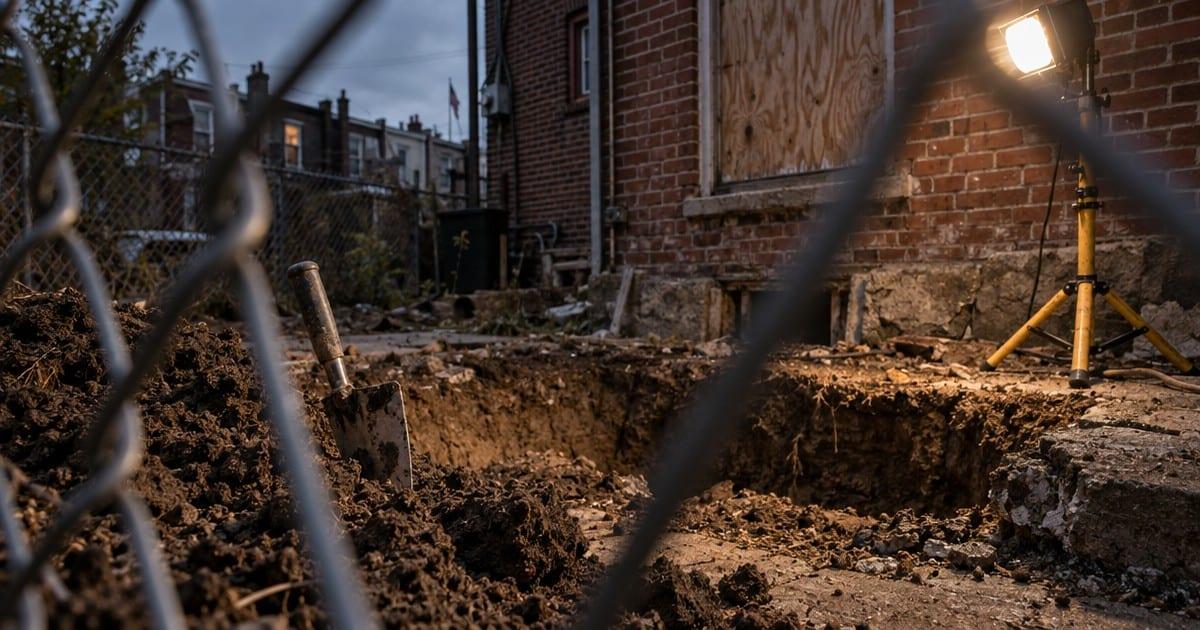
Investigators searching a dilapidated brick home in Philadelphia's Olney section reportedly unearthed a hidden safe and bones, evidence tied to a case involving seven missing or unidentified women. The New York Post, an outlet with 4.2 million followers, carried the report early Monday under the headline "Hidden safe, bones found buried at Philly house of horrors tied to 7 missing women," citing NBC10 in Philadelphia.
According to that reporting, Philadelphia police and the FBI found the safe while removing walls and floors inside the home. Law enforcement sources told the local station it was not immediately clear what the safe contained. Teams also recovered bones from the backyard on Thursday, prompting the Philadelphia Medical Examiner's Office to be called in. Officials are still working to determine whether the bones belong to a human or an animal.
The property is connected to Raymond "R.C." Horsch, described in the reporting as a pornographer and convicted meth producer, and to his son, Eugene. R.C. Horsch died last year and is believed to be one of five urns investigators pulled from the home, according to the Post's account.
Joseph Giacalone, a retired NYPD sergeant who is not involved in the case, told NBC10 that investigators appeared to be treating the backyard as a forensic site rather than a simple excavation. "Right now, it looks like soil samples," Giacalone said. "We saw them going in and taking some samples. And what they'll do is, they'll do it in different places, and they'll do it at different depths to see if there's any chemicals in there."
The search follows Horsch's arrest in June. The reporting states that investigators made multiple other disturbing discoveries at the home, including alleged snuff movies featuring R.C. and several missing women, vats of mysterious chemicals, and writings referencing serial killers. One alleged snuff movie reportedly showed a woman being strangled by R.C., who is described as an erotic photographer believed to have lured vulnerable female drug addicts to his home.
Cops revealed they found images and video of two women — Maribel Frieses, who was last seen in 2018, and Gabrielle Amarando, last seen in 2012 — that appeared to show them deceased, according to the reporting. Blair Tonzelli, who vanished in 2023, and Amy McHale, Horsch's ex-wife who was last seen in 2016, have also been named by authorities.
The story has moved quickly through conservative and crime-focused outlets since the Post's report. The New York Post's account, which carries 4.2 million followers, put the discovery in front of a national audience Monday morning, framing the case around the seven women and the search of the property rather than the legal proceedings that produced it. The Post's report is built on the NBC10 reporting and law enforcement sourcing, and it presents the findings — the safe, the bones, the alleged recordings, the urns — as what investigators have recovered and what sources have described, not as charges proven in court.
That distinction matters as the story travels. Nothing in the reporting establishes that the bones are human, what the safe holds, or how the recovered material connects to any individual woman. The seven women are described as missing or unidentified and linked to the property by detectives, not confirmed as victims of a specific act. The alleged recordings are described as alleged throughout the Post's account and have not been independently authenticated in the reporting carried so far.
Next News Network could not independently verify the claims reported by the New York Post and NBC10, including the discovery of the safe and bones, the contents of the recordings described, or the connection between the property and the seven women.
The case has drawn attention because of the scale of what investigators say they are finding inside a single rowhouse — a structure the Post describes as dilapidated, with walls and floors being pulled apart room by room — and because of the timeline. The women named span more than a decade, from Amarando's disappearance in 2012 to Tonzelli's in 2023. McHale, the ex-wife, was last seen in 2016. Frieses was last seen in 2018. Authorities have not said publicly how they believe each woman is connected to the home.
For readers following the case, the reporting so far establishes a search, a set of forensic recoveries, and a roster of names authorities have released. It does not yet establish what the recovered evidence shows. The medical examiner's involvement in the backyard recovery indicates the bones are being treated as potentially relevant, but the determination of whether they are human or animal is still pending, and the outcome of that determination will shape what the case becomes.
The New York Post's report is the account driving the coverage. As further outlets pick it up, the claims will travel further than the sourcing behind them, which is why the distinction between what investigators say they found and what has been established remains the central question in the story.
Our Take
Seven women are missing or unidentified, and the men at the center of this case are dead or charged — meaning the accountability the public is waiting for will have to come from a forensic file and a courtroom, not from a confrontation. The reporting describes walls pulled apart, floors removed, soil sampled at different depths, urns pulled from a house where a man allegedly filmed women being strangled. That is not a story about a raid. It is a story about whether a decade of disappearances was ever going to be taken seriously by anyone before a search warrant forced the question. The outlets carrying this story are doing what the local station did first: reporting what sources say was found. Conservatives should insist on the same standard here that they rightly demand elsewhere — that allegations are proven, that the dead are not convicted by headline, and that every one of these seven women gets a name, a file, and an answer. If the evidence is what the reporting suggests, the failure is not that the story spread too fast. It is that it took this long to start.
