
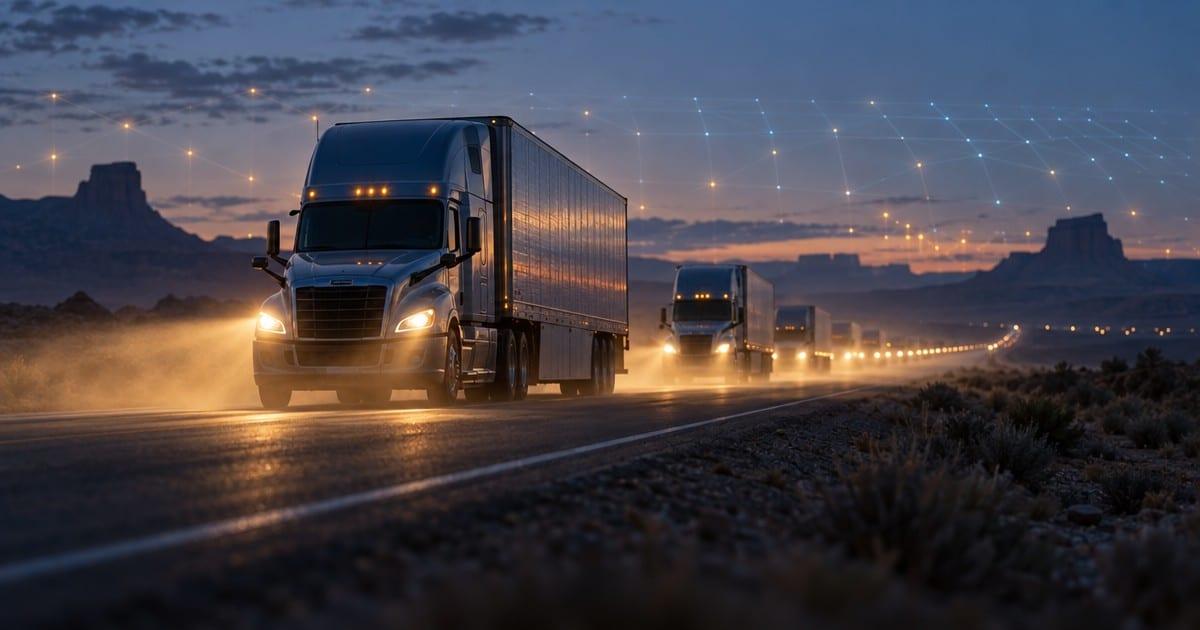
Bot Auto, an autonomous trucking company, is claiming rapid growth in its driverless Class 8 trucking operations and detailing the safety engineering behind its fleet, according to interviews with the company's president and chief operating officer published by FreightWaves.
Brett Suma, President and COO of Bot Auto, told FreightWaves that the company scaled from roughly 350 loads a month with revenue up 270 percent between May and August, and he pointed to customer-aware execution as the primary driver.
"I think there's an element of being like, you know, a customer aware, I think is probably like the number one thing that we have to have something to offer of competitive substance and so we have to deliver capacity, we have to commit and be able to execute," Suma said in the interview. "And so those are the types of things that in order for autonomy to scale, I think are wildly important."
Suma described the company's approach as focused on the economics of trucking rather than promotion. "We don't do a lot of demos. We don't bring our truck to a lot of shows. We don't, you know, we don't do a lot of, you know, promotional videos instead we truck and we pick our customers goods up and deliver them," he said.
He recounted a recent demonstration in which the truck itself performed the work. "We did a demo recently for some people and the demo was our truck. They got to come and see the truck at our yard and then the truck left with nobody in it to go deliver a load," Suma said. "And so that was a really great demo for me instead of doing like a ride along or just having the truck sitting at a show someplace."
Suma framed the company's fleet as a limited, heavily committed resource. "From my perspective, our trucks, you know, limited in fleet and heavy and customer commitments. And so in order to meet our customer commitments and our trucks have to work," he said.
In a separate segment, Suma described the artificial intelligence architecture underpinning the company's autonomous driving system, which he said is built around a foundation model applied to a world model.
"Recognize that we have to build the world's safest driver and we believe that we do and it's built in our foundation model and applying that to our world model," Suma said. "And so from a safety perspective, we run 100 million miles of simulation a day, which is an crazy amount of simulation to do. We encounter things in our simulation that we would never encounter in real life and then we solve for those things and deploy those into our software."
Suma said simulation alone is not enough, and described redundant hardware systems designed to keep the truck controllable if a component fails. He used steering as his example.
"We have a redundant steering system and so it allows us to control the truck if there was something to happen to the primary steering system. If there was something to happen to our redundant steering system, we would still have an emergency pullover steering capability," he said. "So it's all about building what we would refer to as like what are our outs in the situation when it comes to if there was a mechanical issue on the truck or if there was, you know, a controller or something that went out."
FreightWaves, a freight and logistics news outlet with 53,000 followers on X, carried both segments. The outlet also published a separate report, "Bot Auto's Secret to an Affordable Future," describing how the company's foundational model and advanced software, developed by what it called an AI-first team, cut costs.
The segments together present a company arguing that its growth is a function of execution discipline rather than marketing, and that its safety case rests on enormous simulation volume plus physical redundancy in steering and control systems. Suma's comments cast the autonomous tractor as a high-value asset that must be reserved for high-value work.
"There's just a real understanding of, you know, asset utilization and how to what we would refer to our autonomous tractors as high value assets. And so because they're high value assets, we can't have them do low value work," he said. "And so we don't do a lot of low value work with our high value assets. And so it's just a focus on the actual economics of trucking."
The company's claims about revenue growth, load volume, simulation mileage and safety performance are as the company describes them. Next News Network could not independently verify the figures or the safety claims.
Autonomous trucking has become one of the most closely watched segments in American freight, with carriers and shippers weighing the promise of around-the-clock capacity against questions about liability, highway safety and the displacement of human drivers. Bot Auto's pitch, as Suma describes it, is that the technology only scales if it can be sold to customers as dependable capacity first, and a safety story second.
Whether the market accepts that framing remains to be seen. What the FreightWaves segments show is a company willing to put numbers behind its claims and to describe its engineering in specific terms, including a simulation program Suma himself called "an crazy amount of simulation to do."
Our Take
There is a reason the loudest voices in autonomous trucking tend to be the ones with the flashiest videos and the least freight on the road, and it is refreshing to hear an operator say plainly that the trucks have to work and that customers come before demos. Suma's emphasis on asset utilization and customer commitments is the language of a trucking business, not a technology showcase, and that distinction matters. The 270 percent revenue growth figure and the 350 monthly loads deserve scrutiny until they are independently confirmed, and the same goes for the simulation mileage and the safety architecture, however impressive the engineering sounds. Conservatives have rightly warned that automation can become a vehicle for regulators and corporate interests to reshape an industry without accountability, and the freight sector is no exception. The standard here should be simple: let the company prove its safety record on public roads under transparent oversight, keep government mandates out of the cab, and let shippers and carriers decide whether driverless capacity earns its place in the market.
