
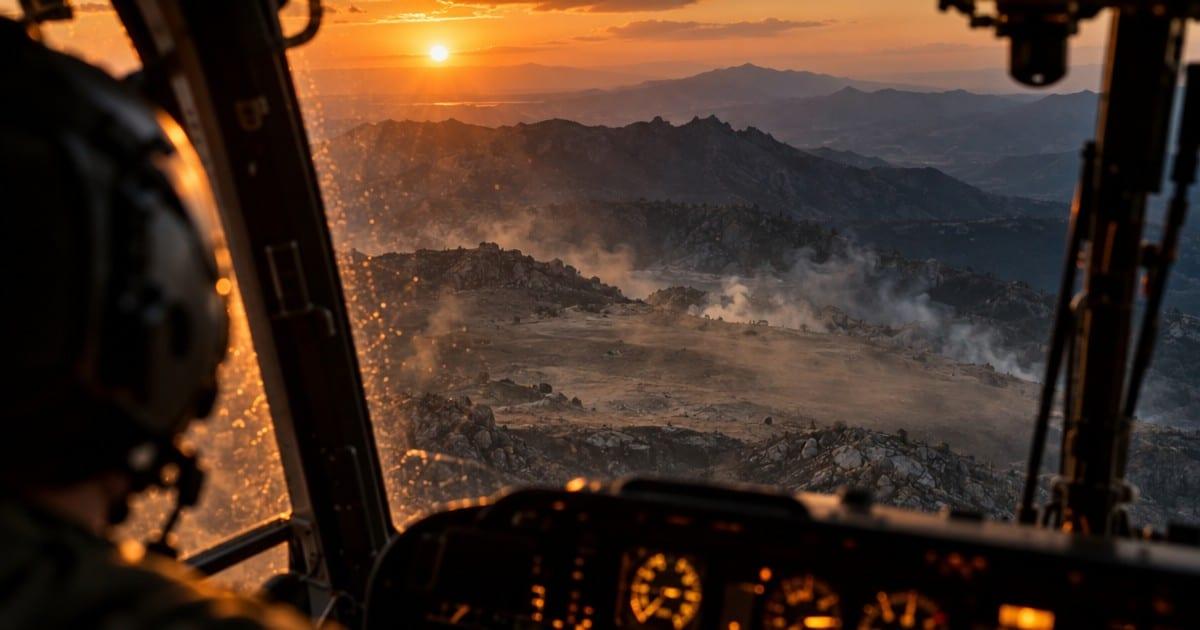
Iranian regime media published footage it says shows the rescue of an Iranian Yak-130 pilot whose plane was shot down by an Israeli F-35 during an air battle in the Forty-Day War, according to a post Tuesday from Visegrád 24, an account with two point one million followers. The same footage, translated from Persian, shows the pilot ejected over the Lavāsān mountains northeast of Tehran, per the same post.
Visegrád 24, which carries the verification of the pilot as its own, posted the clip at 08:42 GMT. The clip opens in confusion, with voices overlapping in the cockpit audio, according to the translation Visegrád 24 supplied: "What now, What now? Can you sit down. No one is following us. Is this? Is this? He's not going to send the Zaxmas. I'm sorry but I don't work. So we can talk." Visegrád 24 did not say what the Zaxmas reference is understood to mean, and declined to translate beyond that passage. The pilot was still in the aircraft at the moment the recording begins.
What is not in dispute is the day's diplomatic calendar. Pakistan's army Chief of Staff and Field Marshal Asim Munir arrived in Tehran Tuesday for a series of high-level bilateral talks with Iranian officials on the status of peace talks with the United States, according to the Washington Times, an account with 490,000 followers. Arab News, The National and This Is Beirut all carried the same arrival, with The National reporting that Qatar says communication between Tehran and Washington "has not stopped" amid a push for a resolution. The National also reports Iran is seeking leverage in those U.S. talks, which is the purpose Munir's mediation is meant to serve. An earlier report from 17 hours before the landing said only that Munir would visit Tehran on Tuesday, without disclosing the agenda.
The pairing of the two stories is the point. Iran's regime media chose to broadcast the rescue footage on the morning of the same day a senior mediator was due to land in the capital. Visegrád 24's post and the arrival reporting land within hours of each other, and the rescue account is now circulating alongside coverage of the mediation, in the same news cycle, on the same day.
The Forty-Day War reference in the Visegrád 24 post has no independent corroboration in the material available. The Lavāsān mountains northeast of Tehran are a known military and training area, though the post does not say what the aircraft was doing there or when the ejection occurred. The post does not identify the pilot, the rescue team, or the unit that recovered him. Nothing in the post says whether the pilot survived his injuries or returned to duty. The vision model description of the footage is of a low-resolution broadcast, consistent with rescue helicopter footage released through Iranian state channels. The audio, per the translation, is fragmentary and does not establish a timeline.
The claim's spread has been carried by the same Visegrád 24 post that originated it, with the Washington Times' arrival report providing the diplomatic context on the same morning. Coverage of Munir's visit has been carried by Arab News, The National and This Is Beirut, all of which treat the trip as a mediation and de-escalation effort. The National reports that Qatar is the intermediary saying the channel between Tehran and Washington remains open, with Doha putting a positive frame on the talks. This Is Beirut's headline says only that Munir is scheduled to arrive as Islamabad continues its mediation efforts.
Munir's trip is the substantive story of the day. The rescue footage is the atmosphere in which it is happening. The same broadcast runs on Iranian state channels while the Pakistani army chief is in the air or on the ground in Tehran, and the same day's reporting from The National and Arab News is about de-escalation and diplomatic channel-keeping. That is the tension the two posts describe, and it is the reason Visegrád 24's post is being quoted across the timeline tonight rather than being filed away as an old war clip.
What the footage does not do is settle the underlying question of whether the downing occurred as the post says. Next News Network could not independently verify the claim that an Iranian Yak-130 was shot down by an Israeli F-35 in an air battle during the Forty-Day War, or that the published footage shows the rescue of that pilot.
Pakistan's army chief has not publicly commented on the rescue footage. Iranian officials have not commented on the footage beyond its original broadcast. The arrival statement from the Washington Times does not mention the rescue. The mediation, by all four accounts of it, concerns the U.S. peace track, and the pilot's rescue is a separate strand of the same regional story, broadcast on the same day.
The sequence is straightforward: a rescue broadcast hits Iranian screens in the morning, Visegrád 24 posts the translated clip shortly after 08:42 GMT, and by midday the same timeline carries Munir's arrival and the mediation framing from The National. The Washington Times puts the arrival at 12:22 GMT. By that hour, the rescue footage and the diplomatic arrival are both on the record, and the rescue footage is being used to frame the stakes of the talks.
Munir's agenda, per the Washington Times and Arab News, is the status of the peace talks with the United States, with Iran seeking leverage in those talks. The National's reporting adds Qatar's line that the channel has not stopped. Arab News' framing is explicitly de-escalation. None of the four reports mentions the Yak-130 or the rescue, and none of them ties the broadcast to the timing of the trip. The connection between them is chronological and thematic, not confirmed by any official.
Our Take
There is a reason Iran's regime media put a rescue tape on the air on the morning a Pakistani field marshal was flying to Tehran, and it is not because the tape was new. The message to the mediator was that Iran is still fighting, still recovering its people, and still broadcasting its war record while the diplomats sit down. Whether or not the downing happened as the clip claims, the regime wants the room to feel the war as it opens, and our adversaries should not be given the benefit of the doubt while they do it. Next News Network could not independently verify the underlying account, and readers should treat the rescue footage as what it is: an Iranian government broadcast, aired for effect on a day chosen for effect. The real story, the one that matters for American interests, is that Munir's mediation is being conducted in a capital that is simultaneously running rescue footage of its own shot-down pilots. That is not de-escalation theater. That is leverage theater, and the White House should be clear-eyed about which of the two it is being shown.
