
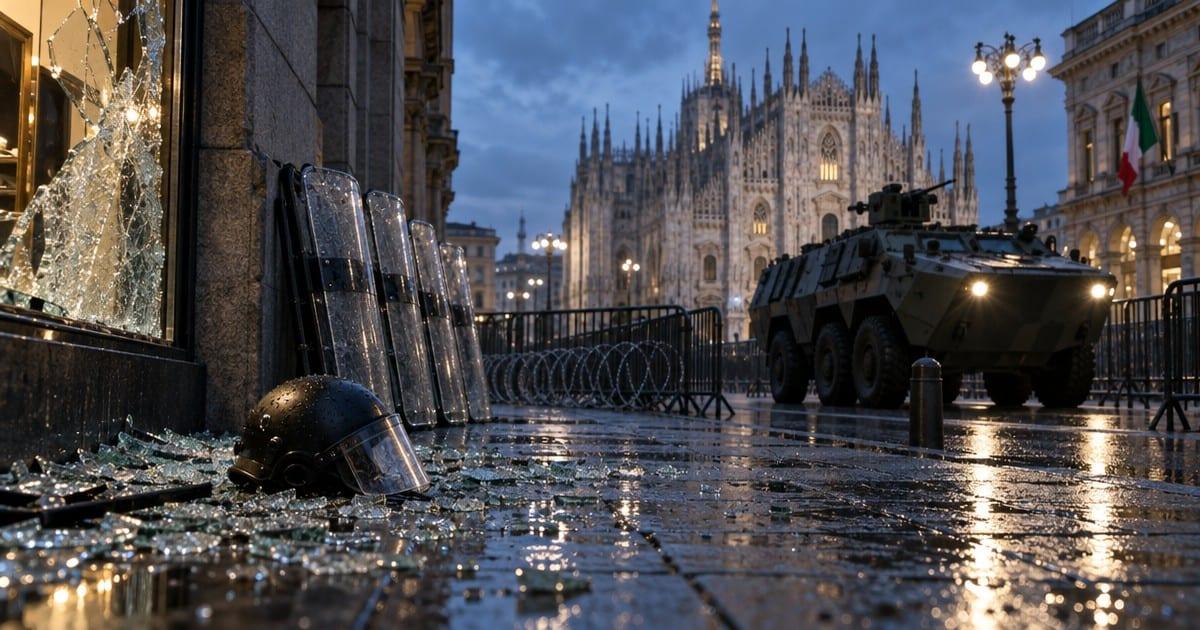
Italy is done playing nice. Prime Minister Giorgia Meloni's government announced Monday it will deploy 500 soldiers to Milan after two days of what Italian media described as "guerrilla war" in the heart of the fashion capital—riots allegedly driven largely by youths from migrant communities that left more than 200 police officers injured and high-end shops looted.
Defense Minister Guido Crosetto approved the deployment Monday, according to Corriere della Sera, as Deputy Prime Minister Matteo Salvini announced the move on social media: "From words to action: 500 more troops to defend Milan." The deployment is expected to be included in a security package up for cabinet approval Tuesday.
The violence erupted over the weekend after what began as a protest over the cost of living and poor public services spiraled into chaos. Milan police reported detaining 271 people—220 of them minors—with 32 arrested and 28 reported to judicial authorities. Eleven suspects face potential prison sentences of up to 15 years.
Milan's Via Montenapoleone, the city's luxury shopping district, looked like a war zone. Chanel, Hermès, Gucci, Prada, Saint Laurent, and Versace all closed early Monday, with many removing merchandise from windows and boarding up storefronts. Sports retailers Decathlon and Arc'teryx, along with Vodafone, were among those ransacked, according to The Guardian.
The cleanup effort alone required 90 workers and 60 vehicles from Milan's AMSA waste management company to clear debris. More than 280 street trash cans were damaged—including six solar-powered "smart bins."
Meloni did not mince words. "To demonstrate is a right." On Monday she chaired an emergency security meeting with ministers and security chiefs.
Foreign Minister Antonio Tajani, also a deputy prime minister, wrote on X that "the government will respond firmly to these attacks on the state, including through measures aimed at curbing violence by minors."
Those measures, according to Corriere della Sera, include extending preventive detention to minors and cracking down on youth gangs—pulling forward provisions from an existing security bill stalled in parliament. The cabinet is expected to approve the decree as early as Tuesday.
Some social media observers noted the Duomo Cathedral—Italy's largest church—appeared to be specifically targeted, given the heavily Islamic makeup of the self-described "Gaza Generation" protesters. More than 5,000 people gathered in Milan over the weekend, according to the BBC.
The unrest mirrors scenes in France, where similar youth-led riots have erupted in recent weeks—a pattern Meloni allies say justifies her government's hardline response. Rioting has also broken out in Spain and Albania.
Not everyone is cheering. Ilaria Salis, a Member of the European Parliament from the left-wing Sinistra Italiana party, reportedly expressed more concern for the rioters than their victims—a stance that echoes the French far left's response to comparable violence in Paris.
The deployment comes ahead of national elections next year, with Meloni positioning herself as the law-and-order leader standing between Italian civilization and the sort of chaos that has engulfed French cities. Interior Minister Matteo Piantedosi has faced pressure to act decisively, and Tuesday's security decree will be the first real test of whether Rome can restore order to its financial capital.
For now, Milan's luxury boutiques are boarded up, 500 soldiers are preparing to deploy, and Italians are waiting to see whether the crackdown restores the peace—or whether the unrest is just beginning.
Our Take
What's happening in Milan is exactly what happens when open borders meet left-wing permissiveness. The same radical ideology that tells young men in the suburbs they are victims rather than accountable individuals—the same ideology that praises "Gaza Generation" agitators—produces cities where police are pelted with paving stones and grandmothers are afraid to walk past Chanel.
Giorgia Meloni understands something the French political class still refuses to learn: you cannot negotiate with a mob. You cannot "dialogue" with hooded thugs burning trash cans and looting Levit's. You send in the army, you crack down on youth gangs, and you make it clear that the state—not the street—holds the monopoly on force.
Notice the response from Ilaria Salis and her comrades on the Italian left: sympathy for the rioters, not the 200+ injured officers. That's the same script we saw in France, in Minneapolis, in Portland. The radicals always side with the chaos because chaos is their path to power.
Meloni is showing the West what leadership looks like. Now the question is whether Italy's coalition holds firm when the left-wing media—and their friends in Brussels—start screaming about "authoritarianism." They will. But the alternative is a Milan where tourists fear the Duomo and shopkeepers barricade their windows every weekend.
Americans should watch closely. What happens when a nation decides to defend its civilization rather than apologize for it? Milan is about to find out.
