
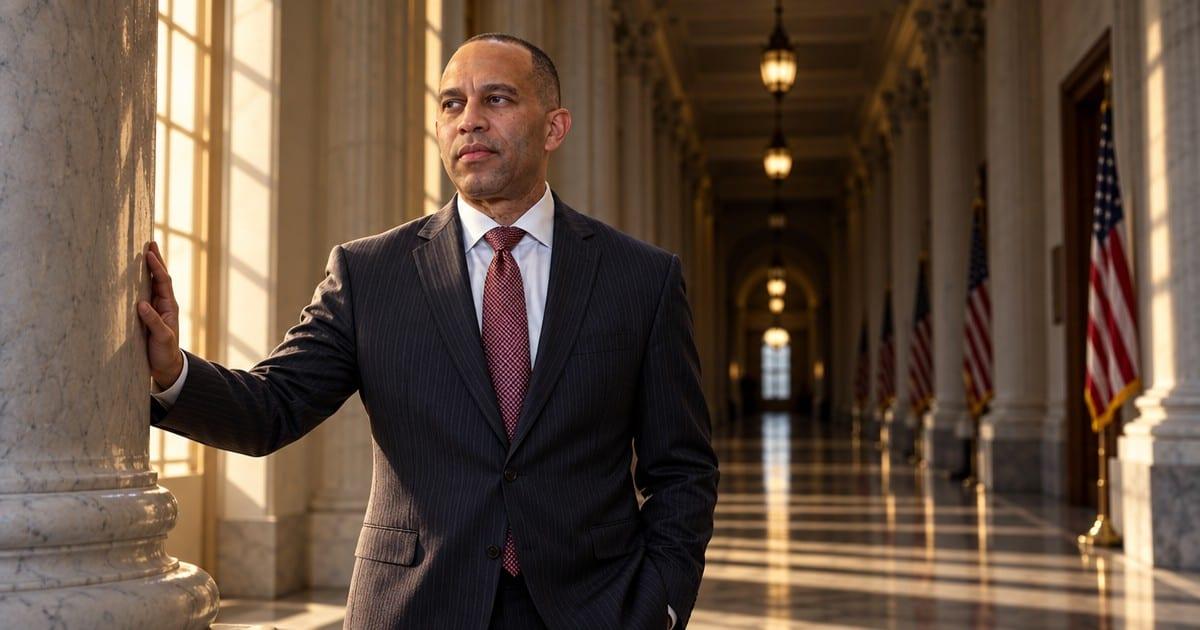
House Democratic Leader Hakeem Jeffries is walking a tightrope. If Democrats flip the House in the Nov. 3 midterms — and polling suggests they have a better than 85 percent chance of doing so, according to The National — Jeffries is almost certain to become House speaker. But the New York Democrat would inherit a caucus split between DSA-backed progressives and moderate majority makers, a divide that could expose the limits of the progressive agenda even as Democrats gain power.
The balancing act is the subject of a Fox News Politics reporter's notebook, which notes that Jeffries faces pressure from the party's left wing while trying to protect moderates who won in Trump-friendly districts. House Democrats plan to focus on driving down the high cost of living — lowering the price of groceries, gas and housing — and fighting to make healthcare affordable for every American, Jeffries said in an interview with USA TODAY earlier this month.
"We are explicitly promising to fight for an affordable America, and we will have a responsibility to do everything in our power to make that happen," Jeffries said.
But even if Democrats win back both chambers, they will quickly run into a pair of barriers — the Senate filibuster and President Donald Trump's veto pen — that will make it hard to enact many of their plans, AOL reported. Neither party has released a detailed agenda for the next two years, but their leaders have given hints.
House Speaker Mike Johnson, a Louisiana Republican, has suggested voters could expect more of the same from the GOP if it defies the odds and hangs onto its slim majority after November.
"What we would do in the next two years is exactly what we have been doing already, and that is putting the conditions in place for a strong America again," Johnson said during a recent interview on CNBC, pointing to the party's push for border security, energy dominance and pro-growth policies.
In the Senate, Democrats face tougher odds in the November midterms because they need to flip at least four seats, including at least three in states carried by Trump in 2024. But polls suggest their campaign to win back the majority is within reach, thanks to leads in North Carolina, according to AOL.
The midterms are being shaped by foreign policy and the cost of living. The National reported that the U.S. war against Iran, launched Feb. 28 by Trump and Israeli Prime Minister Benjamin Netanyahu, has driven up petrol prices by nearly 50 percent and diesel by about two thirds. A survey published this month by the Chicago Council on Global Affairs found that 86 percent of Americans believed the Iran war had harmed the cost of living, while 68 percent said it had not been worth fighting.
"The Republican Party and candidates are being killed by the higher prices," Kristin Diwan, a senior resident scholar at the Arab Gulf States Institute, told The National. "To the extent that people blame them on the Iran war, that is also a liability. The war is extremely unpopular and that crosses party lines."
For Jeffries, the challenge is managing a caucus that could include freshly elected progressives backed by the Democratic Socialists of America alongside moderates who won by distancing themselves from the party's left flank. The Fox News Politics notebook frames this as a balancing act that could expose the limits of the progressive agenda — a dynamic that will play out in real time if Democrats take the majority.
Republicans, meanwhile, are vowing to continue pursuing Trump priorities like border security and domestic fossil fuel production during his final two years in office, AOL reported. The Senate recently took one last political swing before voters have their say, with Democrats blocking two bills Republicans say voters want — a measure to diminish the costs consumers pay for data centers and a plan to restrict stock trades by lawmakers that included a voter ID requirement.
"(People) ought to be guaranteed no electricity bills will go up by a cent because of a data center," Sen. Josh Hawley, R-Mo., said. "It tells these AI companies and these data centers they can't just come into local communities and strip mine out (land). Raise the electricity rates. Kick people off the grid. Take their water."
Democrats argued the bill lacked enforcement. "It is a sham. A charade because it has no enforcement," said Sen. Richard Blumenthal, D-Conn. Senate Minority Leader Chuck Schumer, D-N.Y., called the Ratepayer Protection Act "a fraud."
It is not yet known whether Jeffries would be able to hold his caucus together on the affordability agenda, or whether progressive priorities would collide with the interests of moderates in swing districts. What is clear is that a Democratic majority would test the party's ability to govern with a narrow margin and an internal ideological divide.
Our Take
Here's the reality Democrats don't want voters to think about: a House majority won on affordability promises will immediately run into the cold reality of a Senate filibuster and Trump's veto pen. Jeffries can promise the moon, but he can't deliver it. And the moment he tries to placate the DSA-backed wing of his party, the moderate majority makers who actually won those swing districts will be forced to choose between their voters and their leadership.
That's the trap. Democrats are poised to win power, but they're inheriting a coalition that agrees on little more than opposing Trump. The progressive agenda — Green New Deal-style spending, defund-adjacent rhetoric, open-border policies — is popular in deep-blue districts and toxic in the districts that decide majorities. Jeffries knows it. That's why he's talking about grocery prices instead of the Squad's wish list.
Meanwhile, Republicans have a simple message: we told you what we'd do, and we did it. Border security, energy dominance, pro-growth policies. If Democrats win the House, they'll spend two years investigating and posturing while accomplishing nothing. Voters should ask themselves: do you want a majority that can govern, or a majority that can only complain? The answer on Nov. 3 will tell us whether Americans see through the progressive mirage.
