
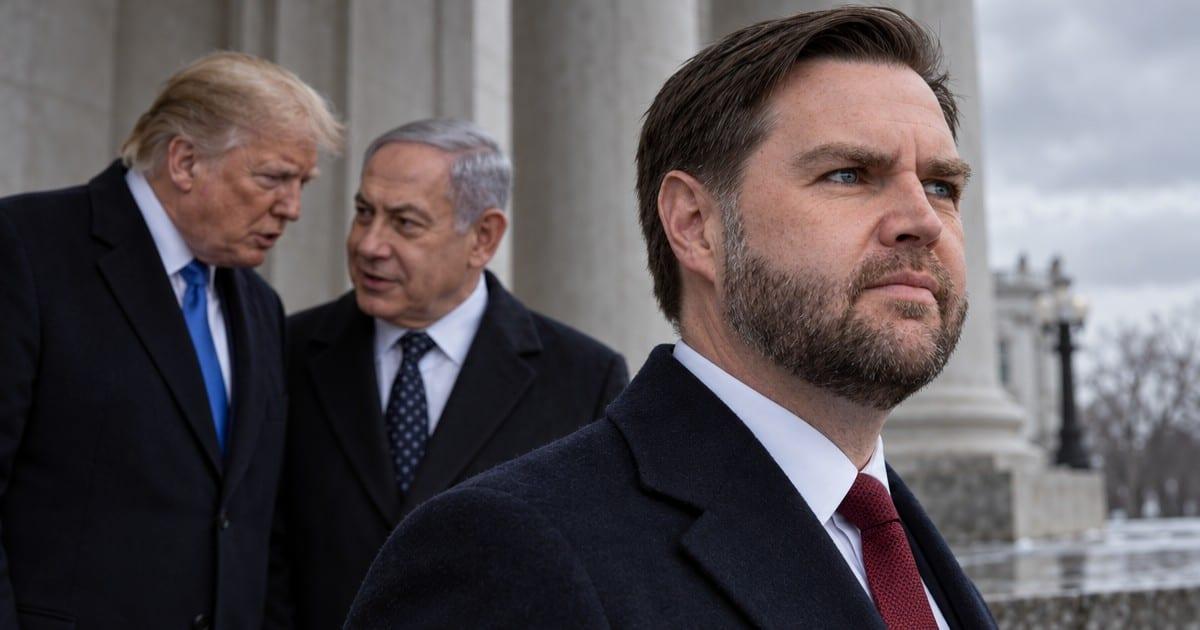
Vice President JD Vance said this week he will not endorse Israeli Prime Minister Benjamin Netanyahu in Israel's upcoming election, putting clear daylight between himself and President Donald Trump just days before Israelis head to the polls on October 27.
According to Politico, Vance told reporters he did not want to get involved in a non-U.S. election. Trump, by contrast, issued an unprecedented endorsement of Netanyahu on Saturday — a first for a sitting American president in an Israeli race — calling him a "Great Warrior" and warning that "the wrong Leader, which would be anyone other than Bibi" would leave the United States alone to face the Iran threat.
Vance's position was amplified across social media. X user @MarioNawfal posted that "Vance REFUSES to back Netanyahu after Trump endorsed him, says he only endorses American candidates," noting Trump's endorsement landed eight days before the vote and that Secretary of Defense Pete Hegseth met Netanyahu unannounced in Israel. Newsmax reported that Hegseth's visit came amid discussions about renewed military operations against Iran.
The contrast is awkward for a White House that has otherwise projected a unified front on Israel. Trump's endorsement, posted Sunday, leaned heavily on the shared U.S.-Israel strike on Iran in late February — a conflict that has upended global markets and reshaped Middle East security. "We're fortunate to have Trump as our leader in the fight to denuclearize Iran," Netanyahu said in a video response, thanking his "dear friend Donald" and calling himself "honored" and "humbled" by the backing.
Netanyahu faces a serious challenge from former IDF Chief of Staff Gadi Eisenkot, whose Yashar! ("Straight!") Party was formed amid public disillusionment over the prime minister's failure to deliver on restoring regional security after the war with Hamas. Eisenkot's son and nephews were killed in Gaza. Reacting to Trump's endorsement, Eisenkot said at an event in Tel Aviv that while he appreciates the president, only Israelis will decide their next prime minister.
Polling from The Jewish People Policy Institute in Jerusalem this month shows most Israelis still view Trump as a great friend of Israel — though a separate JPPI survey shows trust in him has eroded. Some surveys show Yashar! in a tight race with Netanyahu's Likud. The New York Times reported that the Trump brand "is not what it once was in Israel."
Politico noted that Vance's hands-off posture sits uneasily beside his recent campaign appearance in Hungary for former Prime Minister Viktor Orban — a detail that will fuel accusations of inconsistency from critics. Vance has also previously accused some Israeli officials of trying to drag the U.S. into wider conflict, per an Instagram post circulating this week.
It is not yet known whether Vance's remarks reflect a broader administration shift or a personal distinction. The White House has not announced any change to Trump's endorsement. What is clear is that eight days out from a vote that will shape the future of the U.S.-Israel alliance, the president and vice president are sending different signals.
Our Take
Let's be honest about what this is and isn't. Vance declining to endorse a foreign leader is defensible on its face — America First means American elections, and there's a principled case for staying out of other countries' politics. The problem is the timing and the inconsistency. Trump made a deliberate, high-stakes bet on Netanyahu, tied directly to the Iran fight and the security of both nations. A vice president publicly declining to back that bet eight days before the vote undercuts the president's leverage at the worst possible moment.
And the Orban comparison is fair game. If Vance can campaign for a foreign leader when it suits him, the "I only endorse Americans" line rings hollow. Patriots should want a team that speaks with one voice on the threats that matter — Iran chief among them. A divided signal to Jerusalem and Tehran alike is not strength. It's confusion. The question voters should ask: when the president draws a line, does his understudy hold it?
