
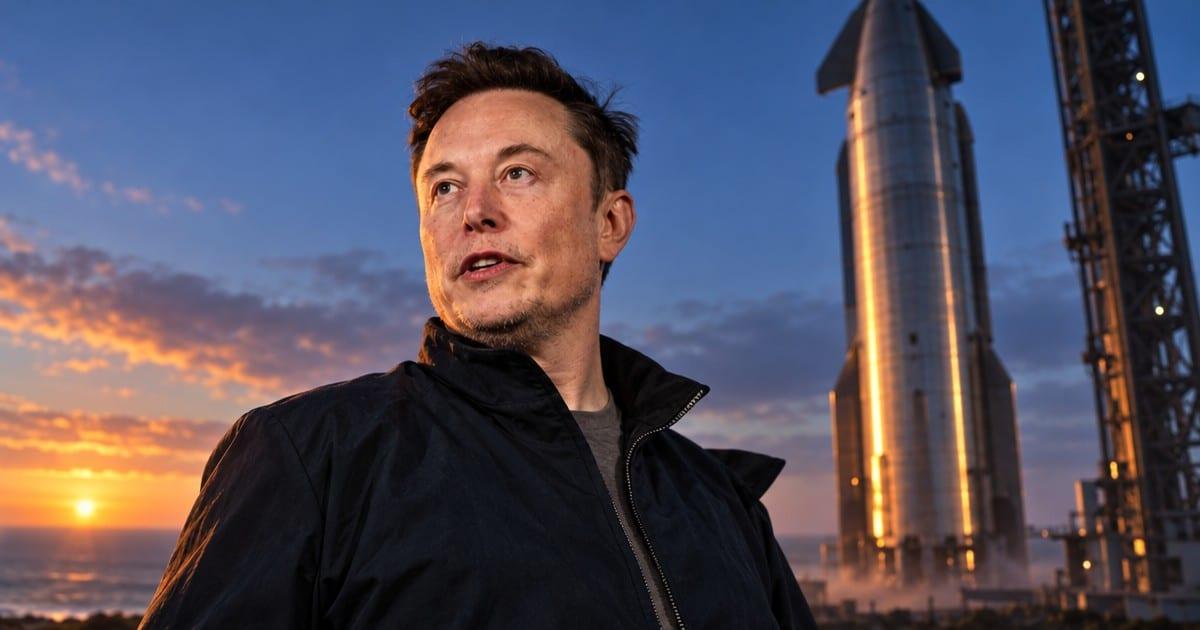
SpaceX reported a quarterly profit that came in above expectations, driven by growth in its satellite communications operations and its business of leasing computing power to other companies, and Elon Musk used the moment to openly endorse the prospect of combining SpaceX with Tesla in what would be the biggest corporate merger on record.
The Washington Times summarized the turn on Tuesday morning: "SpaceX turns a profit after a string of losses as its satellite and computer leasing businesses soar." The report followed a company disclosure that net income for the three months through September reached four point four billion dollars, or thirty-five cents per share — more than double the figure from the comparable period a year earlier, according to WRAL.com.
Bloomberg reported that the profit "surges past estimates on AI and satellite internet growth," and that Musk "openly endorsed the prospect of combining SpaceX with Tesla Inc., in what would be the biggest-ever corporate merger uniting assets from electric cars to AI data centers to rocket and satellite capabilities."
WRAL.com described the same quarter as one in which "satellite communications and artificial intelligence businesses boomed," and noted the company is run by Musk. The earnings figure, the per-share result and the year-over-year comparison all come from that account of the filing.
What traveled fastest was not the balance sheet but the merger remark. The suggestion that Tesla and SpaceX could be folded into a single entity set off a round of commentary that treated the earnings report as a prelude rather than the story itself. The Washington Times framed the quarter around the operating businesses; Bloomberg framed it around both the profit and Musk's stated openness to a combination; WRAL framed it around the scale of the earnings beat. Each of those framings was picked up and argued over separately.
The profit itself is the concrete claim in the reporting: net income of four point four billion dollars for the September quarter, thirty-five cents per share, more than double the prior-year figure, on the strength of satellite communications and leased computing capacity. The merger talk is described as Musk's endorsement of the prospect — a statement of openness, not an announced transaction.
The distinction matters because the reaction frequently blurred the two. A quarterly profit is a filed number. A merger between Tesla and SpaceX would require corporate action that nobody in the reporting describes as underway or scheduled. Bloomberg's language is that Musk "openly endorsed the prospect" — the prospect, not the deal.
Next News Network could not independently verify the reported figures or the merger remarks.
The background is a company that had posted a string of losses before this quarter. That history is the reason the profit drew notice at all: SpaceX spent years as a capital-intensive launch business whose financial results were measured against its ability to fund development rather than against earnings. The satellite communications side — the Starlink constellation — and the newer business of leasing computing capacity to outside companies are what the reporting credits with the swing.
Those two lines of business are also what connect the earnings story to the merger talk. A rocket company that also sells broadband and rents out computing power sits alongside an electric vehicle manufacturer that has moved into AI data centers. Bloomberg's description of a combined company — "from electric cars to AI data centers to rocket and satellite capabilities" — is essentially a list of the assets the two firms already hold.
The reactions divided along predictable lines. Some commentators treated the profit as vindication of a long, expensive build-out and pointed to the leased computing business as evidence the company had found a second revenue engine beyond launch services. Others treated the merger remark as the more consequential item, arguing that combining the two companies would concentrate an unusual range of infrastructure — launch, broadband, vehicles and data centers — under one roof, and said so plainly.
The earnings beat also drew the attention of commentators who had spent years predicting the satellite business would not pay for itself. The reported profit gave those arguments a concrete number to work against, and the number was large enough that the terms of the debate shifted from whether the business could be profitable to how durable the profitability would prove.
None of that settles the merger question. An endorsement of a prospect is not a filing, and the reporting describes no transaction, no timetable and no structure. The earnings figures are the company's own, as relayed by the outlets covering them, and the merger remark is Musk's, as characterized by Bloomberg.
What the sequence shows is how quickly a quarterly result becomes a platform for a much larger argument. The profit was the news on Tuesday morning. By the time the coverage circulated, the conversation had moved to what the profit might make possible — and to whether one person should control that much of it.
Our Take
The left has spent years telling anyone who would listen that Starlink was a money pit and that Musk's space venture would never stop burning cash. Tuesday's numbers make that argument harder to repeat with a straight face: four point four billion dollars in net income in a single quarter is not a rounding error, and it came from exactly the two businesses the skeptics said would never scale — satellite broadband and leased computing capacity. When the critics pivot from "it will never be profitable" to "the merger is scary," that is the sound of an argument being abandoned in real time.
Note what the reaction actually reveals. The same commentators who demand that corporations be transparent about their finances went quiet on the earnings and loud on the merger hint, because the earnings undercut a narrative and the merger hint feeds one. If Tesla and SpaceX combine, it would be the largest corporate merger ever — and it would also be a voluntary transaction between a company and its shareholders, subject to the same disclosure and approval rules as any other. The people warning about concentration of power in one man's hands are the same people who cheered when the federal government leaned on social media platforms to police speech. Their concern about concentrated authority is selective, and everyone can see it.
And the fusion of electric vehicles, AI data centers, rockets and satellite broadband is precisely the kind of integrated industrial capability this country needs to compete with China. Beijing is not waiting for permission to build national champions. If Washington's instinct is to smother an American company for growing too capable, the next generation of launch and communications infrastructure will be built somewhere else by someone who does not have to answer to a Senate hearing. The profit is the proof the model works. The merger talk is a signal about what comes next — and the reaction tells you who is afraid of it.
