
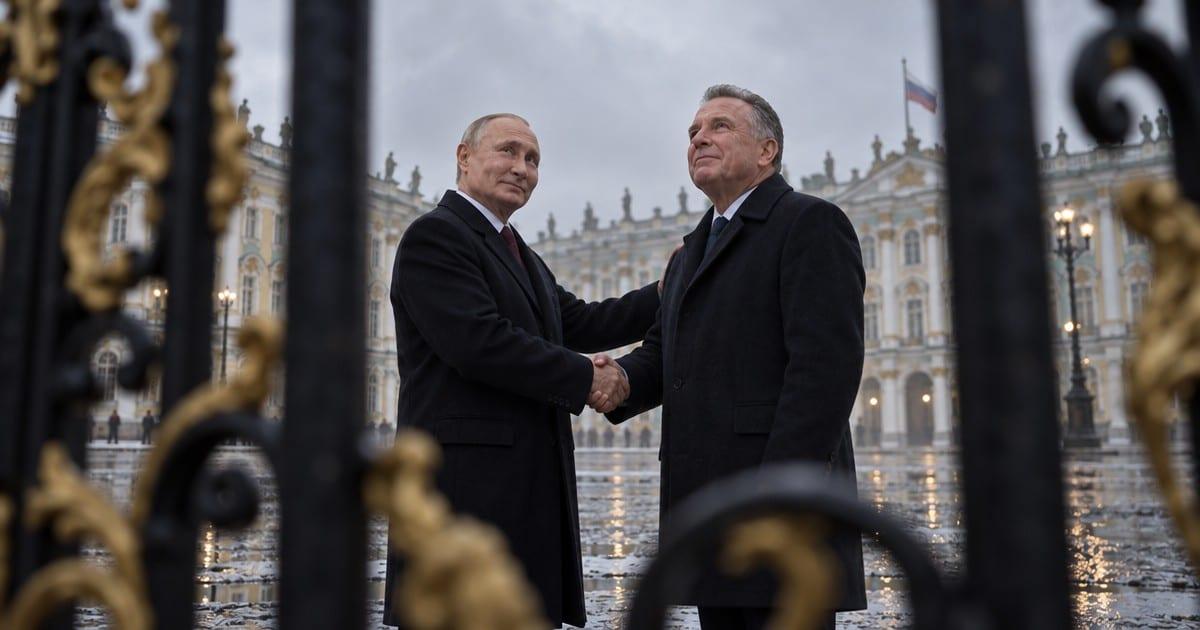
U.S. special envoy Steve Witkoff told Vladimir Putin that the Russian president is "a humanitarian" during face-to-face talks in St. Petersburg on Wednesday, a remark that quickly drew condemnation from critics who said it validated long-standing concerns about the direction of the Trump administration's peace efforts in Ukraine.
Witkoff met Putin at Constantine Palace to discuss a possible framework for ending the war, following talks with Ukrainian President Volodymyr Zelensky in Oslo a day earlier. During the opening exchanges, Witkoff addressed Putin directly, saying, according to a transcript of the exchange circulated on social media: "You talk so much about President Trump being a humanitarian. You are a humanitarian also, sir, and I salute that."
The remark was flagged by Kyle Griffin, a commentator with 1.3 million followers on X, who posted: "Trump envoy Steve Witkoff just called Vladimir Putin a 'humanitarian.'" The clip was also shared by Mario Nawfal, a broadcaster with 3.9 million followers, who posted the exchange with the comment "WTF?!?!" and identified the writer only as Samuel.
The reaction was not confined to social media. Marcy Wheeler, the national security commentator behind the Emptywheel account, wrote that the exchange confirmed a warning she had issued in March: "the longer Witkoff and Kushner are Trump's so-called negotiators, the more likely Putin would convince Trump to join his side in a World War." Wheeler described Witkoff's conduct as a "pathetic display" and said it confirmed her earlier assessment. Her post was carried by an account with 295,000 followers.
The White House did not immediately respond to requests for comment on the exchange. The Kremlin, for its part, signaled openness to further talks. Kremlin aide Yuri Ushakov said Russia is ready to resume trilateral negotiations with the United States and Ukraine in mid-November, according to Clash Report, an account with 895,000 followers. Ushakov said Putin had presented Witkoff with what he called the "objective situation" on the front line, where he claimed the initiative is "entirely with" Russian forces.
Witkoff's meeting with Putin came after a day of diplomacy in Norway, where he and Jared Kushner met with Zelensky and Nordic leaders. According to Clash Report, Witkoff raised the outcome of those Oslo discussions during his opening exchanges with Putin, saying: "I think there's some degree of momentum, and I hope that this today can be another step forward in the peace process and discussing how we resolve the Ukrainian conflict."
The talks touched on a range of issues beyond Ukraine, according to Clash Report, including the possibility of restoring economic cooperation between Washington and Moscow, potential Russian fertilizer exports to the United States, and Putin's suggestion of involving China in discussions about the conflict. Russian Foreign Minister Sergey Lavrov said Tuesday that Moscow would examine Washington's proposals but would not make political concessions, and he played down expectations of a diplomatic breakthrough, indicating that Moscow continues to regard the United States as a geopolitical rival.
Zelensky, meanwhile, indicated during an interview on Fox News that he could accept a settlement that freezes the conflict along current territorial lines, despite Kyiv's continued opposition to formally ceding territory to Russia. Asked whether he would accept a peace deal that freezes the conflict along the current lines, regardless of how it began, Zelensky replied: "Yes."
The White House has framed the talks as part of an ongoing push to end the fighting. President Trump has said it will be "very bad" for Ukraine if it does not strike a deal. The meeting in St. Petersburg was first reported by Newsmax, which noted that Witkoff held talks with Putin "about Moscow's full-scale invasion of Ukraine" as the president pushes Kyiv to make a deal.
Critics seized on the "humanitarian" remark as evidence that Witkoff is unsuited to the role. Wheeler's March article, published on her Emptywheel site, argued that Putin's strategy was to recruit Trump to Russia's side in a broader global conflict, and that the longer Witkoff and Kushner remained in their roles, the more likely that outcome would become. She did not elaborate on how Wednesday's exchange confirmed that thesis beyond calling it a "pathetic display."
The exchange also circulated widely among accounts that have been critical of the administration's approach to Russia. Clash Report, which has 895,000 followers, carried both the news of the meeting and the Kremlin's subsequent statements about resuming trilateral talks. The group's coverage noted that Witkoff called on Putin to consider reopening a negotiating format bringing together the United States, Russia and Ukraine, with technical aspects of a potential settlement among the issues to be addressed.
The Kremlin has previously resisted trilateral meetings, although Moscow had proposed hosting Zelensky for talks with Putin, an arrangement regarded as unworkable by the other parties.
Next News Network could not independently verify the transcript of the exchange or the characterization of Witkoff's remarks.
Our Take
The firestorm over Witkoff's remark is a case study in how a single sentence, stripped of context, can define a diplomatic initiative. The White House will argue that Witkoff was engaging in the kind of flattery that greases the wheels of difficult negotiations, and that the substantive work of ending the war matters more than the pleasantries exchanged at the opening of a meeting. That defense has the virtue of being plausible, but it ignores the broader pattern that critics like Wheeler have identified: a negotiating team that seems more comfortable flattering Moscow than holding it accountable. The "humanitarian" remark did not occur in a vacuum; it came after months of Trump administration pressure on Kyiv to make concessions, and on the same day the Kremlin signaled it would examine Washington's proposals without making political concessions of its own. If Witkoff's goal was to create momentum, the early returns suggest he has created it mostly in one direction. The American people deserve a negotiating team that can be courteous without being credulous, and that remembers which side in this conflict is the aggressor.
