
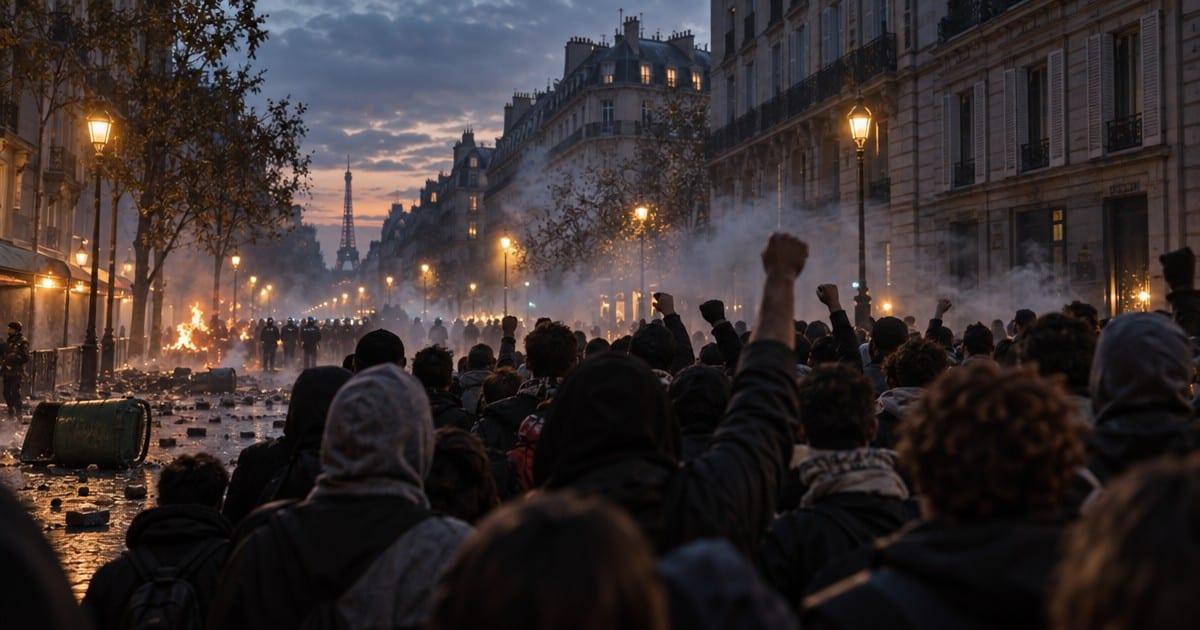
The White House on Wednesday pointed to unrest in France as a warning about what it described as the future being pushed by radical Democrats in the United States, saying the chaos, looting and destruction underway overseas is "exactly the future radical Democrats are pushing for America."
In a post from the official @WhiteHouse account, which carries 5.3 million followers, the administration wrote: "France before and after is a warning. The chaos, looting, and destruction we're watching is exactly the future radical Democrats are pushing for America." The post closed with a direct question to the public: "Is this the future you want?"
The statement came as violent clashes and widespread demonstrations broke out across France, where more than half a million people took to the streets to protest the rising cost of living, according to reporting on the unrest. Protests and regional conflict were described as erupting across France and the Middle East at the same time, with geopolitical tensions in the Middle East unfolding simultaneously with the French demonstrations.
The White House post drew a direct line between the scenes in France and domestic American politics, framing the disorder as a preview of what the administration says would follow if its political opponents had their way. The message was delivered without qualification and without reference to the specific causes of the French protests, which reporting ties to the cost of living.
The post also came amid calls for French President Emmanuel Macron's resignation, which have surfaced alongside the protests and violence. The White House did not mention Macron by name in its post, nor did it address the French government's response to the unrest. The administration's message was directed at an American audience, using the images and reports emerging from France as the basis for a political argument about the direction of the United States.
The phrase "France before and after" framed the unrest as a transformation, presenting the disorder as a departure from what the country had been. The White House did not elaborate on what it meant by "before," and the post did not identify specific incidents of looting or destruction. What the post did do was characterize the events in France in stark terms -- chaos, looting, destruction -- and attach them to a domestic political faction by name.
The question at the end of the post, "Is this the future you want?", turned the statement into a direct appeal to readers, casting the choice before Americans in binary terms. It is a rhetorical form the administration has used before, but here it was anchored to a specific, unfolding event overseas rather than to a domestic policy dispute.
The unrest in France has been described as widespread, with more than half a million participants in the streets and violent clashes reported. The reporting ties the demonstrations to the rising cost of living, a grievance that has driven protest movements in multiple countries in recent years. The White House post did not engage with that grievance or with the economic conditions behind it; it focused instead on the disorder itself and on what the administration says that disorder portends for the United States.
The official account's post is the record of what the administration said. It is a statement of the White House's position, issued from the official account, and it stands as the administration's own characterization of events in France and of its political opponents at home. The post did not cite sources for its claims about the future, nor did it offer a policy proposal connected to the unrest. It was a warning, framed as a question.
The timing placed the statement alongside the French demonstrations and the regional tensions in the Middle East, though the White House post addressed only France. The administration's message was that the scenes abroad are a warning about what could happen here, and it attributed that outcome to radical Democrats. The post did not specify which Democrats it meant or what actions it was referring to, and it did not say what, if anything, the administration intended to do in response.
What the post did state, plainly, is that the White House views the unrest in France as a preview of a future it opposes, and that it wants the public to consider that future when judging the political choices ahead. The question it posed was left open, directed at readers rather than answered by the administration itself.
Our Take
The White House is doing what the White House should do: using the official account to state plainly what it sees and to name the faction it holds responsible. The scenes from France -- more than half a million people in the streets, violent clashes, calls for a president's resignation -- are not abstract. They are the product of a political and economic breakdown, and the administration is right to ask Americans whether they want that same breakdown imported here. The post does not hedge, does not apologize for the comparison, and does not bury the question. It puts the choice directly to the public. That is leadership communicating in plain terms, and it is a welcome contrast to the usual careful nothing that comes out of official Washington. The question "Is this the future you want?" deserves an answer, and the administration has earned credit for asking it.
