
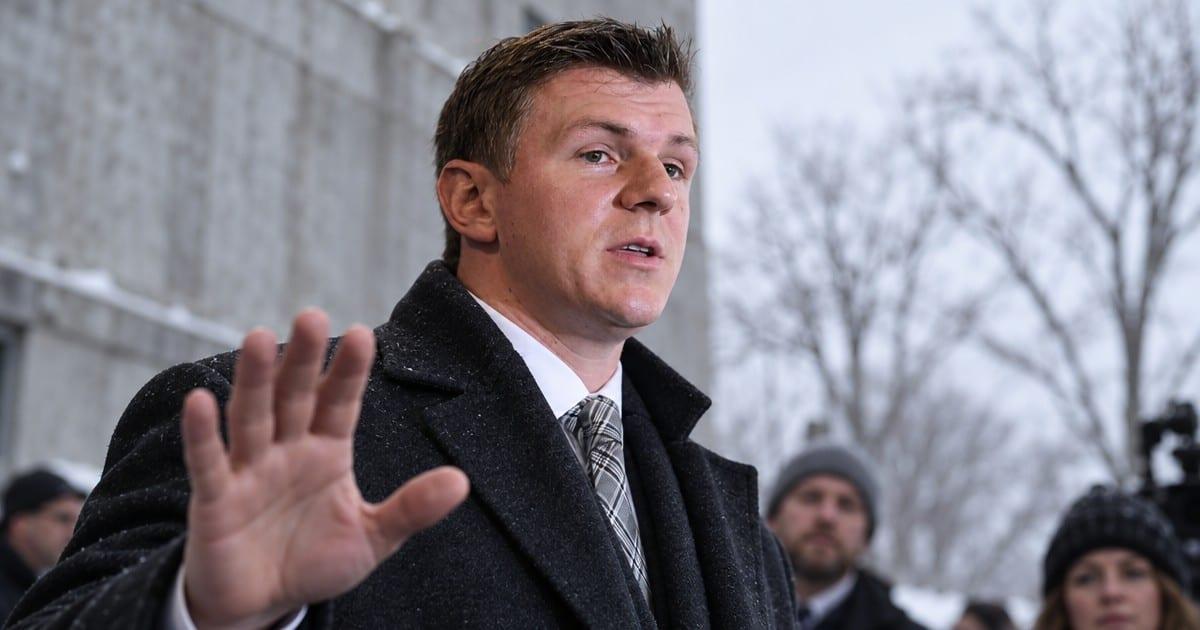
James O'Keefe is rejecting the label "right-wing provocateur" after being charged in Minnesota, saying he is an American journalist defending First Amendment rights for himself and for other reporters.
O'Keefe made the statement in a post on X directed at ABC, writing that he is "not a right-wing provocateur" but "an American journalist" fighting for the First Amendment rights of others to report the news as much as his own. The post came the same day that The New York Times reported he had been charged in connection with a Minnesota voting stunt, and it has since been carried across X by accounts amplifying his defense.
According to the Times, O'Keefe and another content creator, Cam Higby, are accused of breaking the law when they posed as Islamic voters in August. The Times described O'Keefe in its headline as a "right-wing provocateur" — the exact framing his post pushed back against. The charge is an allegation; neither man has been convicted of anything, and the underlying claim about what took place in August has not been independently confirmed by Next News Network.
O'Keefe's post does not address the specifics of the allegation. It instead contests the description of him, drawing a line between provocation and journalism. "I'm not a right-wing provocateur," he wrote. "I'm an American journalist and I'm fighting for your 1st amendment rights to report news as much as mine." The appeal is directed outward — to his audience and to other reporters — framing the case as a question of press freedom rather than of individual conduct.
The response did not stay confined to a single post. O'Keefe's statement was picked up and circulated by accounts across X, where the charge against him has become a subject of wide discussion. The spread is visible in the range of accounts carrying the post and the framing, not in any single metric.
The Minnesota matter centers on the August episode in which O'Keefe and Higby are accused of posing as Islamic voters. The Times reports the two are accused of breaking the law in doing so. What exactly the two did, and whether it crossed a legal line, is the subject of the charge — and it is contested. O'Keefe's own post does not describe the August episode, dispute any specific factual claim about it, or offer a version of events. It responds to the characterization of him, not to the accusation itself.
The "provocateur" framing is not new to O'Keefe, whose work has long drawn that description from outlets that cover him critically. What is notable here is that he chose to answer the label directly and publicly, in a post addressed to a major network, rather than through a statement or a legal filing. The post reads as a claim on the language used to describe him — a fight over how the story is told as much as over what the charge alleges.
O'Keefe's argument rests on a simple equation: that reporting the news is protected activity, and that his own reporting falls within it. "Fighting for your 1st amendment rights to report news as much as mine," he wrote, casting his case as one that carries stakes for other journalists. That is his characterization. Whether the conduct at issue in Minnesota is protected reporting or something else is precisely what the charge puts in dispute, and it is not resolved by the post.
The Times report identifies Higby as a fellow content creator charged alongside O'Keefe. The two are accused of breaking the law when they posed as Islamic voters in August, according to the Times. The report does not, in the portion available here, detail the specific statute or the evidence behind the charge.
The reaction has moved well beyond the original report. O'Keefe's post drew attention from accounts across X, and the charge has become a subject of argument among commentators and audiences who follow him. The substance of that reaction — the defense of O'Keefe as a journalist, the dispute over the "provocateur" label, the question of press freedom — is what has carried. The underlying facts of the Minnesota episode remain what they were: an allegation, not an established account.
Next News Network could not independently verify the claim that O'Keefe and Higby broke the law when they posed as Islamic voters in August.
Our Take
The Times chose the word "provocateur" for its headline, and O'Keefe chose to answer it head-on. That is the right instinct. The charge against him is serious, and it will be tested in a legal process, not on X. But the label attached to a man before that process plays out is itself a form of argument, and O'Keefe is entitled to contest it.
His framing — that he is a journalist defending First Amendment rights — is a claim, not a verdict. The Minnesota allegation is likewise a claim. Both will have their day. What is already clear is that the charge has become a flashpoint far beyond a single courtroom, and the way it is described will shape how it is understood long before any judge rules.
Conservatives should watch this case closely. The charge against O'Keefe and Higby concerns conduct described as posing as Islamic voters — a tactic that, whatever one thinks of it, sits at the intersection of reporting, performance and politics. If the law can reach that conduct, the question of where journalism ends and something else begins is one that will not stay confined to Minnesota. O'Keefe says he is fighting for the right to report the news. The fight over what counts as reporting is the one worth watching.
