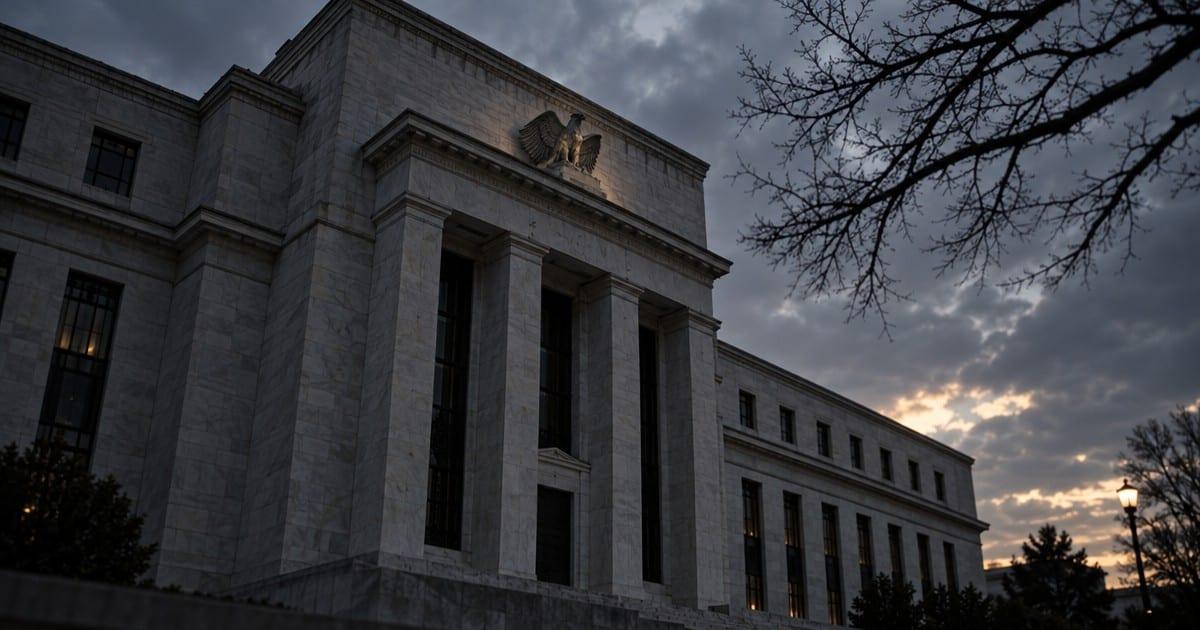
The Federal Reserve's Federal Open Market Committee voted 10 to 2 on Wednesday to hold the federal funds target range at 3.75-4.00%, according to the FOMC statement released at the conclusion of its October 27-28 meeting. The decision keeps borrowing costs steady heading into the final stretch of 2026, but the statement's language on growth and inflation gave markets little reason to expect the pause to last.
Two committee members dissented from the majority, according to the statement and an analysis published by HSBC and reported by FXStreet. The Fed's accompanying language described U.S. economic activity as strong and inflation as elevated, a combination HSBC read as leaving a December rate hike on the table. HSBC maintained its strong U.S. dollar view into 2027 while warning that the path may be volatile, per FXStreet's account of the bank's research.
The 3.75-4.00% range has now been held at consecutive meetings, and the October decision arrived against a backdrop of heavy federal borrowing. The Treasury Department's August refunding statement said that based on projected borrowing needs it anticipated maintaining nominal coupon and floating-rate note auction sizes for at least the next several quarters. The anticipated October sizes it laid out were $39 billion for the 10-year note, $13 billion for the 20-year bond and $22 billion for the 30-year bond, and those were the amounts offered at the October auctions. Treasury's August 3 estimate called for $628 billion of privately-held net marketable borrowing in the October-to-December quarter, assuming an end-of-December cash balance of $850 billion.
Ahead of Wednesday's refunding operations, Treasury polled its primary dealers on how investor demand for its debt is shifting, what changes to auction sizes it should consider, and how its enlarged buybacks of longer-dated bonds have worked, according to a PRNewswire release distributed by a market-data consortium. Treasury also asked dealers whether it should begin avoiding auctions of bills and floating-rate notes on days when the FOMC is expected to release a policy statement — a practice it typically already follows for nominal coupons and inflation-protected securities. Treasury is scheduled to publish updated borrowing estimates and its quarterly refunding statement on Wednesday, November 4, per the same release.
For middle-market borrowers, the October hold does not mean relief. ABF Journal reported in its Middle Market Debt Weekly that the hawkish tone of the October 28 statement puts a December hike in play for floating-rate borrowers, citing the Fed's press release directly. Floating-rate debt prices off short-term benchmarks that move with the Fed's target range, so a December increase would raise interest costs for companies holding those facilities.
The dollar's response and the full vote breakdown beyond the 10-2 margin were not detailed in the statement excerpts available Wednesday. What the committee did say, in the language HSBC flagged, is that activity is strong and inflation is elevated — a pairing that argues against easing and keeps pressure on the committee to act before year-end. The Fed's next scheduled meeting is in December, where the question of whether to raise the target range from 3.75-4.00% will be settled.
Our Take
Two dissents is not a footnote. It is a signal that the fight inside the FOMC is real, and the committee's own words — strong activity, elevated inflation — make the December meeting a live wire. Americans have watched prices at the grocery store and the gas pump for years now, and a 3.75-4.00% range that has sat still while inflation stayed hot is not a victory lap; it is a holding pattern.
The second story buried under Wednesday's statement is the borrowing machine. Treasury is asking dealers how to sell $628 billion in net marketable debt this quarter, floating the idea of bigger long-end buybacks and dodging auction dates that collide with Fed announcements. That is a government that knows its own issuance calendar is a market risk. Every dollar of that debt gets serviced by taxpayers, and every rate hike the Fed delays or delivers lands on the federal balance sheet.
Patriots should watch two dates: the December FOMC meeting, where the hike question gets answered, and November 4, when Treasury publishes its refunding statement and shows its hand on auction sizes. If the Fed hikes in December, ask why it waited. If it doesn't, ask what the committee is afraid of. Either way, the household budget — not the bond desk — is where this lands. Are your representatives in Washington talking about the debt at all, or just the next spending bill?