
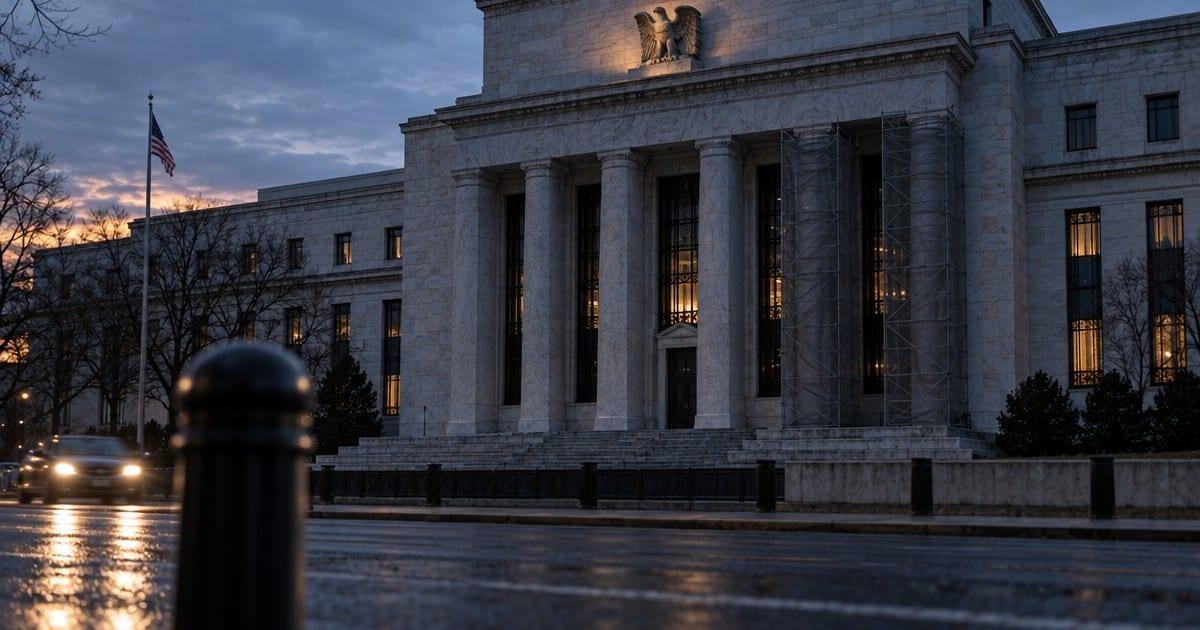
The Federal Reserve Board on Wednesday announced approval of an application by The Bank of Nova Scotia, the Canadian banking giant, in a routine disclosure that landed with little fanfare outside the financial wires.
The central bank's notice offered no further detail on the scope of the approval. As of Wednesday evening, the Board had not published additional documentation on the action.
The timing is notable because it arrives just two days before the Supreme Court is set to consider whether to hear a case that asks directly who gets to hold a master account at the Fed — the kind of account that gives a bank a direct line to the Federal Reserve's wire transfer, check clearing and settlement system. Custodia Bank filed a reply brief in that matter on Oct. 28, according to TokenPost, asking the justices to review the Tenth Circuit's ruling against it.
The justices have the Custodia petition scheduled for a Nov. 13 conference, TokenPost reported. They have not agreed to hear the case.
A Double Standard on Display
Custodia applied for a master account at the Federal Reserve Bank of Kansas City in October 2020. The Kansas City Fed denied the application in January 2023, citing risks it associated with the bank's crypto-focused business model, according to TokenPost. The bank's separate application to join the Federal Reserve System is not part of the Supreme Court case.
In its filing, Custodia argues that the Monetary Control Act of 1980 requires Federal Reserve services to be made available to eligible banks outside the Federal Reserve System. The Federal Reserve Board and the Kansas City Fed counter that the Federal Reserve Act gives regional Reserve Banks discretion over whether to accept deposits. They have asked the justices to deny review.
The Tenth Circuit affirmed the lower court's ruling for the Fed on Oct. 31, 2025. Judge Timothy M. Tymkovich dissented, arguing that the 1980 law requires access for eligible nonmember institutions. The full appeals court denied rehearing on March 13, 2026.
So American depositors are left with a picture that is hard to miss: a foreign bank gets its application approved, while a domestic institution that followed the rules and applied through the front door gets stonewalled for years and has to beg the Supreme Court for a hearing.
What a Master Account Actually Means
A master account is exactly what it sounds like — an account a financial institution holds at one of the Fed's 12 regional banks, giving it a direct route to the payment system. Without one, an institution has to reach payment functions through another bank or a private provider, adding cost and delay.
For Custodia, the denial has meant operating without that direct access while fighting in court. For the Kansas City Fed, the denial was a risk judgment. For the Board, the Nova Scotia approval is a reminder that the same agency can move quickly when it wants to.
The Board's Wednesday notice did not explain its reasoning or attach conditions. That silence is the story as much as the approval itself.
Our Take
Here is what the Fed does not want you to notice. On the same week that the Supreme Court is deciding whether to even hear a case about a domestic bank being locked out of the payment system, the Federal Reserve Board is happily rubber-stamping an application from a foreign bank.
Is The Bank of Nova Scotia a risk to the system? Probably not. But that is not the point. The point is that the Fed has spent years arguing in court that it has discretion — broad, unreviewable discretion — over who gets access to its services. If that is true, then every approval is a choice. Every denial is a choice. And the American people deserve to know what those choices are based on.
Custodia has argued that the Monetary Control Act requires access for eligible banks. Judge Tymkovich agreed. The full Tenth Circuit did not. Now the Supreme Court gets to decide whether to weigh in. The Nov. 13 conference is the next step, and patriots should be watching.
Because if the Fed can approve a Canadian bank's application in a quiet Wednesday notice while a domestic crypto bank waits years for a hearing, then the system is not neutral. It is discretionary. And discretion, in the hands of an unaccountable central bank, is exactly the kind of power the Constitution's framers warned about.
The question now: Will the Supreme Court take the case, or will the justices let the Tenth Circuit's ruling stand and leave the Fed's discretion effectively unchecked? The answer will tell us whether the administrative state answers to anyone at all.