
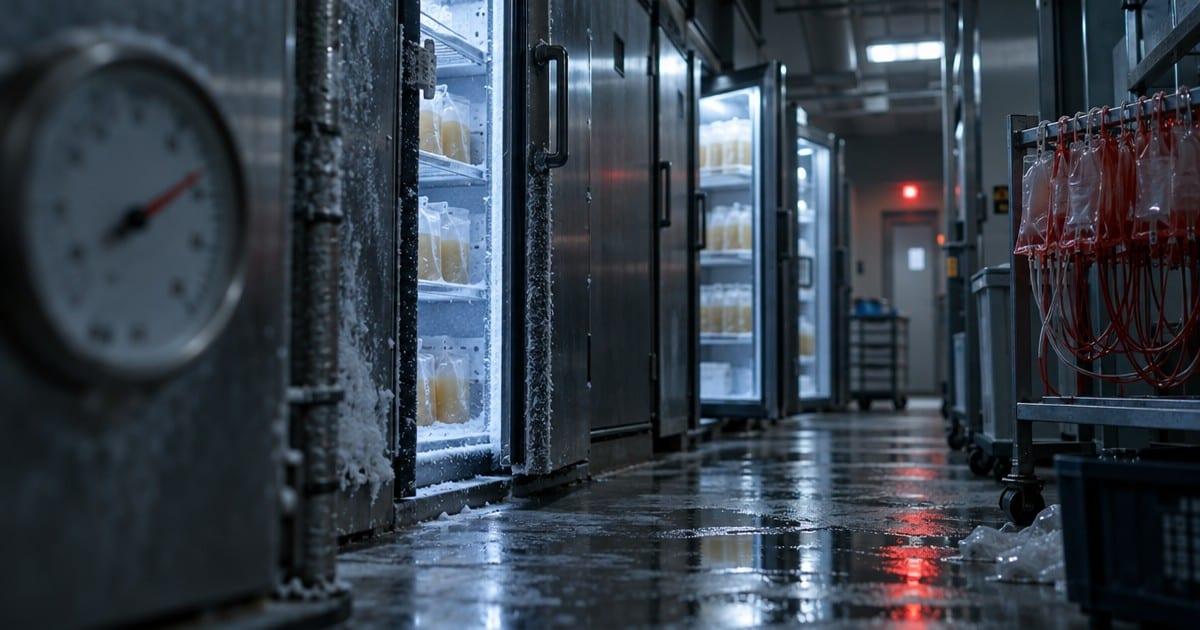
Hackers tried to turn France's blood supply into a science experiment this week. Overnight between Sunday and Monday, intruders accessed control systems at three regional facilities of the French Blood Establishment (EFS) and raised temperature and defrosting thresholds on plasma cold storage to what French weekly Le Canard Enchaîné reported were levels as high as 230 degrees Fahrenheit — where the freezers normally sit at minus 22. That's not a glitch. That's an attempt to destroy critical medical supplies.
It failed. Employees received alerts from monitoring systems and moved the plasma — bags intended for transfusions and for manufacturing medicines — into refrigerators that weren't connected to the compromised network. The EFS said in a statement that "no health consequences have been identified, and no blood products were lost," and that blood collection and distribution continued without interruption for the more than 1,900 hospitals it serves.
"We have staff round the clock since blood can be needed at any time," EFS spokesperson Charley Dubois told Reuters. "They were warned about the problems by alerts and moved the blood to other refrigerators that were not connected."
The French health ministry confirmed the incident Wednesday, saying remote access to the affected refrigeration systems had been disabled and the situation was under control. France's national cybersecurity agency and the ministry are investigating how the attack was carried out, which equipment was affected, and when the systems can safely return to service. No culprit has been named.
The equipment supplier, Coolworld, said in a statement that the vulnerability "relates to a component from a third-party supplier and was outside Coolworld's direct control," adding that only a limited number of units were affected and it was taking "appropriate measures."
A Continent's Freezers Under Siege
The blood bank attack didn't happen in a vacuum. It landed amid a wave of cyberattacks on supermarket refrigeration across Europe. According to the BBC, roughly 40 Delhaize supermarkets in Belgium and Luxembourg were hit, with additional incidents in Sweden, Ireland, the Netherlands, Estonia and Finland. The Guardian reported that temperatures in retail fridges and freezers climbed as high as 50C (122F), forcing retailers to discard tons of food at a cost of millions of euros. Retailers in Italy, Germany, Romania and the UK were targeted Tuesday, after the first wave hit Belgium, Estonia, Ireland, Finland, Luxembourg, the Netherlands and Sweden a day earlier.
In France last month, hackers seized control of cooling units in as many as 700 supermarkets, per the Guardian. And in early August, a series of mysterious refrigerator malfunctions struck commissaries at no fewer than six U.S. military bases — the Pentagon is investigating a suspected hack there.
The pattern is unmistakable: someone is probing the soft, connected underbelly of the West's food and medical supply chains. A regional branch of France's Crédit Mutuel bank also disclosed Wednesday that it had been hit by a cyberattack. After Italy's government convened emergency talks with intelligence officials Tuesday, EU spokesperson Thomas Regnier said the bloc's agencies were holding urgent discussions with national authorities. "These are not isolated incidents and of course we have to be collectively resilient and prepared for such cyber incidents," Regnier said. He declined to name potential culprits, and no one has claimed responsibility.
What the Public Is Seeing
Social media users flagged the blood bank story quickly. An Instagram post circulating Wednesday carried the caption "Hackers reportedly reset blood-sample freezers in France" — the kind of plain-language summary that spreads faster than any government press release, and a sign the public is connecting the dots between the supermarket disruptions and the strike on a national blood service.
Our Take
Let's be clear about what almost happened here. This wasn't a data breach where some records get sold on a forum. Someone reached into the refrigeration systems holding plasma for transfusions and tried to cook it. The only thing that stood between a cyber intrusion and a health crisis was a monitoring alarm and staff who knew what to do at 3 a.m. That is not a security strategy — that is luck with a payroll.
And look at the playing field. Supermarkets in nearly a dozen countries lost millions in spoiled food. A French bank got hit the same week. U.S. military base commissaries had their own fridge mystery in August. The EU is holding "urgent discussions" and Italy's government is convening emergency intelligence talks, but nobody can say who is doing this or why. That's not reassuring — that's a continent scrambling to catch up to an adversary already inside the wire.
Who benefits from chaos in European food and blood supply chains? We don't know yet, and anyone telling you otherwise is guessing. But the vulnerabilities are real, the attacks are coordinated, and the response so far is meetings. Every connected thermostat and networked freezer in the supply chain is a door — and right now, too many of those doors are unlocked.
Americans should be asking the same questions of our own hospitals, blood banks, grocery chains, and military commissaries. Are our critical cold-storage systems segmented from the open internet? Do we have round-the-clock staff watching the alerts the way EFS did? Or are we waiting for the first headline that reads "supplies lost" instead of "supplies saved"?
The French staff who moved that plasma in the dark deserve credit. But a country's medical supply shouldn't depend on heroics at 3 a.m. It should depend on systems hardened before the hackers show up. Ask your local hospital and your grocery chain what they've done. If they can't answer, you've got your answer.
