
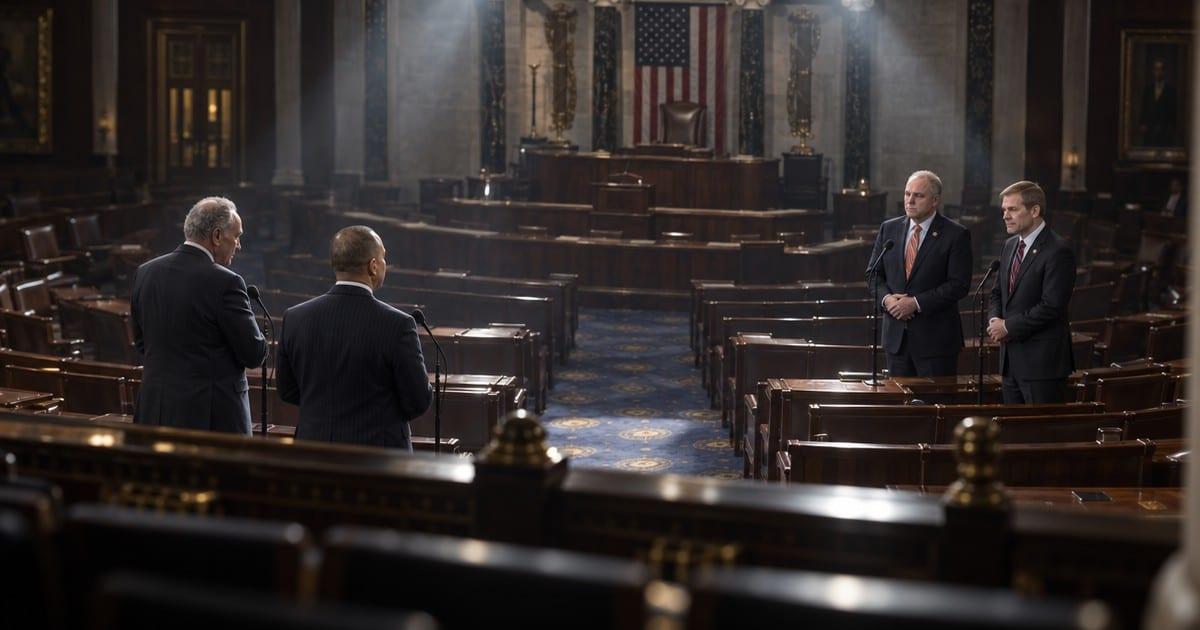
House Republicans are barreling toward a leadership showdown between two of their most recognizable figures — Majority Leader Steve Scalise of Louisiana and Judiciary Chairman Jim Jordan of Ohio — as the party sorts out its top spot in the chamber. The contest, first reported by Fox News Politics, comes as Speaker Mike Johnson, R-La., has made clear he will not pursue the minority leader post.
The jockeying on the Republican side is only half the story. Across the Capitol, newly elected progressive Democrats are publicly refusing to commit to Senate Minority Leader Chuck Schumer, D-N.Y., and House Minority Leader Hakeem Jeffries, D-N.Y., despite the party's strong showing on Tuesday night. The internal elections are set to play out in the coming days and weeks, with both parties facing restive rank-and-file members who are not waiting for permission to speak their minds.
Scalise vs. Jordan: The House GOP Fight
The Republican contest pits Scalise, the current majority leader, against Jordan, the Judiciary Committee chairman and a founding member of the House Freedom Caucus. Both men have deep bases of support inside the conference, and both have signaled they intend to compete for the top Republican position in the House.
Johnson's decision not to seek the minority leader post removes one potential obstacle from the field but does not settle the question of who leads the conference. The Speaker's allies had floated the possibility of a Johnson bid, but that option is now off the table.
Scalise brings the institutional relationships and fundraising network of a leadership veteran. Jordan brings the grassroots energy and conservative credentials that have made him a favorite of the party's base. The vote will be conducted by secret ballot among House Republicans, and neither side has released a public whip count.
Democrats: Schumer Faces Open Revolt
Schumer insists his position is secure. "I'll be re-elected as majority leader," he told reporters on Wednesday, according to Fox News Politics. "But the issue is focusing on the American people and what they want."
His incoming colleagues are not all on board. Sen.-elect Abdul El-Sayed, D-Mich., has long warned he might not support Schumer. "I am going to vote for the option that gives me the best chance of getting money out of politics. Putting money in pockets and passing Medicare for all," El-Sayed said, per Fox News Politics. "I'm interested to see, working with the rest of our caucus, what options we've got." By Thursday on CNN, El-Sayed was reiterating his support for Sen. Chris Van Hollen, D-Md., who hasn't announced he's running for anything. "I think he'd be an amazing Senate majority leader," El-Sayed said of Van Hollen.
Others were even more direct. "No, I will not (support Schumer)," Sen.-elect Adam Hamilton, D-Kan., said on Fox before the election, according to Fox News Politics. "And I've already said I'm not going to vote (for him)." Sen.-elect Annie Andrews, D-S.C., told Fox's Bret Baier, "I think it's really clear that both parties are ready for a new generation of leadership." Sen.-elect Troy Jackson, D-Maine, said, "I told Sen. Schumer that I'm going to support somebody else."
Schumer only needs around 29 of his members to support him in a secret caucus vote to become majority leader — a majority of the expected Senate Democrats who will serve next year. That math gives him room to absorb defections, but the public declarations of opposition are an early warning sign of how the new class intends to operate.
Jeffries and the House Progressives
On the House side, at least five members of the Democratic Socialists of America are pledging to withhold their support for Jeffries as the first Black House speaker in U.S. history unless they secure commitments for their agenda, according to Fox News Politics. The successful candidate for speaker requires an outright majority of the entire House — 218 votes of 435, if all Representatives are present and voting.
The progressive bloc's threat does not by itself derail Jeffries, but it signals that the incoming class is willing to use leverage early. The House Democratic Caucus will hold its leadership elections in the coming weeks, and the size and cohesion of the progressive holdout group will determine how much pressure Jeffries faces.
What It Means for the Trump Agenda
For President Trump and the Republican-controlled government, the House GOP leadership fight is the more immediate concern. The new Congress will be tasked with moving on mass deportation funding, tariffs, deregulation and the DOGE efficiency initiative. A messy leadership contest can delay committee assignments and floor scheduling at the exact moment the administration needs legislative traction.
The Democratic side matters less to the Trump agenda in the short term, but the progressive revolt against Schumer and Jeffries tells you where the opposition party is headed. The new senators are not interested in waiting their turn, and they are already naming alternatives to the current leadership.
House Republicans will meet to vote on their leadership in the coming days. Senate Democrats will follow with their own caucus vote. Neither outcome is settled, and both will shape how the 119th Congress actually functions.
Our Take
Good. Let the Democrats fight. Schumer and Jeffries spent years telling Americans the other party was the threat to democracy, and now their own incoming members are refusing to back them. El-Sayed, Hamilton, Andrews and Jackson are not moderates pleading for unity — they are open socialists who look at Schumer and see a roadblock. If the Democratic Party wants to hand its leadership to the DSA wing, Patriots should welcome the clarity.
The Republican fight is the one that matters. Scalise and Jordan both have real conservative records, and the conference deserves a clean, public airing of the case each man makes. What conservatives should not tolerate is a backroom deal that installs a leader who pays lip service to America First while slow-walking the Trump agenda. The House GOP must come out of this vote unified and ready to move on border security, spending cuts and deregulation. Anything less is a gift to the Left.
Watch the whip counts. Watch who endorses whom. And watch whether the new Democratic senators keep their word when the secret ballot is actually cast.
