
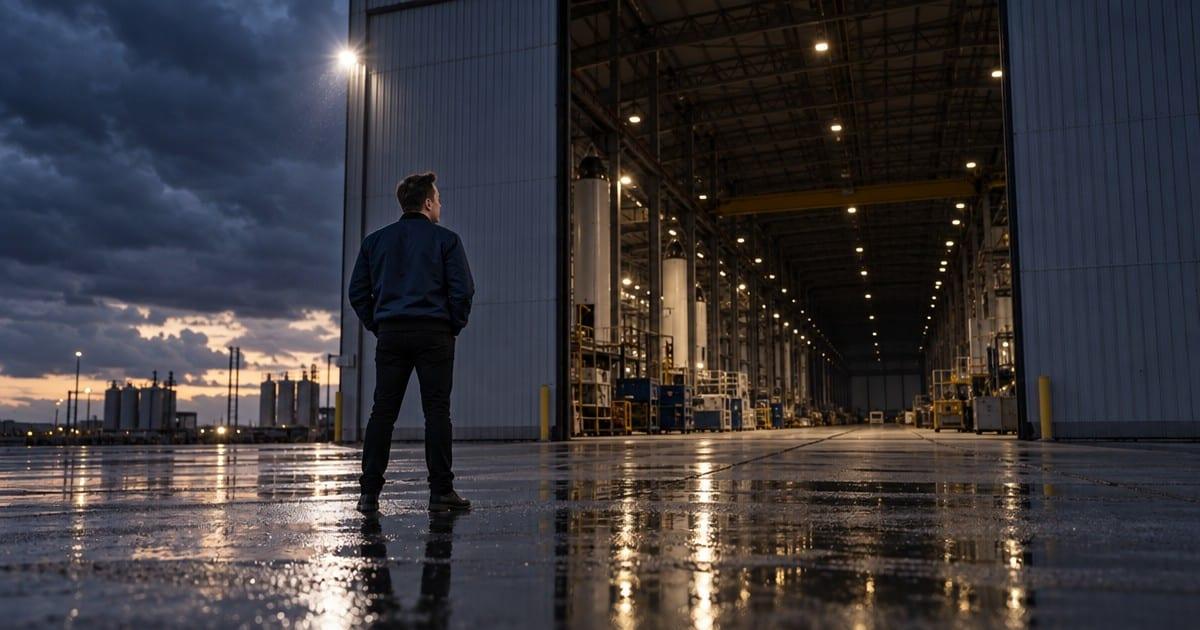
Elon Musk said Tesla will stop building the Cybertruck at its Austin, Texas, plant around the middle of next year, ending a three-year run for the stainless-steel pickup and freeing the line for the company's self-driving Cybercab. The Tesla CEO announced the decision in a post on X.
"Tesla will be winding down production of the Cybertruck at Gigafactory Texas around the middle of next year to make room for increased Cybercab production," Musk wrote.
The Washington Examiner first reported the announcement. Tesla did not say whether Cybertruck production would move to another factory, though the Guardian noted that relocating the specialized tooling required for the truck's steel body would demand significant capital.
The decision closes out a vehicle Musk himself once described as a self-inflicted wound. "We dug our own grave with Cybertruck," Musk told investors on a 2023 earnings call, acknowledging "enormous challenges" in scaling production and turning a profit on the truck. Tesla had aimed for 200,000 Cybertrucks a year. It never came close. In the third quarter of 2026, Tesla delivered just 8,300 vehicles across its "other models" category, which includes the Cybertruck, according to the Guardian. The Model 3 and Model Y carried the quarter with 478,000 combined deliveries. Tesla does not break out Cybertruck sales separately.
The truck's lead engineer, Wes Morrill, appeared to confirm the end of the line rather than a pause. "Cybertruck was an incredible technology development platform and lives on through Cybercab," Morrill wrote on X, according to the BBC. Musk responded to a fan mourning the news with a single word — "true" — before adding that "the Cybertruck fleet will be around for a long time." Tesla fans online eulogized the vehicle, with one calling it "the best vehicle Tesla has ever made," the BBC reported.
The Cybertruck's road was rocky from the start. Musk unveiled the angular, stainless-steel truck in 2019 by having a presenter swing a metal ball at its supposedly unbreakable window — which shattered on camera. Despite the gaffe, Musk said the truck drew 146,000 pre-orders. Deliveries finally began in late 2023 after repeated delays tied to the technical difficulty of manufacturing its steel exoskeleton. Recalls followed, including one in 2025 covering more than 46,000 trucks over a trim issue, the BBC reported. Tesla also stopped production of its Model S and Model X this year, the Guardian noted, narrowing the lineup to the mass-market models and the promised robotaxi.
Musk has been explicit about where he sees Tesla's future: not in selling new models to private buyers, but in robotics, artificial intelligence and an autonomous fleet. The Cybercab — a two-seat, steering-wheel-free taxi — is the centerpiece of that bet. Clearing Austin's Cybertruck line is the physical manifestation of the pivot.
The announcement lands in a rough stretch for Musk. Republican candidates he backed with $446 million in donations lost in the midterm elections, according to the Guardian, and the paper value of his fortune fell by $113 billion as investors weighed whether a Democrat-led Congress could slow the AI boom. Tesla shares fell 11% on Thursday and SpaceX dropped 9%, the Guardian reported.
What the wind-down means for Cybertruck owners and reservation holders is not yet known. Tesla has not said whether service, parts and software support will continue on the existing fleet, though Musk's post suggested the trucks on the road will remain. For the workers at Gigafactory Texas, the change is a reassignment rather than a layoff as the plant retools for the Cybercab — a vehicle that does not yet have a production date attached to it.
Our Take
Here's the uncomfortable truth for the EV cheerleaders who spent years telling Americans the Cybertruck was the future: the market spoke, and the market said no. Musk built a truck for a buyer who doesn't exist in enough numbers — a $100,000 stainless-steel statement piece that couldn't haul a load, couldn't fit in a garage, and couldn't survive a press conference without a window shattering. That's not a knock on Musk's ambition. It's a reminder that the electric-vehicle revolution was sold to the American people on hype, subsidies and government mandates, not on what working families actually need.
But give credit where it's due. Musk is doing what legacy automakers won't: admitting a failure and moving capital toward what he believes is the next frontier. While the Biden-era bureaucrats were busy writing rules to force Americans into EVs they didn't want, Musk is betting on autonomy and robotics — and he's willing to eat a loss to do it. That's how free markets are supposed to work. You swing big, you miss, you pivot, you swing again. No bailouts, no mandates, no regulator holding your hand.
The real question is whether Washington will get out of the way and let Musk build the Cybercab, or whether the same crowd that tried to mandate the EV will now try to regulate the robotaxi into oblivion before it ever picks up a passenger. Patriots should be watching. If the feds start writing rules designed to protect legacy automakers and union jobs from a self-driving taxi, you'll know exactly who they're working for.
