
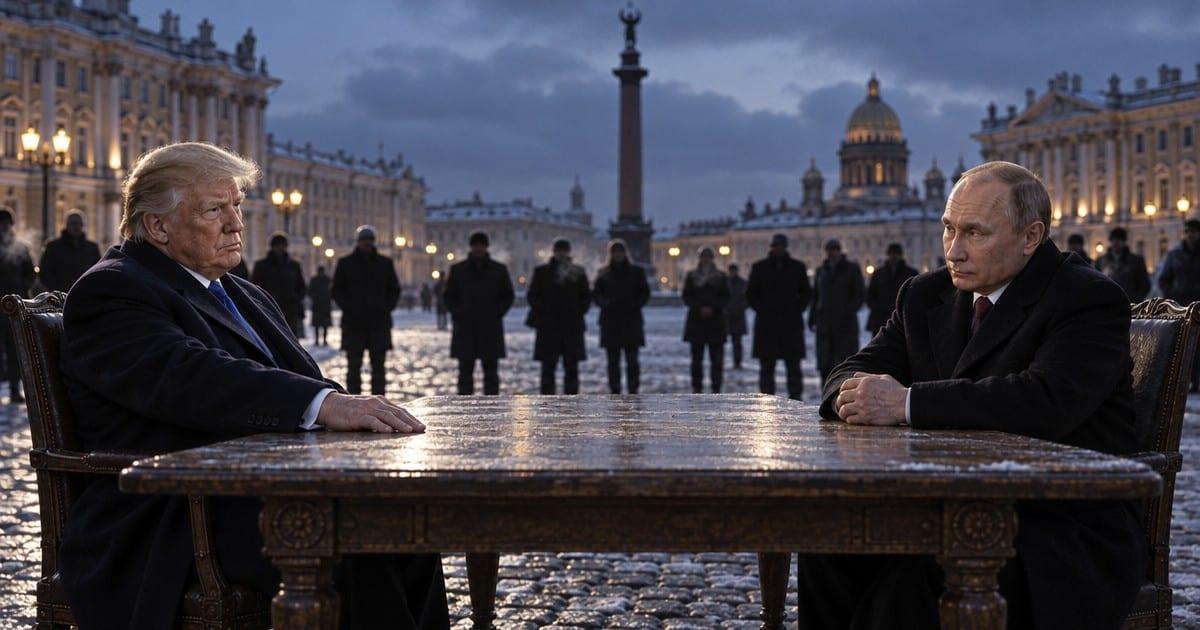
European capitals are in open panic over President Donald Trump's declaration that a peace deal to end Russia's nearly five-year war in Ukraine could expand into a sweeping security arrangement covering the entire continent — and retired U.S. Gen. Philip Breedlove is warning that Russian President Vladimir Putin's ambitions go far beyond Kyiv.
Trump made the remark Thursday at the White House after meeting with Kirill Dmitriev, Putin's presidential envoy, who was in Washington for a joint event with Ukrainian leaders celebrating the Oleshky ceasefire, according to the Washington Examiner. "It's going to be a big agreement, and it's going to involve more than Ukraine... I could even say it might involve all of Europe," Trump told reporters. "It's going to be a big, beautiful agreement, and everyone's going to be thrilled."
Europe is not thrilled. Leaders across the continent have spent the days since expressing alarm at the undefined scope of the plan, which comes ahead of trilateral talks between the U.S., Russia, and Ukraine scheduled for November 10 and 11 in Abu Dhabi.
Breedlove, the former Supreme Allied Commander Europe, told Fox News Digital that Putin has pushed the same vision for years. "Putin has a plan for the world, and he has pushed that plan on leaders several times," Breedlove said. "He talks about it and he writes about it." The retired general described that plan as "three spheres of influence whereby China controls the Far East, Russia controls Europe, and America controls the Western Hemisphere."
"The Western world is waiting to see what this big plan is, and they are very concerned because it is about them," Breedlove added.
Ukrainian President Volodymyr Zelenskyy is sounding his own alarm, invoking the 1945 Yalta Conference in which Allied leaders carved up postwar Europe before the Soviet Union tightened its grip on the East. "We don't want to have Yalta 2.0," Zelenskyy told CNN.
"I believe that that war is going to end and it's going to end soon," Trump said. "And the only reason it's going to end is because of me."
Secretary of State Marco Rubio, speaking ahead of a trip to Paris for G7 foreign ministers' talks, said progress had been made on what post-war security architecture for Ukraine and Europe could look like. "I think that's what the president's alluding to — is that there's been some advances made in what that architecture could look like post-conflict," Rubio said, per Euronews.
The diplomatic activity has been visible beyond the briefing rooms. An Instagram post circulating this week carried the caption "Europe and US briefly upped the pressure on Russia over ..." — a fragment that reflects just how much of the maneuvering is playing out in public while the substance of the deal stays behind closed doors.
Russia and Ukraine remain far apart on the terms of any settlement, particularly the future of Ukrainian territory occupied by Moscow's forces. Putin has repeatedly demanded that Ukraine withdraw troops from four regions Russia claims to have annexed. The New Yorker reported Tuesday that U.S. special envoy Steve Witkoff said the Abu Dhabi meeting would cover "post-war security arrangements, de-escalation, humanitarian efforts, and next steps toward peace."
Trump administration officials have not released the details of what a broader European security agreement would include, what it would require of NATO members, or how it would affect existing alliance commitments. It is not yet known whether the framework would alter the U.S. troop posture in Europe or the sanctions regime on Moscow.
France will be represented at the Abu Dhabi negotiations, according to Foreign Minister Jean-Noël Barrot. NATO allies have also debated whether to open direct outreach to Putin ahead of the talks.
Our Take
Here's what the establishment can't stand: Trump is doing exactly what he said he would do — using American leverage to end a war that has drained U.S. treasure and European stability, and he's doing it by talking to the other side instead of lecturing them through a translator at a G7 photo op.
The same European leaders now clutching their pearls spent years demanding America do more while their own defense budgets stayed anemic. Now that Trump is negotiating the architecture of the continent's future without handing them a veto, they're suddenly worried about spheres of influence. Where was that concern when they were free-riding on American security guarantees?
Breedlove's warning deserves attention, but it's aimed at the wrong target. The general is right that Putin has designs beyond Ukraine. The way to check those designs is from a position of strength — a deal Trump can walk away from — not by pretending the war can grind on forever with no cost to American families at the gas pump and the grocery store.
Zelenskyy's "Yalta 2.0" line is a negotiating tactic, and a smart one. But the real test is whether the final agreement keeps Ukraine sovereign, armed, and free — not whether it makes Brussels feel consulted.
Trump says everyone will be thrilled. The burden is on him to prove the details match the boast. Patriots should watch the Abu Dhabi talks closely — because whatever gets signed will determine whether American power ends a war or just pauses one.
