
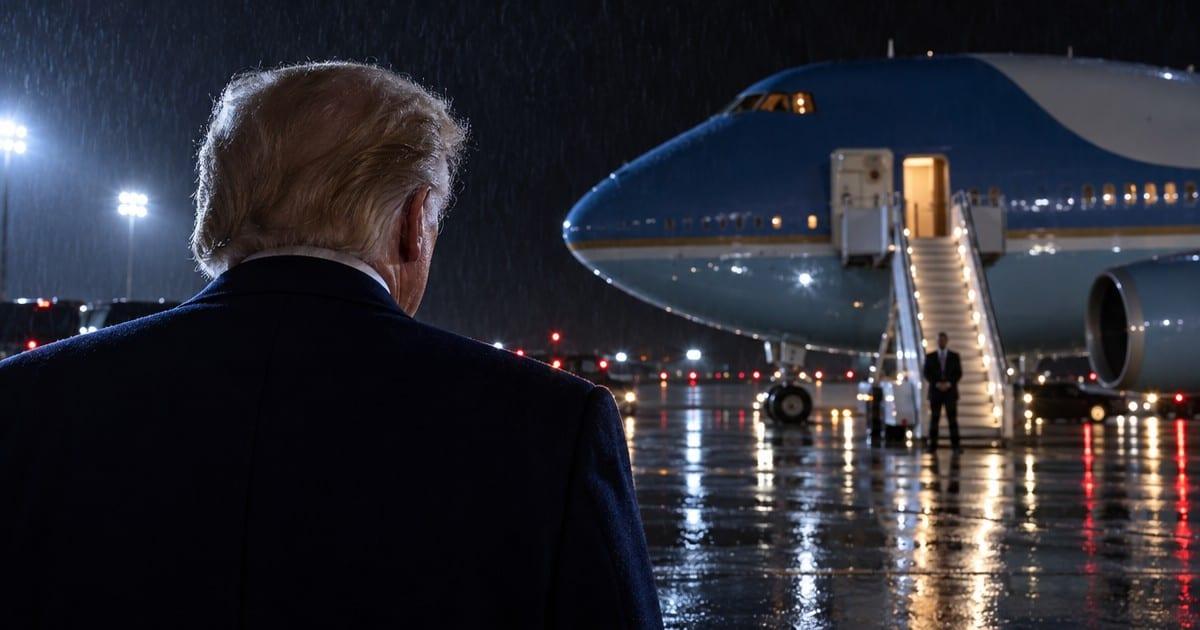
The New York Times is out with a new account of what happened aboard Air Force One in May, and the framing is already doing the work for the Democrats: Did President Donald Trump get "reminded" about a spy warning involving Nvidia CEO Jensen Huang — and let him on the plane anyway?
According to the Times, "people with knowledge of the matter" say Trump was reminded aboard Air Force One en route to China, just before a refueling stop in Alaska where Jensen Huang would join the group, that the U.S. had obtained sensitive intelligence showing Nvidia's chief executive was in a relationship with a woman believed to be a Chinese spy. RedState flagged the report Wednesday. The Times' own account, as relayed by RedState, adds that a memo drafted by Secretary of State Marco Rubio this spring was circulated to a small number of top administration officials and was not intended for Trump — and was not shown to him aboard the plane.
Notice the shell game.
Meanwhile, the actual scandal — the one with names, a company, and an alleged foreign-intelligence nexus — keeps getting buried under the Air Force One parlor game.
Here are the facts that matter. Jensen Huang is the CEO of Nvidia. Alice Huang is a Chinese national and tech executive whose Singapore-based company, Megaspeed, is suspected of diverting embargoed Nvidia chips to Beijing, according to RedState's reporting. The relationship between the two is at the center of a federal probe. Separately, Tech security reporting cited by other outlets notes that Commerce Secretary Howard Lutnick received a classified memo about Jensen Huang and a suspected Chinese intelligence agent before a presidential trip. Those are the outlines of a national-security story with real consequences for export controls, chip supply chains, and the CCP's AI ambitions.
Yet the Times' headline machine is pointed at the plane. Why? Because the plane story implicates Trump personally, while the chip-diversion story implicates a corporate giant, a foreign national, and the export-control regime that both parties have spent years claiming to police.
It is not yet known publicly what specific intelligence the U.S. obtained, what Megaspeed's role was, or whether any chips actually reached Beijing. Those are allegations and open questions. But that is precisely the point: The story that needs sunlight is the one about the alleged diversion of embargoed technology to a hostile power — not a he-said/she-said about who reminded whom on a refueling stop.
The administration's position, as reported, is that the memo was compartmented and not shown to the president. The Times' anonymous sources say otherwise. Neither claim has been confirmed on the record. What is on the record is that Jensen Huang joined the trip, saw Trump briefly, and "remained in the separate part of the plane for almost all of the trip," according to the Times' sourcing as described by RedState.
For everyday Americans, the stakes aren't about seating arrangements on Air Force One. They're about whether advanced American chips — the ones that power AI, weapons systems, and surveillance — are leaking to the Chinese Communist Party through shell companies in Singapore while Washington debates memo protocol. If Megaspeed was a conduit, the export-control regime failed, and the people responsible need to be named.
The legacy media would rather you ask whether Trump was briefed. The better question is why the briefing — and the broader Nvidia-China probe — wasn't front-page news weeks ago.
Our Take
This is the classic legacy-media two-step: take a genuine national-security investigation, strip out the parts that implicate corporate power and foreign agents, and rebuild it as a Trump-process story. The Times doesn't want you reading about Megaspeed, Alice Huang, or a suspected Chinese intelligence asset with ties to the CEO of America's most important chip company. It wants you reading about whether a president was "reminded" of something on a plane.
Patriots should demand the real answers: What did the intelligence show? Who at Commerce and the National Security Council knew? Why was a Chinese national's Singapore company allowed to operate in Nvidia's ecosystem at all? And why is the press corps treating a compartmented memo like a presidential pop quiz instead of a window into a possible technology leak to the CCP?
The plane story is a distraction. The chip story is the scandal. Ask your representatives which one they're investigating.
