
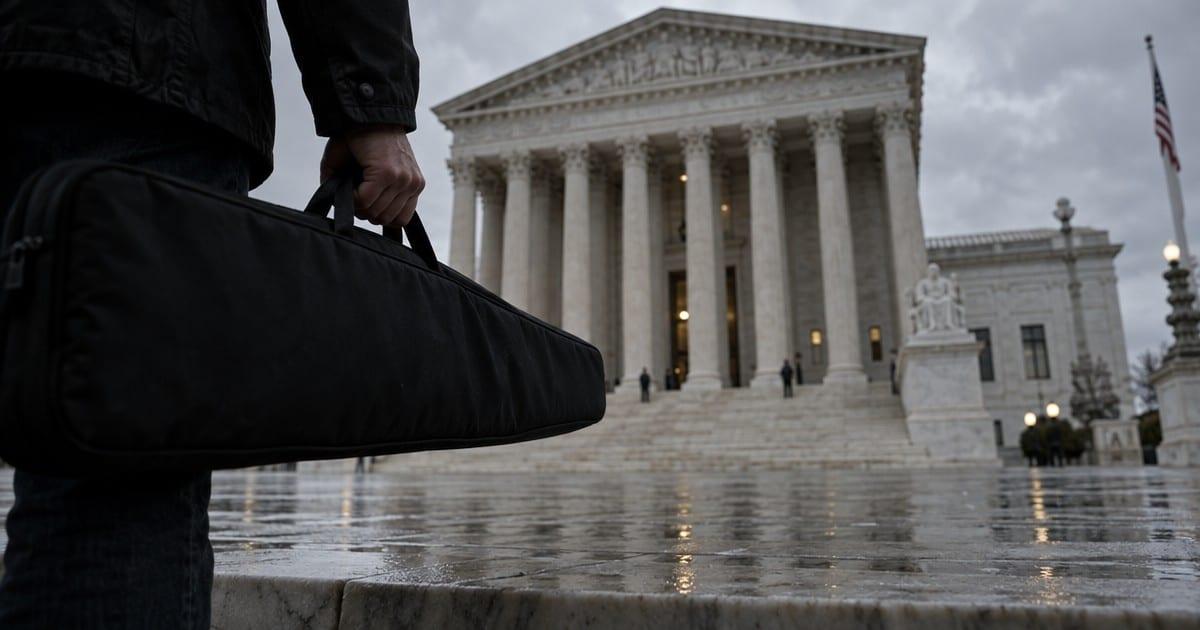
The United States Supreme Court has agreed to hear a Second Amendment challenge to Maryland's ban on so-called 'assault weapons,' putting the unconstitutional gun control regimes of multiple blue states directly in the crosshairs. The Court's decision to take the case sets the stage for a definitive ruling on whether states can prohibit firearms that are in common use by millions of law-abiding Americans.
A Direct Challenge to the Bruen Standard
The challenge rests on the Supreme Court's 2022 decision in New York State Rifle & Pistol Association v. Bruen, which established that gun laws must be consistent with the nation's historical tradition of firearm regulation. Gun rights groups argue that bans on rifles like the AR-15 — the most popular rifle in America — have no historical precedent from the founding era and therefore fail the Bruen test entirely.
Maryland's law, enacted in 2013 following the Sandy Hook tragedy, prohibits the sale, transfer, and possession of dozens of specific semi-automatic rifles, pistols, and shotguns that the state labels as 'assault weapons.' The law also bans magazines capable of holding more than ten rounds. Gun rights organizations have spent more than a decade fighting the statute in lower courts, arguing it criminalizes firearms that are commonly owned for self-defense, hunting, and competition.
The Supreme Court's decision to grant certiorari signals that at least four justices believe the lower court rulings upholding Maryland's ban deserve closer scrutiny. Given the Court's current composition and its recent willingness to expand Second Amendment protections, the case has immediate implications for similar bans in California, New York, Illinois, Delaware, Hawaii, Massachusetts, New Jersey, Connecticut, and Washington state.
The Legal Landscape After Bruen
Following the Bruen ruling in 2022, federal courts across the country have struck down numerous gun control laws for failing to meet the historical tradition standard. However, several lower courts — including the Fourth Circuit, which upheld Maryland's ban — have carved out exceptions for 'assault weapons' bans by treating modern semi-automatic rifles as somehow distinct from firearms protected by the Second Amendment.
Second Amendment advocates argue this is judicial sleight of hand designed to circumvent the Supreme Court's clear instruction. The firearms in question are not machine guns. They fire one round per trigger pull, just like any standard semi-automatic handgun or hunting rifle. Their cosmetic features — pistol grips, adjustable stocks, barrel shrouds — have no bearing on their function or lethality compared to other legal firearms.
Reuters first reported the Court's decision to hear the case, which legal observers say could be the most significant firearms ruling since Bruen itself. The case is expected to be argued in the spring of 2027, with a decision likely by late June.
Who's Behind the Challenge
The plaintiffs in the case include individual Maryland residents who say the ban violates their constitutional rights, along with gun rights organizations that have fought the law since its passage. They argue that the firearms Maryland has banned are in common use across the country — a key test the Supreme Court established in its landmark 2008 District of Columbia v. Heller decision. Under Heller and Bruen, firearms in common use for lawful purposes cannot be banned outright.
The state of Maryland has defended the law as a public safety measure, arguing that the firearms in question are particularly dangerous and that the state has a compelling interest in restricting them. The Fourth Circuit agreed, ruling that the ban was consistent with a historical tradition of regulating 'dangerous and unusual' weapons.
The Supreme Court's decision to hear the case suggests at least some justices are skeptical of that lower court reasoning.
Our Take
This is the case the Second Amendment community has been waiting for since Bruen came down more than four years ago. While the Trump-Vance Administration has rolled back federal overreach on firearms and appointed constitutionalist judges to the bench, the blue states have remained comfortable hiding behind activist lower courts that treat the Constitution as a suggestion rather than the supreme law of the land.
Maryland's ban was never about public safety. It was about politicians in Annapolis telling law-abiding citizens which guns they are allowed to own based on how the firearm looks. The AR-15 is not a 'weapon of war.' It is a semi-automatic rifle owned by tens of millions of Americans for home defense, competition, and hunting. Criminals do not obey magazine capacity limits. They never have. The only people disarmed by these laws are the honest citizens who follow them.
The left's response will be predictable. They will warn of doom. They will claim the Supreme Court is 'extreme.' They will say this ruling will lead to more crime. What they will not do is point to any evidence that Maryland's ban reduced violent crime — because it didn't. Baltimore has had an 'assault weapons' ban on the books for more than a decade, and its murder rate has consistently ranked among the worst in the nation.
If the Court rules as the Constitution demands, bans in California, Illinois, New York, and every other state that treats the Second Amendment as a privilege to be revoked will fall like dominoes. That is not judicial activism. That is the Constitution doing exactly what it was designed to do: protecting individual liberty from politicians who think they know better than the Founders.
Patriots, the fight for the Second Amendment has never been won in the halls of Congress alone. It is won in courtrooms where the plain text of the Constitution still means something. This case could be the one that finally settles the question: Shall not be infringed means shall not be infringed.
What do you think that will mean for the states that have spent decades treating gun owners like second-class citizens? Because starting now, their days of hiding behind activist judges are numbered.
