
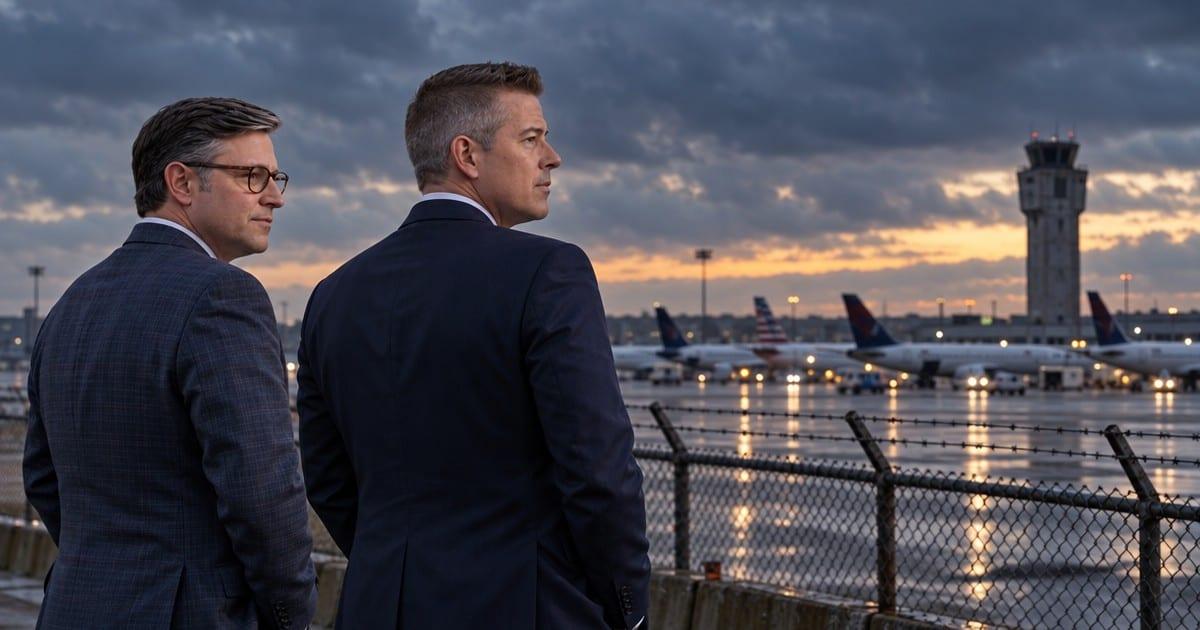
House Speaker Mike Johnson (R-LA) on Saturday threw his support behind Transportation Secretary Sean Duffy's demand for $50 billion to modernize the Federal Aviation Administration's air traffic control system, following a nationwide ground stop that halted flights for nearly five hours and left travelers stranded across the country.
Duffy, speaking at the White House on Friday evening after the FAA lifted its ground stop, called on Congress to approve the massive funding package — an additional $20 billion on top of his previous $30 billion request — to replace what he described as an "incredibly old" system. Johnson's backing gives the push significant momentum on Capitol Hill, though it remains unclear whether Senate Majority Leader John Thune (R-SD) will follow suit.
The ground stop, triggered by what the FAA called "extraordinary circumstances" and "reasons of safety," was later attributed by Duffy to work replacing legacy copper wires with a fiber-optic system at a single remote facility. The incident forced the agency to ground all flights nationwide, a drastic step that rippled through the airline industry and renewed scrutiny of the country's decades-old aviation infrastructure.
"Now, if you look to the past administrations going back 25 years, $15 billion dollars has been given to the FAA to fix this air traffic control system. And guess what? Barely anything was done," Duffy said Friday.
But Duffy's demand drew immediate fire from critics who pointed to his own record. In 2019, while serving as a Wisconsin congressman during a prolonged government shutdown, Duffy voted against a Transportation, Housing and Urban Development appropriations bill that would have provided more than $10.4 billion for the FAA, including funding for research and development, air navigation facilities, and air traffic organization activities. The bill, introduced by Democrats, passed the House but died in the Senate. The Daily Beast, in a report headlined "Trump Goon Sean Duffy Haunted By Vote Against FAA Billions He Now Demands," highlighted the vote as evidence of inconsistency.
Duffy acknowledged Friday that past administrations had funded the FAA but insisted the money was mismanaged. "Barely anything was done" with the $15 billion allocated over 25 years, he said, arguing that the system's deterioration demands a fresh, larger commitment.
Rep. Tim Burchett (R-TN) piled on congressional leadership Saturday, calling on Johnson and Thune to "step up to the daggum plate" on FAA funding — a sign that pressure is mounting from within the Republican conference for swift action.
The administration's funding request has evolved rapidly. Thursday's call for $30.1 billion echoed a White House-backed bill introduced in September by Sen. Eric Schmitt (R-MO), which would provide $10.1 billion for air traffic control upgrades, including $2 billion for cloud computing and national airspace system telecommunications. That funding would come on top of $12.5 billion allocated to the effort through the July 2025 reconciliation law, according to Roll Call.
The FAA's aging infrastructure has been a concern for years, but Friday's ground stop brought the issue to the forefront of public attention. The disruption affected thousands of flights and raised questions about the resilience of a system that relies on equipment and processes dating back decades. Duffy's proposal would target the replacement of outdated copper wiring with modern fiber-optic systems, among other upgrades.
Johnson's endorsement Saturday signals that House leadership is prepared to move on the funding request, though the path through the Senate remains uncertain. Thune's office has not publicly indicated whether he supports the $50 billion figure.
For American travelers, the stakes are immediate: without upgrades, similar ground stops could recur, disrupting travel plans and costing the economy billions. For Republicans, the debate tests their ability to govern on infrastructure — an area where Democrats have historically held an advantage — while managing internal disagreements over spending.
Our Take
Sean Duffy is right about one thing: the FAA's air traffic control system is a relic, held together with copper wire and bureaucratic inertia. The five-hour ground stop wasn't a glitch — it was a warning. And Mike Johnson deserves credit for backing the call to fix it.
But here's the inconvenient truth: Congress has been throwing money at the FAA for decades, and the system is still broken. Duffy himself voted against a $10 billion FAA funding bill in 2019, and now he's demanding $50 billion. That's not flip-flopping — it's an admission that the old approach failed. The question is whether this new money comes with real accountability or just another blank check to the administrative state.
Patriots should demand transparency: Where exactly will the $50 billion go? What benchmarks will be set? Will the FAA's bureaucracy be held accountable for delays and cost overruns? The American people deserve a modern, reliable aviation system — but they also deserve to know their tax dollars won't vanish into the same black hole that swallowed the last $15 billion.
Duffy says "barely anything was done" with past funding. He's right. Now he and Johnson need to prove this time is different — before the next ground stop leaves Americans stranded again.
