
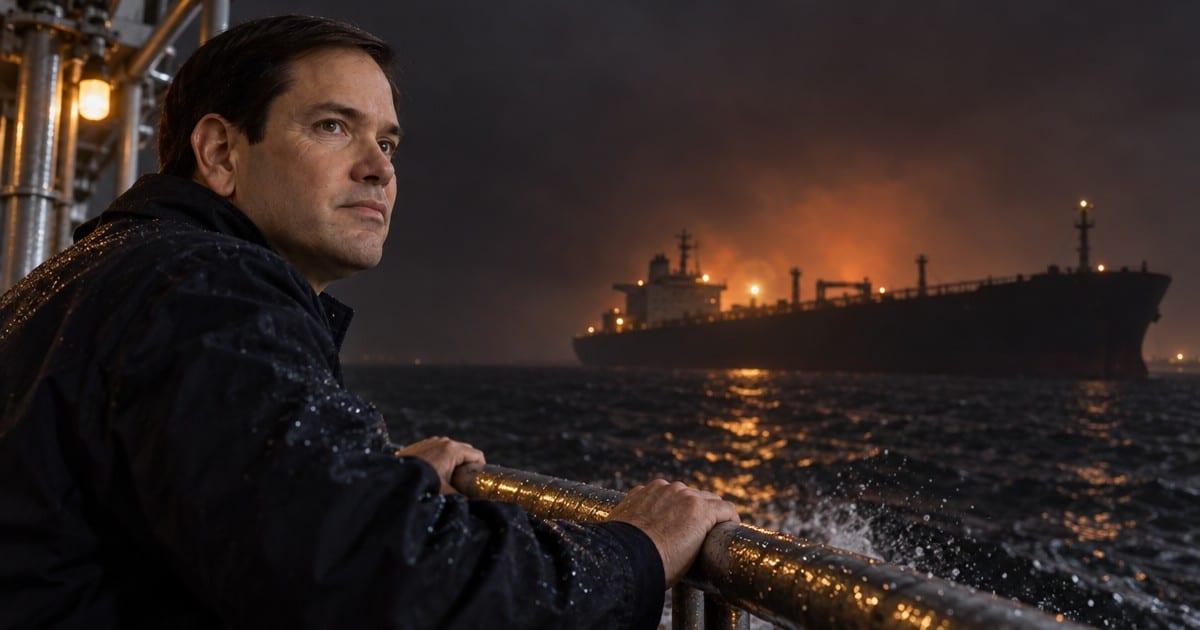
Tehran is selling the world a burning tanker that no one can verify exists. Three oil tankers reportedly hit mines and caught fire in the Strait of Hormuz—and not a single shipping company, flag state, or insurance underwriter has put its name behind the incident. No names, no flags, no cargo manifests, no salvage records. Just Iranian state television telling the world an inferno is raging while the only confirmed fire is the one consuming Iran's economy from the inside out.
Secretary of State Marco Rubio dropped the hammer this week with an assessment that should make every American sit up and take notice: the economic pain on Iran is now so severe that further bombing isn't needed. The maximum-pressure squeeze is working, and the Islamic Revolutionary Guard Corps (IRGC) is panicking. Why? Because JPMorgan now reports the crude market swung to a surplus of 1.4 million barrels per day in October. Gulf exports are back to 86 percent of pre-war levels. Physical oil is still moving through the Strait—and Iran's ability to profit from it is collapsing in real time.
The Propaganda Fuse: State TV, Wire Services, and Your Gas Pump
Ayatollah Ali Khamenei's Revolutionary Guard lit a propaganda fuse, and the Associated Press carried the smoke as if it came from a burning ship. The Guard first claimed two tankers exploded. Then state television raised the count to three—and never named a single vessel. That unverified claim is the entire story. Why does Iran need a burning tanker on the evening news? Because one unconfirmed fire near Hormuz can spook insurers, spike war-risk premiums, slow charter traffic, and push crude futures higher without a single confirmed incident. The target is your gas tank, Patriots. This is economic warfare disguised as breaking news.
The regime's own announcements cannot keep count. The tweets shown in this report reveal a story chasing its own tail in real time—two tankers, then three, then silence on the most basic question of all: which ships?
Trump's Leverage Is Economic, Not Artillery
President Donald Trump said it plainly: "We don't need a deal with Iran. The days have long since passed." That is the sound of leverage, not desperation. For months, the Trump-Vance administration has understood that economic strangulation—not another bombing run—is the real pressure point. Rubio's assessment confirms it. JPMorgan's 1.4-million-barrel daily surplus proves the squeeze worked. Gulf exports returning to 86 percent of pre-war levels shows the physical oil is still moving while Iran's ability to monetize it collapses.
Meanwhile, the regime that just lost the oil war told the IAEA that monitoring talks cannot proceed under military threat. Two attack drones headed for Bahrain were swatted out of the sky. The desperation is showing, and the lie machine is working overtime to fill the vacuum left by Iran's own economic ruin. A quiet Hormuz is a disaster for Tehran's leverage. So state television invents fire.
Show Us the Ships
The demand to Tehran is simple: show us the ships. Give the names, the flags, the cargo manifests, the insurers, and the salvage records. Put the evidence on the table—or admit the whole thing was a broadcast designed to manipulate global energy markets and squeeze American families at the pump. The next provocation, if it comes, will be Tehran's choice—not ours. America doesn't need the deal. The days have long since passed. What we need now is for the press to stop running Iranian state television's fiction as fact and start asking the one question the regime cannot answer: where are the ships?
