
President Donald J. Trump departed Shenzhen on Thursday after a marathon of summit diplomacy that resulted in the first-ever face-to-face meeting between the leaders of the United States, China, and Russia. The day concluded with a written declaration toward peace, a direct challenge to the globalist establishment, and a reminder to Xi Jinping that the days of America getting shafted on trade are officially over.
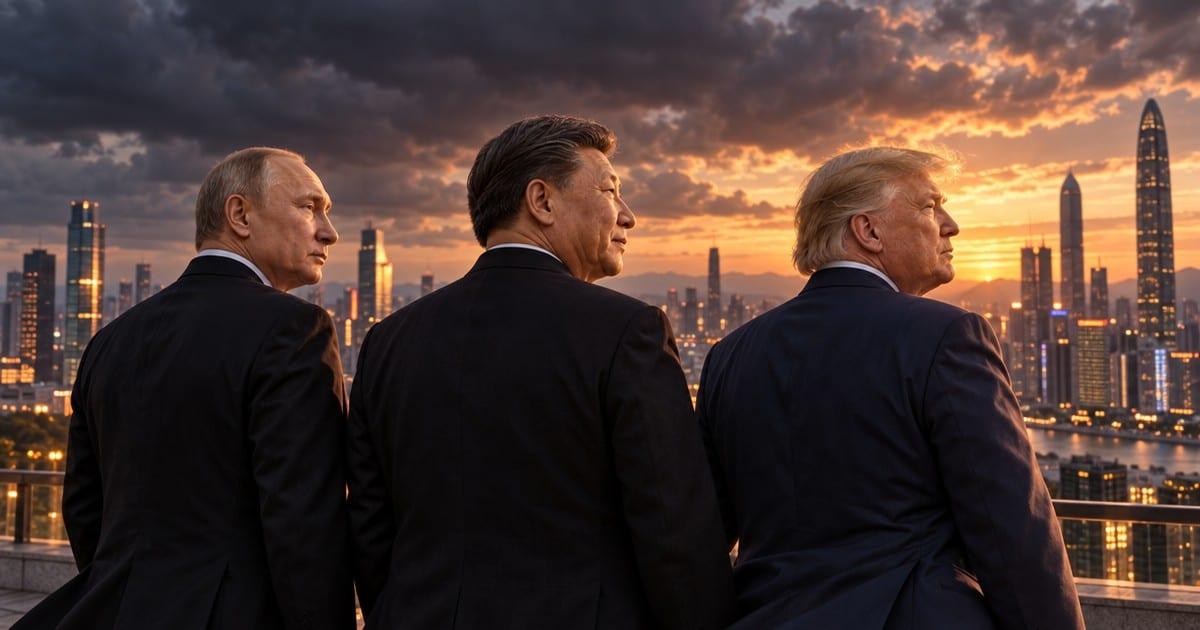
While the mainstream media obsesses over palace intrigue, President Trump was busy rewriting the rules of engagement with two of the world's most adversarial powers. The three leaders stood shoulder-to-shoulder against a blue backdrop reading "China-Russia-US Shenzhen summit," presenting a visual that the corrupt Washington establishment said could never happen. Trump stood to Xi's left, Putin to his right. It was a picture of raw power—the kind that scares the hell out of war hawks and globalists who profit from endless conflict.
The "Ask": America First in Action
During his bilateral sit-down with Xi Jinping at Kylin Villa, President Trump did not mince words. Surrounded by the flags of both nations, Trump thanked Xi for an "incredible warm welcome" but immediately pivoted to the economic betrayal of the past.
"I'm going to ask him to do some more for our farmers," Trump stated, calling the old U.S.-China relationship "very lopsided."
That is not a suggestion. That is a demand. For too long, American farmers and manufacturers have been forced to eat the cost of bad trade deals signed by uniparty hacks who cared more about their corporate donors than the American worker. Trump told Xi directly that past presidents "didn't do their job." That is what strength looks like; it is the complete antithesis of the Biden-era weakness that invited aggression abroad and poverty at home.
Peace Through Strength, Not Surrender
The centerpiece of the day was the trilateral session, which the White House confirmed as the first of its kind. Trump, Xi, and Putin gathered in a room dripping with chandeliers to discuss the heavy issues the media said were unsolvable. Trump looked at the two leaders and declared, "we are really making history." He raised the issues of denuclearization and the war in Ukraine—not as a beggar, but as a negotiator representing the world's strongest economy.
Earlier in the day, Trump had a pull-aside with Putin, walking toward the Russian leader and calling him "my friend" while predicting "wonderful things" could come from the meeting. While the Left will scream at the optics, patriots understand the assignment. Talking to your adversaries prevents World War III. The three leaders signed a declaration committing the permanent Security Council members to strategic stability, stable energy flows, and UN reform. In short, Trump is draining the swamp on a global scale.
Trump also used his platform at the APEC plenary to tout the roaring American comeback. He laid bare the facts for the world to hear: inflation is running below two percent for the last three months, trade deals are coming, and America will not be suffocated by AI regulation that benefits China. "The United States has been a Pacific power for hundreds of years," Trump reminded the room. He pledged to block any bureaucratic red tape that stifles American industry, ensuring the "super intelligence" revolution is won by the Stars and Stripes, not the CCP.
As the President stepped onto Air Force One and the wheels went up, the contrast with the previous administration could not have been starker. Instead of weakness and apology tours, we have strength, dialogue, and results. The Shenzhen summit proves that when you put an American businessman in charge instead of a career politician, you get peace deals instead of forever wars and demands for farmers instead of empty rhetoric.
