
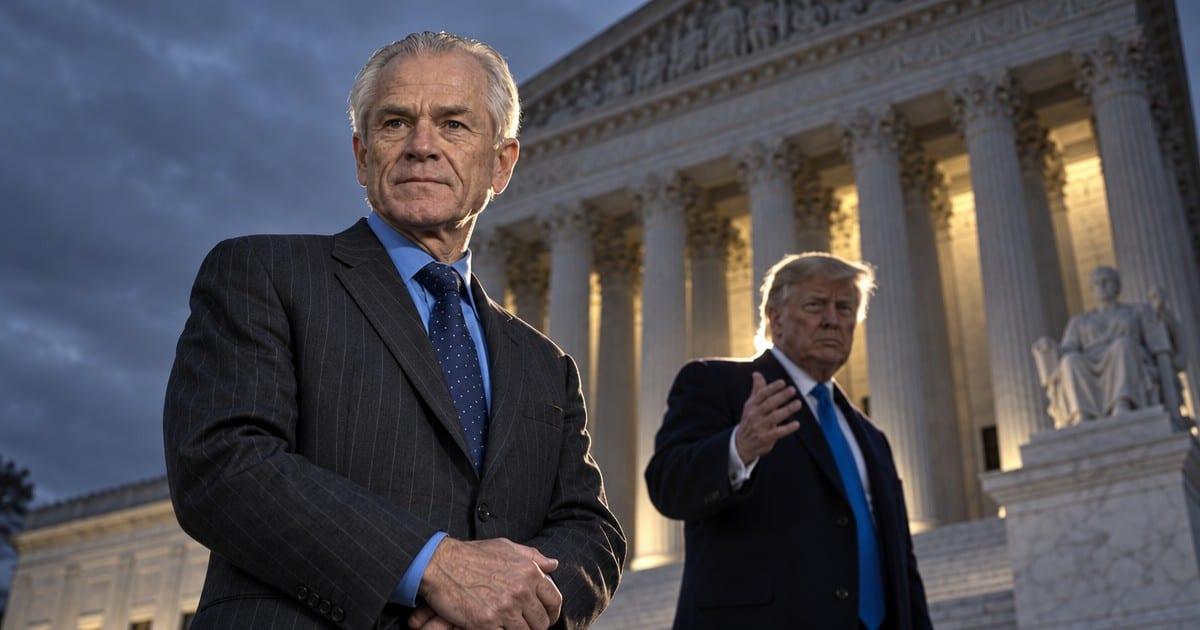
Peter Navarro, the Senior Counselor to the President, has filed a petition asking the Supreme Court to review his contempt of Congress convictions, arguing that the D.C. Circuit Court of Appeals misread the statute that sent him to prison. The case, first reported by Fox News Politics, could change how the federal government prosecutes officials who defy congressional subpoenas — including the wave of letters Democrats are already sending to Trump administration officials.
Navarro, who served as a senior trade advisor during President Donald Trump's first term and now holds the title Senior Counselor to the President, was convicted in 2023 on two counts of contempt of Congress. The charges stemmed from his refusal to testify and turn over documents to the Democratic-led House January 6 Committee, which he said was barred by executive privilege. He served a four-month sentence.
What Navarro is arguing
The core of the petition is the word "willfully." Navarro's attorney, Abhishek Kambli, argues the D.C. Circuit misinterpreted the statute by not requiring prosecutors to prove the defendant knew he was breaking the law. Kambli points to United States v. Murdock, a 1933 Supreme Court ruling holding that a taxpayer's sincere but mistaken belief that the Constitution protected his refusal to answer investigators' questions mattered in determining whether he acted willfully.
"We absolutely believe that we are correct on the law on this, because Congress chose to use the word willful when it put this statute together, and there's no reason to believe that willful applies any differently in this context than it has in just about every other one," Kambli said, according to Fox News Politics. He added that a ruling in Navarro's favor "would have the added effect of toning down lawfare and weaponization."
The three-judge D.C. Circuit panel that upheld the conviction ruled that only the president can invoke executive privilege under Article II, and that Trump never granted Navarro protection. "Dr. Navarro claimed executive privilege before even seeing the subpoena and refused to turn over documents, appear for his deposition, or engage with the Select Committee's efforts to accommodate his privilege claim," the court wrote. "A court, in other words, cannot simply take a defendant at his word that the President invoked privilege because doing so would impermissibly tangle separation-of-powers lines."
If the justices take the case, they could make it harder to convict someone for defying a congressional subpoena by requiring proof that the person knew they were breaking the law — a higher bar than prosecutors currently face.
Why Democrats are watching closely
The timing matters. According to CNN Politics, Democrats are putting top Trump administration officials and allies on notice with letters to dozens of them as their investigative agenda takes shape ahead of the new year. The top Democrat on the House Oversight Committee has begun laying the groundwork for promised investigations of the Trump administration, per CNN. Navarro's case, if the justices accept it, would land in the middle of that effort.
Navarro is not the only Trump official to face contempt proceedings. Steve Bannon, a former senior advisor to Trump, was also convicted of contempt of Congress for defying the same committee and served a prison sentence. Both cases relied on the same willfulness standard Navarro is now challenging.
The Supreme Court has not yet said whether it will take the case. It is not known when the justices will decide.
Our Take
Here's the trap the headline is talking about: Congress issues a subpoena, an official claims executive privilege, and the courts then say only the president can invoke that privilege — but nobody ever asks whether the official reasonably believed he was protected. That's how Navarro ended up in a federal prison while the man whose privilege he was asserting never faced a consequence. If a sincere but mistaken belief about the law can't be a defense, then every subpoena from a hostile committee is a potential felony count, and every administration official serves at the pleasure of the other party's investigators.
Kambli is right that "willful" is doing real work in that statute. The Murdock precedent isn't obscure — it's over ninety years old, and it says exactly what Navarro's team says it says. The D.C. Circuit's answer, essentially, is that courts can't trust a defendant's word on privilege because it would tangle separation-of-powers lines. Fine. Then Congress should write a statute that says so, instead of stretching a word that means something else.
Americans should watch this one closely. If the Court takes Navarro's case, it could put a stop to the subpoena-as-weapon playbook before the new Congress gets rolling. If it doesn't, every Trump official who gets a letter from a Democrat chairman now knows the price of asserting a privilege claim the courts might later reject. That's not law enforcement. That's a criminal trap, and Navarro is asking the highest court in the land to spring it open.
