
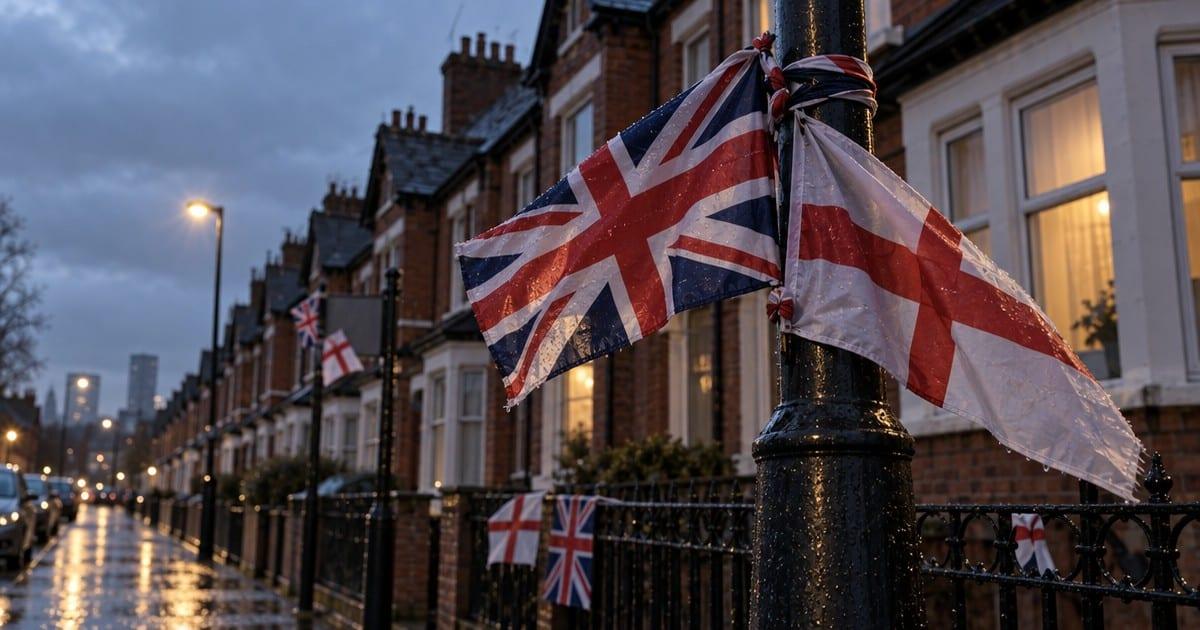
Patriots who turned Birmingham's lamp-posts into a sea of red and white have been handed a court order instead of a thank-you. Birmingham City Council has secured an interim High Court injunction barring unauthorized flags from being attached to street furniture and highway infrastructure across England's second-largest city, following months in which thousands of St. George's Cross and Union Jack flags appeared on lampposts, bridges and roadsides.
The order, granted by Judge Emma Kelly, was sought against Raise The Colours co-founder Ryan Bridge, fellow supporter Ben Cullen and other "persons unknown" who have attached — or intend to attach — flags to street furniture in Birmingham. Breaching the injunction carries a penalty of up to two years in prison. The council says it has spent almost £170,000 this year removing flags from lamp-posts.
The council argued in court that unauthorized flags on highway infrastructure create safety risks, obstruct visibility and interfere with council assets. Court documents also referenced alleged incidents including reports of intimidation, harassment and obstruction, and the hearing was told one man suffered a broken leg after being run over by a cherry picker while flags were being put up. Those claims are the council's, and the underlying allegations have not been tested at trial; no date has been set, though the court heard any future trial could involve several days of evidence.
Judge Kelly was explicit that the order is narrower than the headlines suggest. "The interim injunction needs to be understood for what it is," she said. "It is not the court nor the claimant banning the" — the judge's point being that the flags are not banned from display altogether, only from being attached to public infrastructure without authorization.
That distinction has done little to cool the argument. Birmingham's council has made a point of flying the LGBT flag, and critics argue the enforcement campaign applies one standard to one banner and another to the St. George's Cross. The flags began appearing across parts of the city earlier this year, many associated with the campaign group Raise The Colours, and became one of Birmingham's most visible and debated talking points — a working-class, patriotic display that the council now characterizes as a hazard.
The story traveled fast on social media. An Instagram post circulating the council's High Court application drew attention to the case as the injunction was granted; the post's caption was indexed as "Birmingham City Council applied for a High Court ..." and the post itself does not contain the full ruling or its reasoning.
For residents, the practical effect is this: flying a flag from your own property remains legal, but attaching one to a lamppost, bridge or roadside structure in Birmingham can now put you in contempt of court. Community groups and flag campaigners who have organized displays across the city face the same restriction. The council has said the move is about safety and order, not identity — a claim that will be tested by whether it pursues the same enforcement against every unauthorized banner on public property.
The ruling also lands in a country where the display of the English flag has become a live political fault line. Patriots have argued for a year that raising the St. George's Cross is a statement of ordinary national pride, not provocation, and that authorities treat it as a problem while granting institutional approval to other symbols. Birmingham's injunction gives that argument its sharpest test yet — in court, on paper, with a two-year prison threat attached.
Our Take
Here is what Birmingham's council has actually accomplished: it has told the people of its city that the flag of England is a safety hazard when it appears on a lamppost, while the same municipal machinery makes room to fly the LGBT banner. If the sight of the St. George's Cross makes you tense, that is your problem — not the flag's, and not the taxpayers' who are footing a £170,000 bill to scrub red and white from the streets.
The judge says this is not a ban on the flag. Fine. Then the council should have no objection to a policy that treats every banner on public infrastructure the same way — or, better, to a policy that stops treating the English flag as contraband in the first place. The safety argument is the excuse; the pattern is the point. Patriots raised the colors because they were told, for years, that their country was something to be apologized for. Birmingham just proved them right.
So the question for every reader is simple: if displaying your own nation's flag in your own city can now land you in prison, what exactly is left of the country the flag stands for? Raise the colors. And watch what they do next.
